

Remote monitoring HVAC systems give facilities teams continuous visibility of plant health and energy use, catching faults days or weeks before a chiller fails or a tenant complains. Sensors feed data through gateways to a cloud dashboard, flagging drifting delta‑T, rising motor current or CO2 breaches long before they become emergency call‑outs. Multi‑site estates and stretched engineering teams see the biggest returns, since one dashboard replaces dozens of site visits.
TL;DR:
- Proper sensor placement and thorough pre-installation surveys are crucial, as skipping observation phases often leads to inaccurate data and failed pilots.
- Battery life and communication protocol choice depend on site layout, with LoRaWAN suited for retrofits and cellular or Wi-Fi better for bandwidth-heavy applications.
- Fault detection relies mainly on current clamps, temperature sensors, and CO2 sensors, with pairing temperature and flow data essential for early coil fouling detection.
- Most deployments start as advisory systems integrated into existing BMS to preserve safety and control, expanding to full control only after validation.
- Cost recovery typically occurs within 2 to 4 years on UK commercial estates through energy savings, reduced emergency repairs, and improved maintenance efficiencies.
Table of Contents
- What is remote HVAC monitoring and how does the architecture work?
- What energy and maintenance savings can you expect?
- Which sensors and protocols actually earn their keep?
- Should monitoring control your BMS or just advise it?
- What does a realistic commissioning checklist look like?
- How do you avoid bad data undermining the whole system?
- Which use cases and KPIs deliver the fastest wins?
- What should you ask a monitoring supplier before signing?
- How Delta First approaches remote monitoring and maintenance
- Ready to pilot remote monitoring on your estate?
- Sources
- FAQ
What is remote HVAC monitoring and how does the architecture work?
Remote HVAC monitoring combines field sensors, a communications gateway and a cloud platform to track plant performance without an engineer standing next to the unit. Temperature, pressure, current and vibration sensors sit on chillers, AHUs and boilers, sending readings to a local gateway that either forwards raw data to the cloud or does some processing on site before transmission.
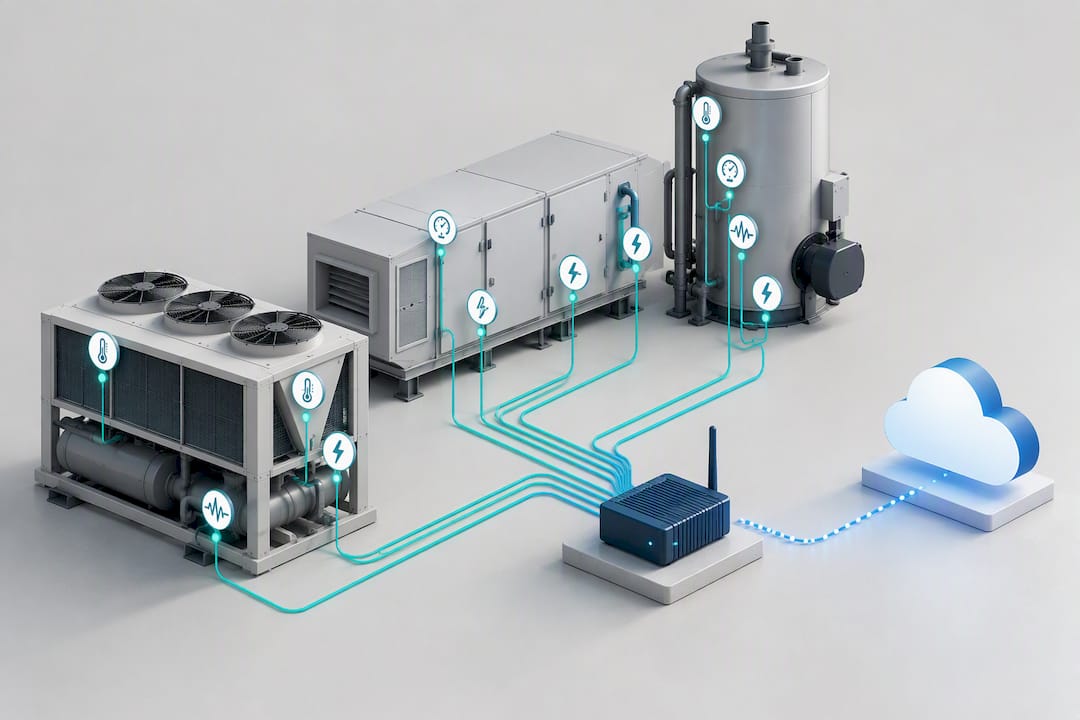
The gateway’s job matters more than most specifications suggest. It handles protocol translation between field devices and the cloud platform, buffers data during connectivity drops, and sometimes runs edge logic to flag anomalies without waiting for a round trip to a server.
Connectivity choice depends on the building fabric and site layout:
- LoRaWAN for multi-floor retrofits where cabling is impractical and battery life matters
- Wi-Fi where existing network infrastructure already covers plant rooms
- Cellular for standalone or remote sites with no fixed network
- Wired Modbus or BACnet where the BMS already provides a backbone
Pro Tip: Site gateways should be placed away from the IT comms room. Concrete-framed buildings shield radio signals badly, and a ceiling-void or mid-floor placement usually cuts the number of gateways you need.
What energy and maintenance savings can you expect?
Poorly controlled HVAC plant wastes more energy than most estates teams realise. Undetected faults and improper controls can inflate energy use by 15 to 30 percent, and continuous monitoring is one of the more reliable ways to claw that back.
A retrofit IoT layer over an existing BEMS typically pays back within 2 to 4 years on a UK commercial office, using Carbon Trust and BEIS energy benchmarks rather than vendor-supplied case studies. A vendor’s own payback claims are marketing; a Carbon Trust benchmark survives scrutiny from a finance director.
Beyond the energy line, monitoring changes how maintenance teams actually work:
- Fewer emergency call-outs because faults surface as alerts, not breakdowns
- Extended asset life through earlier intervention on fouling coils and failing pumps
- One dashboard for multi-site portfolios instead of separate site visits
- Cleaner compliance records for statutory reporting and tenant service level agreements
Remote access to controls also lets one engineer manage several small sites from a single screen, cutting travel time and improving response speed across a portfolio.
Which sensors and protocols actually earn their keep?
Not every sensor produces a useful signal. For fault detection and diagnostics, four types do most of the work: current clamps on motors and compressors, supply and return temperature sensors for delta‑T calculations, CO2 sensors for ventilation demand, and vibration sensors on rotating plant.
Delta‑T alone tells you little. Reliable chiller and AHU fault detection needs supply and return temperature paired with flow or pump current, because a delta‑T anomaly combined with a shifting motor current trend is what actually catches a fouled coil early.
- Sampling cadence: faster sampling improves resolution but drains battery life on wireless sensors, so match cadence to the fault you are hunting rather than defaulting to “as often as possible”
- LoRaWAN typically suits multi-floor retrofits best, offering longer battery life and keeping sensor traffic separate from the corporate IT network
- Wi-Fi or cellular work better for high-bandwidth or latency-sensitive applications
- Protocol translation at the gateway (BACnet, Modbus, MQTT) lets old and new equipment speak the same language
Should monitoring control your BMS or just advise it?
Most successful deployments start advisory and stay that way for longer than clients expect. An IoT overlay publishes telemetry and recommendations to the existing BMS rather than replacing its control authority, which preserves safety interlocks and makes the BMS supplier far more willing to cooperate.
- Keep the bridge one-way at first: monitoring reads from the BAS, it doesn’t write to it
- A two-way bridge without careful testing risks a monitoring outage blinding your BAS to real faults
- Set clear data retention rules and address tenant privacy where sensors cover occupied space
- Decide between edge machine learning and cloud analytics based on latency, bandwidth and privacy needs, not marketing preference
Edge inference earns its complexity where bandwidth or privacy rules out constant cloud processing. A short, site-specific training window on the edge model usually cuts false positives faster than tuning a generic cloud algorithm.
What does a realistic commissioning checklist look like?
Skipping the observation phase is the single most common way pilots go wrong. A practical sequence runs in this order:
- Survey the site and map every asset, control point and existing BMS object
- Collect baseline energy data for at least a few weeks before installing sensors
- Site sensors correctly, avoiding draughts, direct sun and dead airflow zones
- Observe for 4 to 8 weeks before tuning schedules or deploying automated alerts
- Validate data quality against manual spot checks before trusting any dashboard figure
- Configure alerts and route them into the existing maintenance work-order system
Commissioning hours run longer than most first-time integrators budget for. Sensor placement, BAS object mapping and alert routing all eat time that rarely appears on an initial quote.
Pro Tip: Never automate a schedule change before the observation window ends. Automating on incomplete data just locks in whatever bad behaviour the system already had.
How do you avoid bad data undermining the whole system?
Three failure modes account for most monitoring problems: flatlined sensors that stop updating without triggering an obvious fault, API failures that silently drop data, and sensor drift that slowly skews readings until an alert threshold means nothing.
- Build validation rules that flag suspiciously static readings, not just out-of-range ones
- Add sensor redundancy on critical points like chiller flow and return temperature
- Recalibrate on a fixed schedule rather than waiting for a visible fault
- Plan for lifecycle costs beyond initial capex, including hosting, security patching and eventual hardware replacement
Multi-site estates face an additional risk worth planning for from day one: the silo effect, where each site’s overlay works fine in isolation but never rolls up into a single portfolio view. Decide on data aggregation architecture before the first sensor goes live, not after five sites have five incompatible dashboards.
Which use cases and KPIs deliver the fastest wins?
Three use cases consistently deliver early, defensible returns: anomaly detection on chillers and AHUs, demand-controlled ventilation driven by CO2 readings, and occupancy-based setback scheduling.
- Track plant runtime hours against expected duty cycles
- Monitor fault frequency and time-to-acknowledge on alerts
- Watch delta‑T trends on major plant for early fouling signs
- Log CO2 threshold breaches as a ventilation performance indicator
Feed every alert directly into your existing work-order system rather than a separate monitoring inbox, and hold off on any control changes until the 4 to 8 week observation window closes. Our guide to predictive maintenance for UK commercial buildings covers how these KPIs tie into a wider maintenance strategy.
What should you ask a monitoring supplier before signing?
Procurement mistakes here are expensive and hard to reverse once sensors are installed and a contract is signed. Evaluate suppliers against a short list of hard questions rather than a glossy brochure.
- Ask for a sample dataset and dashboard before committing, not after
- Confirm who owns the data and what happens to it if you switch supplier
- Get commissioning hours quoted per site, in writing, not as a single portfolio estimate
- Check whether the platform supports multi-site roll-ups or only single-building dashboards
- Clarify warranty terms on sensors and gateways separately from the software subscription
Red flags include vague answers on data ownership, no clear BAS integration experience, and reluctance to share a real sample dataset. Procurement models vary too: capital purchase, managed service subscription, or monitoring folded into an existing PPM contract each suit different budget structures. For operators managing critical plant beyond HVAC, the same monitoring discipline applies to systems like a diesel monitoring system for data centre operators, where uptime pressure is even higher.
How Delta First approaches remote monitoring and maintenance
Monitoring only earns its cost when it feeds directly into maintenance action, not a dashboard nobody checks. Delta First folds remote monitoring data into planned preventative maintenance and reactive workflows, so an alert becomes a scheduled visit rather than an ignored notification.
A pilot typically starts small: one or two plant rooms, a defined observation period, and a clear scope agreed before any sensor goes on the wall. A planned maintenance survey forms the groundwork, mapping assets and baseline performance across Essex, Suffolk, Norfolk and Greater London.
— Ashley
Ready to pilot remote monitoring on your estate?
A practical route into remote monitoring is offered for facilities teams who want it folded straight into maintenance, not sold as a standalone gadget. Instead of separate monitoring vendors and maintenance contractors, a single accountable team can handle sensor commissioning, alert routing and repairs when faults arise, with engineers deployed in the Essex, Suffolk, Norfolk and Greater London areas.

A pilot typically begins with a site survey to map assets and agree scope, whether that means a standalone monitoring install, a full PPM contract with monitoring built in, or a wider full FM contract covering electrical, mechanical and fabric work alongside HVAC. Get in touch to request a quotation or planned maintenance survey and find out what a pilot would look like on your buildings.
Sources
- Impact of Practical Challenges on the Implementation of Data-Driven Services for Building Operation: Insights from a Real-Life Case Study
- Commercial Building Sensors and Controls Systems – Barriers, Drivers, and Costs
- Smart buildings: IoT, BEMS and UK retrofit patterns (IoT‑Works)
- From device to the cloud: approaches and challenges in getting HVAC&R data from remote devices | Ecolibrium Magazine
FAQ
What is an HVAC monitoring system and what does it do?
An HVAC monitoring system uses sensors and connected software to track plant performance, temperature, energy use and faults continuously, without an engineer being on site. It typically feeds data to a dashboard and raises alerts when readings move outside expected ranges.
What is the $5,000 rule for HVAC systems?
The $5,000 rule is a US insurance and warranty guideline used to decide whether to repair or replace ageing HVAC equipment: multiply the unit’s age by the estimated repair cost, and if the total exceeds a certain threshold, replacement is usually the better financial choice. It is not a UK regulatory standard, though the same repair-versus-replace logic applies when planning chiller replacement on ageing plant.
What does remote monitoring do?
Remote monitoring gives facilities teams live visibility of HVAC performance, energy consumption and fault conditions from any location, rather than relying on scheduled site visits. It typically shortens fault detection time and reduces unplanned call-outs by catching problems while they’re still minor.
How can I monitor the temperature remotely?
Temperature is monitored remotely using wireless sensors connected through a gateway to a cloud platform, which displays readings and sends alerts when thresholds are breached. LoRaWAN sensors work well for multi-floor commercial buildings, while Wi-Fi suits sites with existing network coverage in plant rooms.
How much does remote HVAC monitoring cost to install?
Costs vary by site size, sensor count and whether monitoring integrates with an existing BMS, so Delta First quotes each project individually after a site survey. Current pricing details are available by requesting a quotation directly.