

Predictive maintenance AI forecasts equipment degradation from live sensor data and historical work-order records, enabling condition-based interventions rather than fixed-schedule visits. The result: fewer unplanned call-outs, lower emergency repair costs, and measurable uptime gains. Predictive maintenance programmes can increase equipment uptime and AI-optimised facilities typically outperform traditionally managed buildings in key performance metrics. Yet recent surveys have found a majority of organisations still lack a formal AI strategy, which means most FM teams are earlier in the process than they realise.
The practical starting point is straightforward:
- Identify one critical system (HVAC, chiller, or boiler) as your pilot asset.
- Collect at least 90 days of baseline KPI data before deploying sensors or models.
- Define success metrics upfront: uptime percentage, mean time to repair (MTTR), and emergency call-out frequency.
- Engage a qualified building services partner to audit data readiness and sensor options.
Contact Delta First to request a pilot survey and baseline assessment for your estate.
How does predictive maintenance AI actually work?
At its core, AI-driven maintenance uses continuous IoT telemetry combined with historical asset and work-order data to detect anomalies and estimate remaining useful life. IoT sensors collect time-series data covering temperature, vibration, pressure, noise, and energy consumption. That data flows from the sensor to an edge gateway, then to a cloud or on-premises analytics platform where machine learning models identify patterns that precede failure.
AI techniques range from rule-based diagnostics through to anomaly detection on time-series streams and hybrid physics-informed models that estimate how long a component will last under current operating conditions. The model output triggers an alert, which feeds into your CMMS or CAFM as a prioritised work order. Engineers then act on condition-based evidence rather than a calendar date.
The full technology stack typically includes:
- Asset registry and CMMS/CAFM — the authoritative record of every asset, its history, and its maintenance schedule.
- IoT sensors — vibration, temperature, pressure, current, and acoustic sensors retrofitted to critical plant.
- Edge gateways — local processing units that filter and compress data before transmission.
- BMS integration — feeds existing building management system outputs into the analytics layer.
- Time-series datastore — purpose-built database for high-frequency sensor readings.
- ML and anomaly-detection models — the analytical engine that surfaces fault signatures.
- Integration APIs — connect model outputs back to CMMS/CAFM for automated work-order creation.
- Dashboard and alerting layer — gives engineers and FM managers a clear, prioritised view of asset health.
Pro Tip: Data hygiene and consistent asset tagging are prerequisites, not afterthoughts. Fragmented asset records and siloed BMS data are the most common reasons predictive models underperform in the first six months of a deployment.
What does the evidence show about measurable benefits?
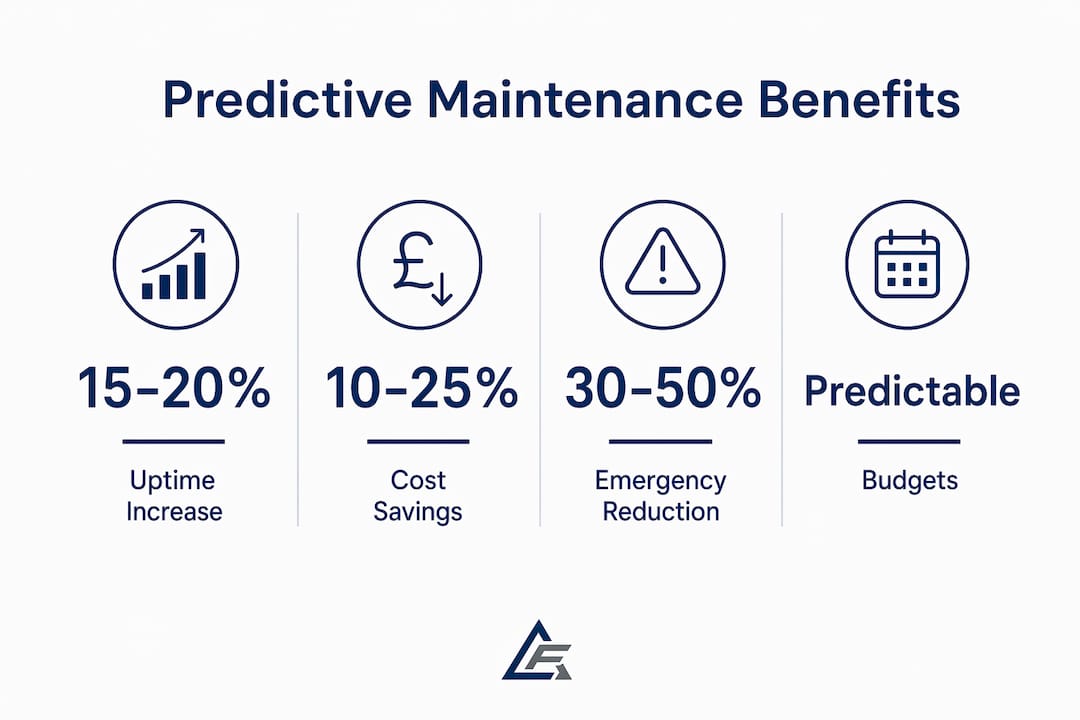
Predictive maintenance AI typically raises uptime and overall operational performance. The figures below represent ranges reported across industry research and UK FM commentary.

| Metric | Reported improvement | Source context |
|---|---|---|
| Equipment uptime | 10–20% increase | Industry research, multiple deployments |
| Overall operational performance | 20–30% above traditional operations | AI-optimised facilities benchmarks |
| Organisations without a formal AI strategy | 59% | Industry survey data (2024) |
These gains translate directly into fewer unnecessary planned preventative maintenance visits, lower emergency call-out costs, and longer asset life. Practical deployments show predictive maintenance helps extend asset life, reduce unexpected failures, and optimise energy consumption when integrated with CMMS and BMS workflows. UK FM commentary consistently highlights energy optimisation and operational resilience as the primary commercial drivers for investment.
A significant share of organisations surveyed recently had no formal AI strategy. — meaning the majority of UK FM teams still have the opportunity to gain a competitive advantage by acting now.
Regional FM providers report that predictive approaches also produce more predictable maintenance budgets and better sustainability outcomes, both of which matter for public sector clients managing tight capital programmes. Data-led maintenance is commercially deployable today without capital-intensive infrastructure upgrades; organisational inertia remains the most common barrier.
Which assets deliver the fastest, clearest return?
Start with high-impact plant where failure is costly, safety-critical, or both. HVAC systems, chillers, boilers, pumps, and critical motors consistently deliver the fastest measurable ROI and build stakeholder confidence quickly.
Priority asset ranking:
- HVAC systems — high failure cost, direct comfort and compliance impact, relatively straightforward to sensorise.
- Chillers — expensive to repair, long lead times for parts, significant energy draw.
- Boilers and heat exchangers — safety-critical, statutory inspection requirements, clear failure signatures.
- Pumps and motors — vibration and current signatures are well-understood; retrofit sensors are low-cost.
- Electrical distribution and UPS — critical in healthcare, data centres, and education; thermal imaging and current monitoring provide early warning.
When selecting your pilot asset, apply this checklist:
- Failure cost — what does an unplanned breakdown cost in downtime, repairs, and disruption?
- Downtime impact — does failure affect safety, compliance, or occupant welfare?
- Data availability — does the asset already have BMS points or maintenance history?
- Ease of retrofit — can sensors be installed without major plant shutdown?
- Regulatory significance — is the asset subject to statutory inspection or compliance reporting?
Step-by-step implementation roadmap for a UK pilot
Run a short, time-boxed pilot with clear KPIs, then use the results to secure budget for a phased rollout. Attempting to deploy across an entire estate at once is the single most reliable way to stall a programme.
- Define objectives and KPIs — agree uptime targets, MTTR reduction goals, and emergency call-out frequency with stakeholders before any hardware is ordered.
- Select pilot asset and site — apply the asset-selection checklist above; one system, one building.
- Audit data and install sensors — conduct a data-hygiene review, map existing BMS outputs, and install IoT sensors where gaps exist.
- Integrate with BMS and CMMS — connect sensor streams and BMS data to the analytics platform; confirm work-order creation workflows.
- Run models and validate alerts — allow a model warm-up period (typically 4–8 weeks) and validate alerts with on-site engineer feedback.
- Convert alerts into standard work orders — revise SOPs so predictive alerts follow the same authorisation and scheduling process as PPM tasks.
- Measure and report against baseline — compare KPIs at 90-day and 6-month checkpoints.
- Refine and scale — use ROI evidence to justify expansion to additional assets and sites.
Sample KPIs to track:
| KPI | Baseline measure | Target improvement |
|---|---|---|
| Equipment uptime (%) | Record pre-pilot | +10–20% |
| Overall operational performance (%) | Record pre-pilot | +20–30% |
| Mean time to repair (MTTR) | Hours per incident | Reduction target agreed |
| Emergency call-outs per quarter | Count pre-pilot | Reduction target agreed |
| Unnecessary PPM visits | Visits per asset per year | Reduction target agreed |
| Energy intensity | kWh per m² | Reduction aligned to ESG goals |
A typical pilot runs across three phases: data collection and sensor installation (weeks 1–6), model warm-up and alert validation (weeks 7–16), and ROI checkpoint and scale decision (months 4–6).
Typical costs, timelines, and how to estimate ROI
Pilots are frequently scoped as modest sensor and integration projects over 3–6 months; ROI is usually measurable within 12–36 months for critical assets. Cost components to budget include:
- Sensors and retrofits — unit costs vary by asset type and sensor specification; vibration and temperature sensors for a single HVAC unit are typically low-cost items.
- Connectivity — cellular or Wi-Fi gateway provisioning, SIM costs, and network security configuration.
- Platform subscription or licence — analytics platform fees, often charged per asset or per site.
- Integration work — BMS and CMMS connection, API development, and data mapping.
- Engineering time — installation, commissioning, and ongoing model review.
- Training and support — engineer upskilling and ongoing vendor support.
A simple ROI calculation: take the annual cost of emergency call-outs and unplanned downtime for the pilot asset, apply the 10–20% uptime improvement range, and compare the avoided cost against total pilot expenditure. For a critical chiller or boiler, avoided emergency repair and business disruption costs alone often justify the sensor investment within the first year.
Timeline summary:
- Discovery and scoping: 2–4 weeks
- Pilot (sensor install to ROI checkpoint): 3–6 months
- Scale across estate: 6–24 months depending on portfolio size and data maturity
What should you ask suppliers and technology partners?
Prioritise data access, open APIs, demonstrable UK experience, and clear SLAs for model accuracy and response times. A supplier who cannot answer the questions below clearly is not ready to deliver a reliable programme.
Procurement checklist:
- Who owns the data generated by sensors on your assets?
- Where is data hosted, and does it remain within the UK or EEA?
- What cybersecurity standards does the platform hold (ISO 27001, SOC 2)?
- Does the platform integrate with your existing CMMS or CAFM via open APIs?
- What are the SLAs for alert accuracy, false-positive rates, and platform uptime?
- What training and handover documentation is provided?
- How are audit trails and compliance reports generated?
Questions to ask during supplier demonstrations:
- Can you show pilot outcomes from a comparable UK estate?
- What KPIs did you measure, and what were the results?
- How does the model explain its predictions to engineers?
- What on-site support is available during installation and warm-up?
- What is the escalation procedure if the model generates a critical alert out of hours?
When scoring proposals, weight technical fit and data readiness most heavily, followed by commercial terms, local engineering support, and evidence of outcomes from comparable deployments.
Data protection, cybersecurity, and UK compliance
Agree GDPR-compliant data handling, clear data ownership clauses, secure connectivity, and defined incident-response responsibilities before any sensors go live. This is not optional; it is a contractual prerequisite.
Technical and contractual requirements:
- Confirm data controller and data processor roles in writing before deployment.
- Agree a data retention policy covering sensor telemetry, maintenance records, and model outputs.
- Require encryption in transit (TLS 1.2 or higher) and at rest for all stored data.
- Specify secure gateway provisioning and network segmentation to isolate OT from IT networks.
- Request evidence of vulnerability management processes and penetration testing results.
- Include audit rights, SLAs for data availability, breach notification timings (within 72 hours under UK GDPR), and data deletion obligations on contract termination.
For mechanical systems compliance more broadly, the same principle applies: document everything, assign clear responsibility, and build audit trails into the contract from day one.
Pro Tip: Prefer suppliers who can confirm UK or reputable EEA data residency and provide ISO 27001 or SOC 2 certification evidence. Asking for this upfront filters out vendors whose security posture is not mature enough for a commercial or public sector estate.
Common pitfalls and how to avoid them
Most pilot failures trace back to poor data readiness, unclear KPIs, over-ambitious scope, or weak change management. The fix in each case is to plan smaller and measure faster.
- Fragmented asset records — run a data-hygiene audit before procurement begins; incomplete records produce unreliable model outputs.
- Missing BMS integration — sensors alone are insufficient; BMS data provides the operational context models need.
- Insufficient sensor density — under-instrumenting a critical asset produces blind spots; follow manufacturer guidance on sensor placement.
- Unrealistic accuracy expectations — no model is perfect; agree acceptable false-positive rates with engineers before go-live.
- Failure to revise workflows — predictive alerts only add value if they feed into authorised work orders; update SOPs before the pilot starts.
- Neglecting user training — engineers who do not trust or understand the alerts will ignore them; invest in structured training during warm-up.
Where sensor infrastructure is limited, UK FM guidance recommends starting with AI-assisted diagnostic tools used by engineers during inspections, then progressing to full sensor-based prediction as data maturity improves.
Pro Tip: During the model warm-up phase, have on-site engineers review every alert and record whether it was valid, a false positive, or inconclusive. That feedback loop accelerates model accuracy and builds engineer confidence simultaneously.
Key takeaways
Predictive maintenance AI delivers measurable uptime improvements and cost reductions when deployed on critical assets with clean data, clear KPIs, and a phased pilot approach.
| Point | Details |
|---|---|
| Start with critical plant | HVAC, chillers, and boilers deliver the fastest ROI and the clearest baseline for KPI measurement. |
| Uptime gains are evidenced | Programmes consistently report measurable uptime improvements; AI-optimised facilities show notable performance gains compared to traditional operations. |
| Data readiness comes first | Fragmented asset records and siloed BMS data are the leading causes of model underperformance. |
| Pilot before scaling | A 3–6 month time-boxed pilot with agreed KPIs produces the ROI evidence needed to secure budget for estate-wide rollout. |
| Delta First supports the full pathway | Delta First provides PPM contracts, sensor installation partnerships, BMS integration support, and pilot delivery with UK-qualified engineers across Essex, Suffolk, Norfolk, and Greater London. |
Why starting small and measuring fast is the right approach
The temptation in any AI programme is to think big from the outset. A multi-site, multi-system deployment sounds impressive in a board presentation. In practice, it almost always stalls because the data is not ready, the workflows have not been revised, and the engineers have not been brought along.
The approach we recommend at Delta First is grounded in what actually works in UK commercial and public sector estates. A single critical asset, a 90-day baseline, a clear set of KPIs, and a qualified engineer reviewing every alert during warm-up. That is the model that produces results stakeholders can see and budgets can follow.
Local engineering support matters more than most technology vendors acknowledge. When a predictive alert fires at 11pm on a critical boiler serving an NHS facility or a school, you need an engineer who knows the building, not a remote helpdesk. Our delivery capability across Essex, Suffolk, Norfolk, and Greater London means that local accountability is built into the service, not bolted on as an afterthought.
AI augments engineers; it does not replace them. FM leaders consistently describe AI as an enabler that automates pattern recognition while leaving tactical and strategic decisions to qualified engineers. Training and change management are not optional extras; they are what separates a programme that delivers from one that generates alerts nobody acts on.
Delta First can help you plan and deliver a predictive maintenance pilot
Fewer emergency call-outs, lower energy costs, and a maintenance budget you can actually predict: that is what a well-run predictive maintenance programme delivers. Delta First provides the full pathway from initial site survey through sensor installation partnerships, BMS and CMMS integration support, and ongoing planned preventative maintenance contracts delivered by UK-qualified engineers.
Our services relevant to a predictive maintenance pilot include PPM contracts, reactive maintenance cover, HVAC and mechanical servicing, BMS integration support, and transparent KPI reporting. We serve commercial offices, NHS and healthcare estates, schools, local authorities, retail, industrial, and hospitality clients across Essex, Suffolk, Norfolk, and Greater London.
To get started, request a pilot quotation or planned maintenance survey from Delta First. Our engineers will assess your data readiness, identify the right pilot asset, and give you a clear scope and timeline. Visit deltafirst.co.uk or contact us directly to arrange a site survey.
Useful sources and further reading
Use these sources when preparing procurement specifications, internal business cases, or technical briefings for stakeholders.
- Predictive maintenance in 2025 — Stonehelp Consulting — covers uptime improvement ranges and the commercial case for AI-driven maintenance across industrial assets.
- Data-led maintenance in UK FM — Acutro — vendor-neutral UK FM commentary on data readiness, model types, and the risk of inaction.
- Unlocking AI in FM — FMJ — energy optimisation and operational resilience as investment drivers; useful for ESG business cases.
- IoT and maintenance management — Tractian — technical explanation of sensor types, data flows, and time-series monitoring.
- Best AI tools for FM — PM Assist — practical UK FM perspective on interim diagnostic tools and progression to full PdM.
- Predictive maintenance and FM performance — CBFM Heating — regional UK FM commentary on budget predictability and sustainability outcomes.
- Digital maturity and asset registers — Realcomm — covers the data standardisation prerequisites for reliable predictive models.
Recommended
- Integrated facilities management: a practical guide for UK businesses – Commercial Building Services Insights
- What are smart buildings? A UK guide for facilities managers
Need a reliable maintenance and compliance partner? Delta First provides planned preventive maintenance, statutory compliance support and reactive repairs from one accountable contractor across Essex, Suffolk and London, with 24/7 emergency cover. Call 01206 237422 or request a quote.
Talk to Delta First
Delta First Building Services is a Colchester-based M&E contractor working across Essex, Suffolk and London, with commercial work in Norfolk. Our directly employed electrical team is supported by vetted specialist subcontractors where extra certification is needed, and we offer genuine 24/7 emergency cover. Get in touch to arrange a survey or quote.
[…] estates teams managing multiple sites, Delta First’s approach to predictive maintenance and remote monitoring extends this model further, using performance data to anticipate failures […]
[…] used, a significant fault or near-miss incident, or a change in the workforce using the equipment. Predictive maintenance principles apply here: condition data from inspections is more reliable than a fixed […]
[…] maintenance, not a standalone project. Once installed, automatic PFC data feeds into the same predictive maintenance approach we already apply to switchgear and distribution boards, flagging capacitor degradation […]
[…] Predictive maintenance for UK commercial buildings: 2026 guide […]
[…] When controllers log runtime hours and fault histories, maintenance teams can move from reactive to predictive maintenance models, extending plant life and reducing unplanned […]