

There is no single legal interval for PAT testing in the UK. The Electricity at Work Regulations 1989 require dutyholders to maintain electrical equipment so as to prevent danger, but they do not prescribe how often that maintenance must happen or name portable appliance testing by name. Your job as a dutyholder is to set a risk-based schedule, use HSE suggested initial frequencies as a starting point, and then adjust intervals using evidence from user checks, formal visual inspections, and test results.
The practical starting point for most premises looks like this:
- User checks: daily or weekly by the equipment user, no specialist tools required.
- Formal visual inspections: periodic, carried out by a competent person, typically every 1–4 years depending on environment.
- Combined inspection and test (PAT): only where visual checks cannot confirm safety, after repair or modification, or before first use of second-hand equipment.
- High-risk environments first: construction sites, catering kitchens, and equipment used by the public need shorter intervals than low-risk office settings.
The HSE’s FAQ on PAT testing is unambiguous: frequency is a matter for dutyholder judgement, not a fixed calendar rule. Start with HSE Table 1 guidance, collect evidence, and let the data drive your schedule.
Key takeaways
No statutory PAT testing interval exists in the UK: dutyholders must set a risk-based schedule using HSE suggested initial frequencies as a starting point and adjust intervals using evidence from user checks, inspections, and test results.
| Point | Details |
|---|---|
| No fixed legal interval | The Electricity at Work Regulations 1989 require safe maintenance, not annual testing; frequency is a dutyholder decision. |
| Use HSE Table 1 as your starting point | HSG107 and INDG236 give suggested initial intervals by environment and equipment type; treat them as a baseline, not a ceiling. |
| Three-tier regime | Combine daily user checks, periodic formal visual inspections, and targeted PAT; all three tiers are needed for a complete maintenance regime. |
| Record and review | Log every check and test, analyse fault trends after 2–3 cycles, and document the rationale for every interval decision to support audit. |
| Delta First PPM surveys | Delta First builds risk-based PAT schedules for commercial estates across Essex, Suffolk, Norfolk, and Greater London. |
What UK law actually says about electrical equipment maintenance
The legal foundation is Regulation 4 of the Electricity at Work Regulations 1989, which places a duty on employers, self-employed persons, and others in control of electrical equipment to ensure it is maintained in a condition that prevents danger. That duty is absolute in the sense that it cannot be delegated away, but it is not prescriptive: the regulations say nothing about annual testing, PAT stickers, or specific intervals.
This matters because a significant amount of confusion in the market stems from the mistaken belief that annual PAT testing is a legal requirement. It is not. The HSE confirms directly that the law requires maintenance to prevent danger and that testing frequency is a matter for dutyholders’ judgement, informed by risk assessment and evidence.
HSE guidance documents, principally HSG107 and INDG236, and the IET Code of Practice provide suggested initial maintenance intervals and practical frameworks. These are guidance, not statute. A dutyholder who departs from them is not automatically non-compliant, provided they can demonstrate a reasoned, evidence-based rationale for their chosen intervals.
What the law does require is that you:
- carry out a suitable risk assessment for the equipment and environment;
- act on the findings and implement a proportionate maintenance regime;
- keep records sufficient to demonstrate that equipment is being maintained safely.
Landlords managing houses in multiple occupation face an additional layer of obligation. Local HMO licensing conditions can impose specific safety maintenance expectations that go beyond the general Electricity at Work duty, so landlords should check their local authority’s licence conditions rather than relying solely on national guidance.
User checks, visual inspections, and PAT: understanding the difference
The HSE and IET both describe a three-tier maintenance hierarchy. Getting the right activity to the right task saves money and produces better safety outcomes than blanket annual testing.
Tier 1: user checks
User checks are carried out by the person using the equipment, typically daily or at the start of each shift. No specialist tools or formal training are required, though a simple checklist helps. Users should look for damaged cables, cracked plugs, signs of overheating or burning, missing earth pins, and any obvious physical damage to the appliance body. A kettle with a frayed flex should be taken out of service immediately, regardless of when it was last formally tested.

Tier 2: formal visual inspection
A formal visual inspection is carried out by a competent person, someone with enough knowledge and experience to identify defects that a casual user might miss. This includes checking internal plug wiring (where accessible), confirming the correct fuse rating, inspecting cable anchorage, and assessing the appliance for signs of misuse or deterioration. No test instruments are needed. Intervals typically range from annually to every four years, depending on environment and equipment class.
Tier 3: combined inspection and test (PAT)
PAT, properly called combined inspection and test, adds electrical measurements to the visual check. HSG107 explains that some faults, particularly insulation breakdown and loss of earth continuity, cannot be detected by visual examination alone. PAT is therefore justified where visual checks cannot confirm safety, after any repair or modification, before first use of second-hand equipment, and in higher-risk environments where the consequences of a fault are severe.
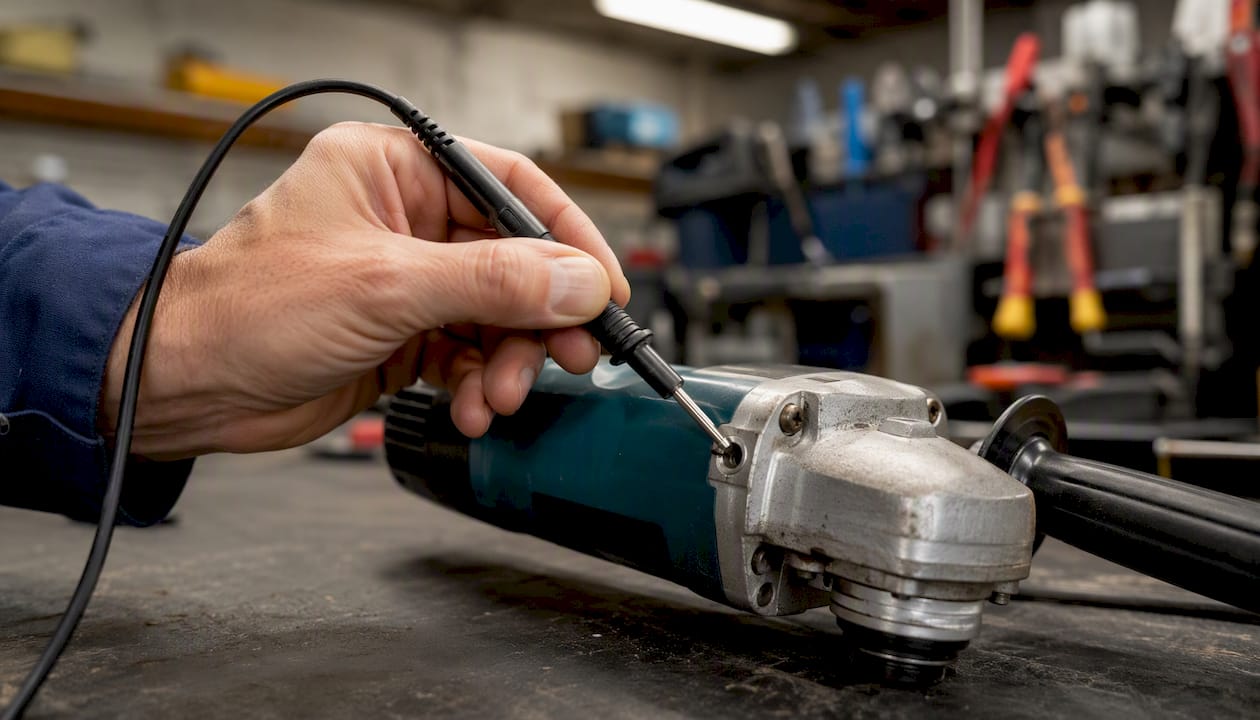
The comparison below summarises the three tiers:
| Activity | Who carries it out | Tools required | Typical trigger |
|---|---|---|---|
| User check | Equipment user | None | Daily / start of shift |
| Formal visual inspection | Competent person (Level 1 minimum) | None | Periodically, per schedule |
| Combined inspection and test (PAT) | Competent person (Level 1 or 2) | PAT tester | Per schedule, after repair, before first use |
Competency levels matter here. HSG107 distinguishes between Level 1 competence, using a simple pass/fail PAT tester with no need to interpret instrument readings, and Level 2 competence, which involves interpreting test results, understanding equipment classes, and making judgements about borderline readings. When equipment is complex, when fixed wiring questions arise, or when a test result requires engineering interpretation that affects safety, a qualified electrician is the appropriate choice.
HSE suggested initial frequencies: what table 1 actually tells you
HSG107’s Table 1 and the simplified version in INDG236 give suggested starting intervals grouped by environment and equipment type. These are not legal requirements. They are the HSE’s best estimate of appropriate frequencies before local evidence is available, and they are explicitly intended to be adjusted once you have collected inspection and test data from your own estate.
The table below presents the key starting intervals drawn from HSE guidance:
| Environment | Equipment type | User check | Formal visual inspection | Combined test (PAT) |
|---|---|---|---|---|
| Office / low-risk | IT equipment (Class II, double insulated) | Weekly | 1–2 years | Up to 5 years (or not required) |
| Office / low-risk | Kettle, toaster (Class I, hand-held) | Weekly | 1–2 years | Up to 2 years |
| Office / low-risk | Extension leads | Weekly | 1–2 years | Up to 2 years |
| Industrial / construction | Portable tools (Class I, hand-held) | Before each use | Monthly | 3 months |
| Industrial / construction | Extension leads on site | Before each use | Weekly | 3 months |
| Catering / kitchen | Fixed equipment (Class I) | Weekly | 1 year | 1–2 years |
| Hotels / public use | Guest appliances (Class I) | Between guests | 3 months | 1 year |
| Schools / education | IT equipment (Class II) | Weekly | 1–2 years | Up to 4 years |
A few practical notes on applying these figures:
- Class I equipment (earthed metal casing) carries greater risk if the earth connection fails, so it generally warrants more frequent testing than Class II (double insulated, no earth).
- Hand-held equipment is subject to more mechanical stress than stationary items and should be inspected more frequently.
- Extension leads are among the most commonly abused items on any estate; treat them as high-risk regardless of environment.
To illustrate: an office laptop (Class II, double insulated, used by one person at a fixed desk) may need only a formal visual inspection every two years and a combined test every four to five years, or possibly never if inspection consistently shows no defects. A 110V power drill used daily on a construction site needs a user check before every use and a combined test every three months. The HSE’s own estate review found that annual PAT was unnecessary for many items in low-use office settings, and intervals were extended once user check and inspection data confirmed consistently low fault rates.
Pro Tip: When you first set up a schedule, err on the side of the HSE’s suggested initial intervals. After two or three inspection cycles with clean results, you have documented evidence to justify extending the interval. That evidence is what protects you at audit.
How to build a risk-based PAT testing schedule that stands up to audit
A defensible PAT testing schedule is built in five steps. The process is not complicated, but it does require discipline in recording and reviewing.
Step 1: create an asset register
Record every portable and transportable electrical appliance in scope. For each item, capture: unique asset ID, make and model, equipment class (I or II), location, primary user or user group, frequency of use, and a criticality rating (what happens if this item fails or causes an incident). Group similar items in similar environments together; you do not need a separate risk assessment for every kettle in every kitchen.
Step 2: risk-assess each group
For each asset group, consider: the environment (wet, dusty, outdoor, office), how often the item is used and moved, who uses it (trained staff, members of the public, vulnerable people), the consequences of failure, and the item’s history of faults or damage. A laptop used by one administrator in a dry office is low risk. A floor-standing fan used in a school corridor by pupils is moderate risk. A power tool used on a live construction site is high risk.
Step 3: assign initial intervals
Use HSE Table 1 as your starting value for each group. Where your risk assessment identifies factors that increase risk beyond the HSE’s assumed baseline (heavier use, harsher environment, less experienced users), shorten the interval. Where factors reduce risk (fixed position, controlled environment, experienced users), you may already have grounds to extend it, though you will need evidence to justify that decision.
Step 4: run the regime and record everything
Record every check: date, inspector or tester name, findings, any remedial action taken, and the next due date. After two to three full cycles, analyse the fault data. If a group consistently shows zero defects across multiple inspection cycles, that is evidence to support extending the interval. If a group shows repeated faults, shorten it.
Step 5: set review triggers and review annually
Your schedule should be reviewed at least annually. It must also be reviewed immediately after any of the following: a repair or modification to an appliance, a change in how or where equipment is used, a significant fault or near-miss incident, or a change in the workforce using the equipment. Predictive maintenance principles apply here: condition data from inspections is more reliable than a fixed calendar.
A sample schedule record should include these columns: Asset ID | Description | Class | Location | User group | Risk level | Last user check | Last visual inspection | Last PAT | Next PAT due | Tester | Result | Action taken.
Pro Tip: Document the rationale for every interval decision, not just the interval itself. An auditor or insurer does not just want to see a test sticker; they want to see the reasoning that produced the schedule. A one-paragraph note per asset group is sufficient.
Who can carry out PAT testing, and how to choose a competent provider
Competency is the single most important factor in a PAT regime, and it is frequently underestimated. The HSG107 guidance is clear that the person carrying out tests must have the knowledge and experience to do so safely and to interpret results correctly.
Level 1 competence covers the use of simple pass/fail PAT testers. A Level 1 tester can carry out routine combined inspection and test on standard portable appliances, record results, and apply labels. This level is appropriate for the bulk of testing on a typical commercial estate: office equipment, kitchen appliances, extension leads. Many facilities teams train in-house staff to Level 1 for routine testing, which can reduce PAT testing cost significantly over time.
Level 2 competence is needed when test results require interpretation, when equipment is complex or unusual, or when a borderline result needs an engineering judgement. Level 2 testers understand what the numbers mean, not just whether the instrument shows a pass or fail. For equipment where a wrong decision could have serious safety consequences, this level of competence is not optional.
A qualified electrician is the right choice when PAT findings raise questions about fixed wiring, when equipment modifications are needed, or when the scope of work goes beyond portable appliance testing into the electrical installation itself.
When selecting an external PAT testing provider, check the following:
- Evidence of tester competence (training records, qualifications, or membership of a relevant professional body).
- A clear method statement describing how they will carry out inspections and tests.
- A sample report showing the format and level of detail they provide.
- The ability to produce and maintain an asset register on your behalf.
- Willingness to support a risk-based schedule rather than defaulting to blanket annual testing for every item regardless of risk.
That last point is worth emphasising. A provider who insists every item on your estate needs annual testing, without reference to equipment class, environment, or usage, is not applying HSE guidance. A good provider will help you understand hard services compliance and build a schedule that is proportionate, auditable, and cost-effective.
Record-keeping and labelling: what auditors and insurers expect
A test sticker on an appliance is useful as a quick visual indicator, but it is not evidence of a compliant maintenance regime on its own. Auditors and insurers want to see the underlying records.
For each check or test, your records should capture: the date, the name and competency level of the inspector or tester, the asset ID and description, the test or inspection result, any remedial action taken (and by whom), and the next due date. Where a fault was found and the item was taken out of service, the record should show what happened to it.
Labelling conventions should be consistent across your estate. A PAT label typically shows the test date, the next test due date, and a unique asset reference. Do not rely on the label alone to confirm an item is safe: a label shows when an item was last tested, not its current condition. User checks between formal inspections are what maintain safety day to day.
Digital registers are preferable to paper for most commercial estates. They are easier to search, harder to lose, and straightforward to share with an insurer or enforcement body. Cloud-based asset management tools allow facilities teams to access records from any site and generate trend reports without manual data extraction. Retention periods for electrical maintenance records are not prescribed by statute, but a minimum of three years is widely recommended in practice, and longer retention is advisable where records support a decision to extend testing intervals.
When presenting records to an insurer or enforcement body, the minimum dataset they typically look for includes: a complete asset register, a written maintenance policy or schedule with rationale, inspection and test records for at least the previous two cycles, evidence of remedial actions taken, and a record of schedule reviews.
Recommended starting intervals for common premises and equipment
The following starting intervals are drawn from HSE guidance and are intended as the first value you enter into your schedule before local evidence is available. Adjust them based on your risk assessment and the fault data you collect.
- Office IT equipment (laptops, monitors, desktop PCs, Class II): formal visual inspection every 2 years; combined test every 4–5 years, or not required if consistently clean inspections.
- Office kitchen appliances (kettles, microwaves, toasters, Class I): formal visual inspection every 1–2 years; combined test every 2 years.
- Extension leads (office): formal visual inspection every 1–2 years; combined test every 2 years.
- Extension leads (construction site): user check before each use; formal visual inspection regularly; combined test periodically.
- Portable power tools (construction, Class I, hand-held): user check before each use; formal visual inspection regularly; combined test periodically.
- Hotel guest appliances (irons, hairdryers, kettles, Class I): formal visual inspection periodically; combined test annually.
- School IT equipment (Class II): formal visual inspection every 1–2 years; combined test every 4 years.
- HMO/rented property appliances (landlord-supplied, Class I): formal visual inspection at each tenancy change; combined test every 1–2 years; check local HMO licensing conditions for any additional requirements.
- Catering equipment (Class I, fixed position): formal visual inspection annually; combined test every 1–2 years.
For hospitality and retail estates, where equipment is used by the public, HSE guidance suggests more frequent formal inspections, around every three months, and annual combined tests. Equipment used by the public is subject to greater wear and more unpredictable handling than equipment used by trained staff.
Grouping strategy: if you test a group of items together for efficiency, apply the shortest interval that applies to any item in the group. Do not allow a high-risk item to be carried along on a low-risk group’s schedule.
Why a risk-based approach is the only sensible way to manage PAT frequency
The instinct to test everything annually is understandable. It feels safe, it is easy to explain, and it produces a consistent paper trail. The problem is that it is neither what the law requires nor what the evidence supports, and it diverts budget from genuinely high-risk assets to low-risk ones that do not need it.
The HSE’s own experience is instructive. After reviewing their estate, they found that annual PAT was unnecessary for many items in low-use office settings and reduced testing frequency once user check and inspection data showed consistently low fault rates. That is not a corner-cutting exercise; it is exactly what the guidance recommends.
The facilities managers and estates teams who get this right are the ones who treat PAT as part of a broader planned preventative maintenance regime rather than a standalone annual event. They log faults, track trends, and use that data to make defensible decisions about intervals. When an auditor or insurer asks why a particular item is tested every three years rather than annually, they have a written rationale backed by inspection records. That is a far stronger compliance position than “we test everything every year because that is what we have always done.”
There is also a cost argument. Over-testing low-risk assets is a direct, avoidable cost. Redirecting that budget to more frequent inspection of genuinely high-risk items, portable tools on construction sites, guest appliances in hotels, equipment used by vulnerable people, produces better safety outcomes for the same or lower spend. The IET Code of Practice and HSG107 both support this approach, and any competent provider should be able to help you build a schedule that reflects it.
Delta First can help you build a compliant, cost-effective PAT schedule

Delta First provides planned preventative maintenance, compliance management, and electrical services across Essex, Suffolk, Norfolk, and Greater London. Our qualified engineers carry out PAT testing as part of a structured PPM programme, producing asset registers, inspection records, and risk-based schedules that meet HSE guidance and stand up to audit.
Rather than defaulting to blanket annual testing, we work with facilities managers, estates teams, landlords, and business owners to build a schedule that reflects the actual risk profile of their estate. That means shorter intervals where risk is genuinely higher, and longer, evidence-justified intervals where inspection data supports them. The result is a compliant regime that costs less to run and focuses resource where it matters.
Whether you manage a single commercial premises or a multi-site estate, contact Delta First to request a quotation or book a planned maintenance survey. We will assess your asset base, apply HSE guidance to your specific environment, and produce a written schedule you can use immediately.
Sources
- Maintaining portable and transportable electrical equipment (HSG107)
- The Electricity at Work Regulations 1989 (SI 1989/635)
- Gov
Talk to Delta First
Delta First Building Services is a Colchester-based M&E contractor working across Essex, Suffolk and London, with commercial work in Norfolk. Our directly employed electrical team is supported by vetted specialist subcontractors where extra certification is needed, and we offer genuine 24/7 emergency cover. Get in touch to arrange a survey or quote.