

The fastest, cheapest route to decarbonising heat in buildings follows a fixed order: cut demand through fabric and controls first, optimise existing plant second, electrify with heat pumps or hybrid systems third, then layer in renewables and storage. In dense urban sites, a heat network often beats electrification outright. None of it works without Warm Homes Plan and Boiler Upgrade Scheme funding lined up early, and a facilities team steering the sequence.
TL;DR:
- Funding schemes like the Warm Homes Plan and Boiler Upgrade Scheme favor early planning and comprehensive feasibility studies to maximize grant opportunities.
- The recommended sequence begins with fabric improvements and controls, followed by optimizing existing plant, then installing heat pumps or hybrid systems near end-of-life.
- Hybrid systems and zone-specific heat networks are ideal for buildings with high peak loads, limited electrical capacity, or existing infrastructure nearby.
- Balancing timing, cost, and disruption is critical, with phased upgrades and hybrid solutions often providing the best practical approach for sensitive facilities.
What UK policy demands from building owners on decarbonising heat
The Warm Homes Plan commits £15 billion over this Parliament and targets expanding the heat pump market to over 450,000 annual installations by 2030, backed by grants and market-development measures. Government policy also aims to double the share of heat demand met by heat networks to 7% by 2035 in England, rising toward about a fifth of total building heat by 2050.
For building owners, three things follow:
- Fabric-first stays the priority before any plant swap, because poor insulation inflates the size (and cost) of whatever low-carbon system replaces the boiler.
- Heat network zoning is coming to more towns and cities, and connection or exemption rules will increasingly shape what a building is permitted to install.
- EPC and landlord standards reform is expected to tighten over this decade, so buildings sitting on ageing gas plant face a shrinking compliance runway.
Grant windows move faster than capital programmes. A building that waits for its boiler to fail before planning risks missing funding cycles entirely.
A practical roadmap for facilities managers to follow
Start with a baseline, not a boiler quote. Pull twelve months of energy bills, current Energy Performance Certificates, the asset register and meter data, then calculate energy use intensity (EUI) so every later decision is measured against a real figure rather than a guess. Commercial retrofit evidence shows benchmarking against comparable buildings is what makes target-setting realistic rather than aspirational.
From there, the sequence runs:
- Fabric and controls — insulation, glazing, draught-proofing and basic control upgrades, which reduce the heating load before anything else is touched.
- BMS optimisation and recommissioning — recalibrating existing controls, which frequently delivers the fastest payback of any measure on this list.
- Plant replacement aligned to end-of-life — timing heat pump or hybrid installation to when the existing boiler or chiller is due for renewal, not before.
- Electrification and renewables — heat pumps, on-site generation and storage once the building’s demand and fabric are already reduced.
Decision gates matter as much as the sequence itself. Hybrid systems suit buildings with high peak loads or limited electrical capacity; heat network connection makes sense where zoning designates the site and a network already exists nearby; lifecycle timing determines whether a grant-funded early swap or a phased replacement makes better financial sense.
Pro Tip: Never replace a boiler in isolation. Commission a feasibility study alongside the replacement decision, because the electrical infrastructure implications of heat pumps are far cheaper to fix on paper than after installation.
Which low-carbon heating technology suits which building
No single technology fits every site, and the UKERC synthesis on decarbonising heat is explicit that the right mix depends on building archetype, not preference.
- Air-source and ground-source heat pumps typically run at a coefficient of performance (COP) between 2.5 and 4, meaning they output two-and-a-half to four units of heat per unit of electricity consumed. On commercial sites, modular or cascade arrangements are usually preferable to a single large unit, preserving part-load efficiency and giving redundancy if one module fails. Emitter compatibility is the common trap: older high-temperature radiators often need resizing or replacing to work efficiently with a heat pump’s lower flow temperatures.
- Heat networks tend to be the lowest-cost option where district infrastructure already exists or where waste heat from an industrial process or data centre sits nearby. Zoning designations increasingly dictate connection obligations and exemptions, so checking a site’s zone status early avoids abortive design work.
- Hybrid systems and heat batteries suit hospitals, schools and other high-occupancy sites where continuity of heat matters. Running a heat pump alongside a gas or storage backup gives redundancy and lets works proceed with minimal disruption to occupants.
- Direct electric resistive heating remains sensible only for small, off-grid buildings or genuinely temporary needs, given its running-cost penalty against a heat pump.
What decarbonisation funding and procurement actually look like
The Boiler Upgrade Scheme and wider Warm Homes Plan funding prioritise heat pump installations, with eligibility generally tied to replacing fossil-fuel heating and meeting minimum efficiency standards, so check current scheme rules against your building type before budgeting.
Cost trade-offs rarely sit where owners expect:
- Capital versus operating cost — heat pumps cost more upfront but usually cost less to run than gas once fabric measures have cut the load.
- Grid-connection risk — electricity distribution upgrades can carry significant lead times and cost, and should be quantified in the business case before commitment, not discovered mid-project.
- Procurement route — in-house capital spend, grant-led retrofit, lifecycle replacement, and PFI-style contracts each suit different ownership structures; PFI-specific guidance recommends treating the decarbonisation report and the feasibility study as separate stages, the first identifying options, the second pricing them properly.
Getting BMS, maintenance and refrigerants right locks in the savings
Optimisation delivers results faster than most owners expect. UKGBC guidance puts the average operational energy saving from better controls and BMS optimisation at around a quarter of non-domestic building energy use, making a BMS health check one of the highest-return actions available before any capital spend on plant.
Three operational disciplines protect that saving over time:
- Recommissioning on a schedule, not just at handover, since control settings drift as buildings and occupancy patterns change.
- F-gas and refrigerant management, including a proper refrigerant inventory within the asset register, given the phase-down of high-warming refrigerants affecting heat pump and chiller specification.
- Planned preventative maintenance (PPM) carried out by contractors who understand the new plant, since a poorly maintained heat pump loses efficiency just as fast as a neglected boiler did.
Pro Tip: Book the BMS health check before the heat pump feasibility study. It’s often cheaper, faster to action, and the savings it reveals can help fund the bigger project.
How Delta First supports FMs through every stage of decarbonising heat
Delta First maps directly onto this roadmap. Our engineers carry out energy surveys and metering to establish the baseline, deliver BMS maintenance and recommissioning to capture quick wins, then move into HVAC retrofit and heat recovery ventilation specification once fabric and controls work is done.
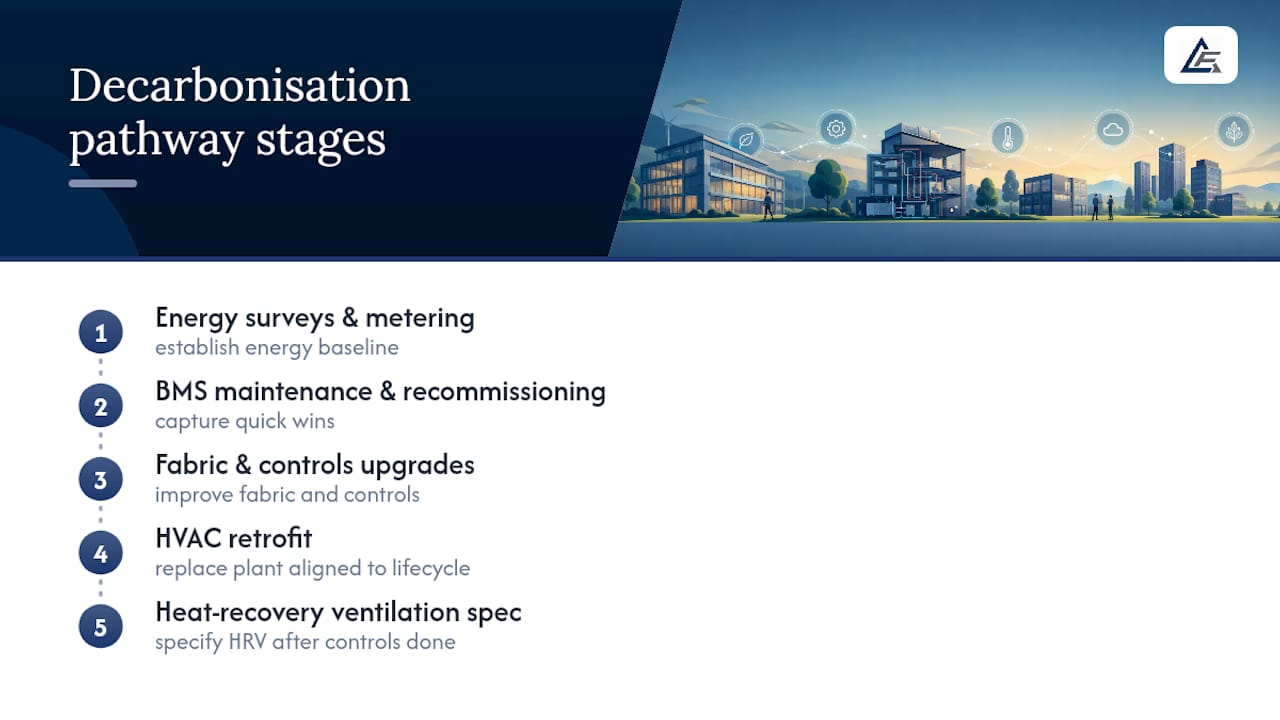
We work alongside estates and facilities teams from the outset, aligning new plant with lifecycle replacement dates so capital isn’t wasted on kit that still has years left. Feasibility studies and planned maintenance surveys sit at the centre of that process, reducing risk before a single piece of plant is ordered. If your building is approaching a plant replacement decision, requesting a decarbonisation survey now is the cheapest way to avoid an expensive mistake later.
Your starting checklist for the next 12 months
Facilities teams don’t need a five-year strategy document to start. They need four or five actions completed properly.
- Establish an energy baseline using twelve months of bills, meter data and EPCs.
- Run a BMS health check to capture immediate savings before spending on plant.
- Identify end-of-life plant across the asset register so replacement timing is planned, not reactive.
- Check Boiler Upgrade Scheme and Warm Homes Plan eligibility against the building type and current heating system.
- Commission a feasibility study covering technical options, cost, carbon impact and grid-connection risk.
Treat the first three as short-term (0 to 3 months), the feasibility study as medium-term (3 to 9 months), and plant replacement or renewables installation as the longer-term phase, timed to lifecycle need rather than forced early.
Balancing cost, disruption and carbon: an editorial view
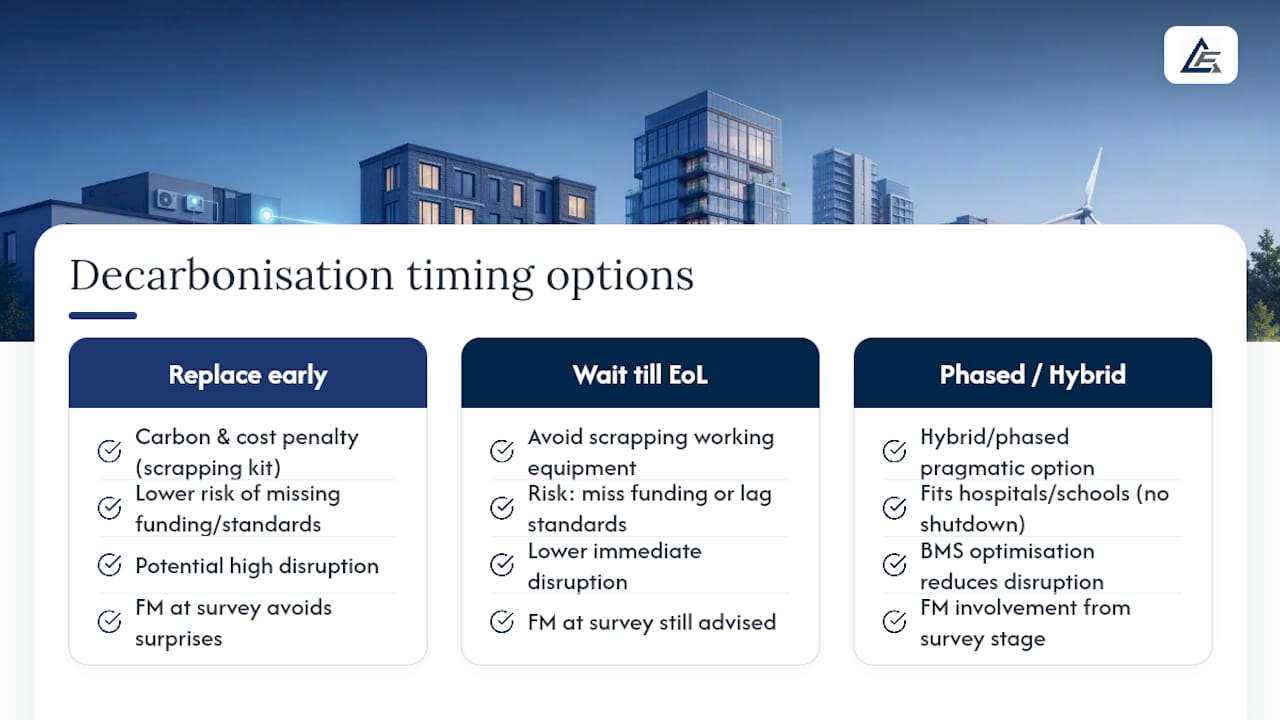
The hardest part of decarbonising heat isn’t the technology. It’s the timing decision: replace plant early and pay a carbon and cost penalty for scrapping working equipment, or wait for end-of-life and risk missing funding windows or falling behind tightening standards. There’s no universally right answer, only a right answer for a specific building at a specific point in its asset lifecycle.
What consistently gets underestimated is disruption. A hospital or school cannot simply switch off heating for a fortnight while a heat pump goes in, which is precisely why hybrid systems and phased BMS optimisation earn their place in the sequence, not as a lesser option but as the pragmatic one. Facilities managers who get involved at survey stage, rather than being handed a finished specification, consistently avoid the costliest surprises. If your estate is due a plant review, requesting a PPM or feasibility survey now costs nothing and closes off very little.
— Ashley
Talk to Delta First about your decarbonisation survey
Delta First is the practical delivery partner for the roadmap covered here: energy baselining, BMS optimisation, HVAC retrofit, heat recovery ventilation and the planned maintenance that keeps new low-carbon plant running efficiently for years, not months. Unlike a one-off installer, we work with your facilities team from survey through to lifecycle replacement, which means fewer surprises on cost, grid capacity, or disruption once works begin.

Our engineers cover commercial, education, healthcare, retail and public sector buildings across Essex, Suffolk, Norfolk and Greater London, and for electrification-related works, our commercial electrical services in Essex support the grid and distribution upgrades that heat pump projects often need. If your building has EV charging or storage in scope alongside heating, Qvanta’s commercial charging guidance is a useful companion reference for owners planning both together.
If a boiler or chiller on your estate is approaching end-of-life, request a decarbonisation or planned maintenance survey from Delta First now, before the next funding window closes.
Need support with mechanical or HVAC maintenance? Delta First delivers planned and reactive mechanical maintenance across Essex, Suffolk and London, using certified specialist partners for gas and refrigerant work, with 24/7 emergency cover. Call 01206 237422 or request a quote.
Sources
Recommended
- Sustainability Focus
- Summer HVAC maintenance: a guide for facilities managers
- BMS maintenance: the practical checklist for facilities managers
Talk to Delta First
Delta First Building Services is a Colchester-based M&E contractor working across Essex, Suffolk and London, with commercial work in Norfolk. Our directly employed electrical team is supported by vetted specialist subcontractors where extra certification is needed, and we offer genuine 24/7 emergency cover. Get in touch to arrange a survey or quote.