

Effective BMS maintenance comes down to one formula: a planned preventative maintenance (PPM) programme, control-loop tuning across the first 12 months, and engineers who genuinely know your platform. Get those three right and the outcomes follow on their own.
- Fewer reactive callouts and less unplanned downtime
- Lower HVAC energy costs, with tuned systems delivering 15 to 30% savings versus uncontrolled operation
- Predictable maintenance budgets and usable performance data for future optimisation
The next step is straightforward: book a planned maintenance survey before your next service is due, not after something fails.
Key Takeaways
Reliable BMS performance depends on scheduled PPM, 12 months of post-commissioning tuning, and contracts that guarantee software access and clear response times.
| Point | Details |
|---|---|
| Choose PPM over reactive-only | Scheduled inspection prevents the compounding faults that reactive-only maintenance misses. |
| Budget for 12-month tuning | New installations need a year of monitoring to correct setpoint drift after commissioning. |
| Demand full software access | Contracts should hand over passwords, licences and configuration files in your name. |
| Plan for obsolescence early | Inventory controllers and firmware lifecycle dates before unsupported hardware forces an emergency replacement. |
| Partner with Delta First | Delta First offers PPM-led BMS maintenance surveys with written reports across Essex, Suffolk, Norfolk and Greater London. |
Table of Contents
- What is BMS maintenance and what types does it cover?
- BMS maintenance checklist: before, during and after a visit
- How do you choose a BMS service partner?
- Why commissioning and 12-month tuning matter
- Predictive maintenance, obsolescence and the human factor
- How Delta First can help with your BMS maintenance
- Sources
What is BMS maintenance and what types does it cover?
A Building Management System centralises control of HVAC, lighting, power monitoring and security, and it only performs as designed when someone actively maintains it. Maintenance splits into three distinct types, and confusing them is where most budgets go wrong.
- Reactive maintenance fixes faults after they trigger an alarm or a complaint. Necessary, but expensive if it’s your only strategy.
- Planned preventative maintenance (PPM) is scheduled inspection and servicing, typically quarterly or biannually, covering controllers, sensors, actuators and software logs before they fail.
- Target-based optimisation goes further: adjusting setpoints, refining schedules and rationalising alarms against measured energy and comfort data, usually reviewed monthly or seasonally.
Each type covers slightly different ground. PPM visits typically inspect HVAC control loops, temperature and CO2 sensors, lighting controls and power monitoring points. Optimisation work leans harder on trend data and seasonal recalibration. Out-of-hours alarm handling sits across all three: a well-configured BMS should escalate critical alarms (plant failure, fire interface faults) immediately, while low-priority alerts queue for the next scheduled visit rather than triggering a costly emergency callout.
BMS maintenance checklist: before, during and after a visit
A service visit is only as good as the preparation either side of it. Here’s the sequence Delta First engineers follow, and the one your own contractor should be following too.
Before the visit:
- Confirm site access, isolations and any permits-to-work needed for plant rooms.
- Pull the last service report and outstanding remedial actions list.
- Check controller backups exist and are current, not from two firmware versions ago.
- Verify who holds admin passwords and software licences, and confirm they’re accessible.
During the visit:
- Physically inspect panels, wiring and terminations for wear, corrosion or loose connections.
- Calibrate sensors against a reference instrument, not just against what the head-end display reads.
- Test alarm points end-to-end, including escalation routing, not just that the alarm fires locally.
- Review software logs for recurring faults, communication dropouts or repeated overrides.
- Back up controller configurations again post-service, before signing off.
After the visit:
- Issue a written test report with readings, not just a “system checked” tick box.
- Log every change made to setpoints, schedules or programming, with dates and reasoning.
- Schedule any remedial works with clear timescales rather than leaving them open-ended.
Prioritise faults that compound: a stuck damper actuator or a drifting temperature sensor left unaddressed for months quietly inflates energy bills long before anyone notices comfort complaints.
Pro Tip: Ask your contractor for calibration certificates on test instruments used during sensor checks. If they can’t produce one, the “calibrated” reading on your report is just an assumption.

How do you choose a BMS service partner?
Picking a contractor on price alone is how buildings end up with a BMS nobody fully understands. Compare on these criteria instead.
Contract essentials to check before signing:
- Defined scope covering all controlled systems, not a vague “HVAC controls” line
- Written response-time SLAs, split by fault priority (critical, urgent, routine)
- A spares policy stating what’s held on the van versus ordered in
- Full software access and password handover in your name, not the contractor’s
Questions worth asking at tender stage: How many years’ experience does the team have on your specific BMS platform? Can they show relevant qualifications and public liability insurance? Will they commission and tune the system as part of the contract, or is that a separate cost?
Red flags to walk away from: contracts that keep passwords and configuration files with the contractor after termination, no mention of tuning or commissioning support, no training offered to your in-house team, and vague reporting that doesn’t specify what gets tested.
Facility management research flags interoperability and vendor lock-in as recurring risks precisely because contracts fail to specify open access and handover terms upfront.
Why commissioning and 12-month tuning matter
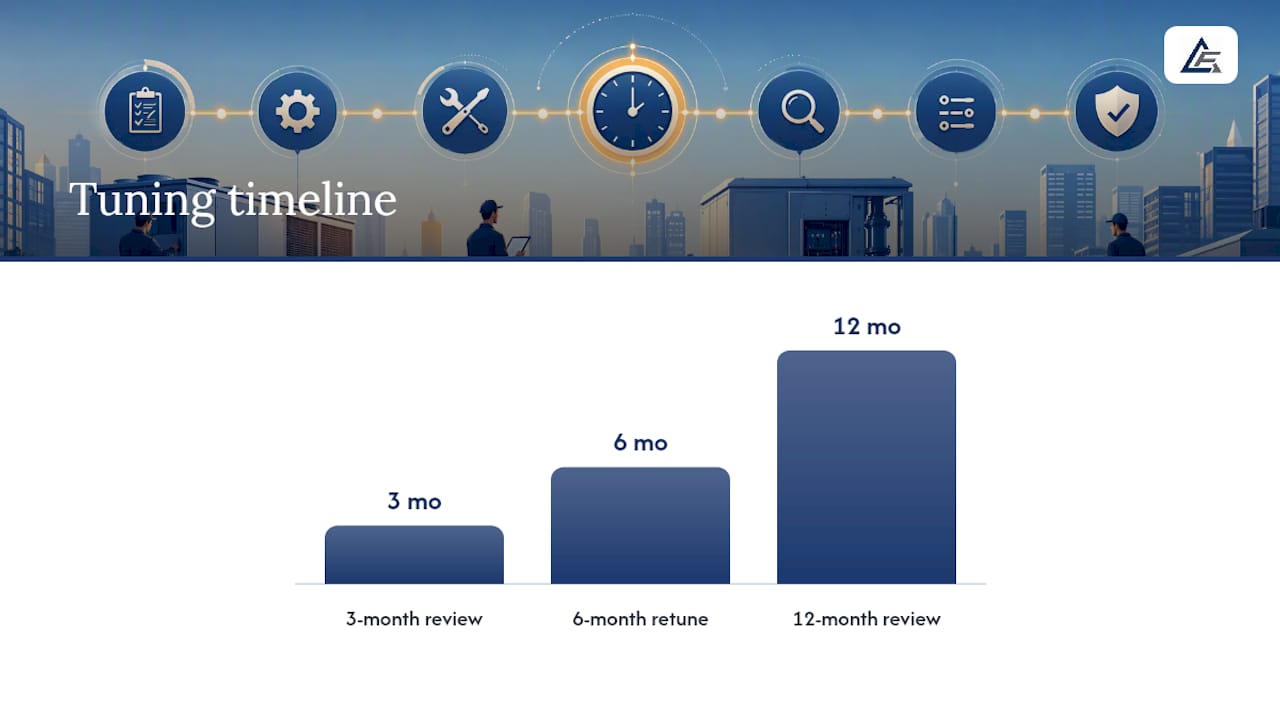
Commissioning rarely gets a system running at its full potential on day one. Energy authority guidance recommends monitoring and fine-tuning new installations for a minimum of 12 months after handover, because initial setpoints, control-loop gains and schedules almost always need correcting once real occupancy patterns emerge.
Follow a staged timeline:
- At commissioning: verify setpoints match design intent and check control loops for stability.
- 3 months in: review alarm frequency and start rationalising nuisance alerts.
- 6 months in: retune loops for seasonal load changes, particularly heating-to-cooling transitions.
- 12 months in: compare energy trends against the original baseline and lock in optimised schedules.
Pro Tip: If nobody’s reviewed your control loops since commissioning, treat that as your first red flag, not a reason to assume everything’s fine.
Predictive maintenance, obsolescence and the human factor
Diagnostic-led BMS platforms can flag failing HVAC components before they cause a breakdown, shifting maintenance from calendar-based to condition-based. Predictive analytics show real promise, but academic reviews are clear that the data behind them needs to be clean and the systems genuinely interoperable, otherwise the alerts become noise rather than insight.
Obsolescence is the quieter risk. Controllers running unsupported firmware, expired software licences and proprietary protocols that won’t talk to newer equipment all point to the same problem.
A practical obsolescence plan starts with an inventory: every controller, its firmware lifecycle date, and a staged migration path towards open protocols such as BACnet or Modbus where replacement becomes unavoidable.
Poor training is just as damaging as ageing hardware. A system your estates team doesn’t understand gets left on manual override, which quietly erases the efficiency gains you paid for.
- Unsupported controllers past manufacturer end-of-life
- Expired or unrenewable software licences
- Interoperability gaps between old and new equipment
Common pitfalls we see on client sites
The recurring problems aren’t technical, they’re procedural: no PPM schedule, service reports filed and forgotten, alarms silenced rather than resolved. Our surveys usually surface quick wins fast. One site had three years of uncalibrated sensors driving unnecessary reheat, corrected within a single visit.
— Ashley
How Delta First can help with your BMS maintenance
There are other ways to keep a BMS running, from in-house teams stretching their remit to piecemeal reactive call-outs whenever something breaks. Neither gives you the accountability of a single contractor who commissions, tunes and maintains under one contract, with response times written into the agreement rather than promised verbally.

Delta First delivers electrical, mechanical, HVAC and building fabric maintenance across Essex, Suffolk, Norfolk and Greater London, with planned preventative maintenance contracts built around your specific plant and platform. A planned maintenance survey gives you a written condition report, a prioritised list of remedial works and a realistic PPM schedule, not a sales pitch dressed up as an inspection. For a deeper look at how ongoing monitoring supports wider efficiency goals, our sustainability-focused approach explains the connection. If your BMS sits alongside broader electrical infrastructure needing attention, our commercial electrical contractors team can scope both together. Request a quotation and book your planned maintenance survey today.
Sources
- What are building controls? | CIBSE
- Building management systems | IEEE Technology Navigator
- Facility management and building automation: opportunities and challenges (2024) | DOI
- Energy
[…] BMS maintenance: the practical checklist for facilities managers […]
[…] what a maintenance survey delivers: sample reports, a corrective action plan, and a clear baseline before work […]