

A compliant contractor induction checklist must deliver three things: a site-specific risk briefing, recorded confirmation that the contractor understood it, and a clear link to permits-to-work and RAMS before any work starts. This requirement sits in CDM 2015, regulation 13, which places the duty on the principal contractor, and in HSE guidance on site rules and induction. Below is a ready checklist and delivery method you can use today.
TL;DR:
- Contractors working near asbestos or high-voltage areas must receive targeted training and verification of understanding before beginning work.
- Inductions should be adapted for hazard severity, with detailed briefings for unescorted contractors and brief summaries for visitors or short-term workers.
- Records must link induction sign-offs to permits, RAMS, and competence cards and be retained throughout the contract and beyond.
- Delivery should be in a quiet, accessible setting with questions that verify understanding, avoiding generic or rushed sessions.
- Ongoing re-induction is required when scope changes, new hazards are identified, or contracts are renewed to maintain safety compliance.
Ready contractor induction checklist
A good induction is site specific, not generic. HSE guidance confirms that inductions must be proportionate to the visit and should highlight the particular risks and controls relevant to that site, with unescorted contractors needing a more detailed briefing than a short visitor pass holder. Copy the items below into your form or spoken script and adapt them to the site in front of you.
- Site overview and management structure: name the site manager, principal contractor and the supervisor the contractor reports to for the day.
- Scope of work for this visit: confirm exactly what the contractor is there to do, including any area restrictions.
- Site rules, PPE and behaviour: state mandatory PPE, mobile-phone policy, smoking areas and any zero-tolerance rules.
- Site-specific hazards and controls: cover asbestos-containing materials, overhead or underground high-voltage cables, confined spaces and any chemical storage relevant to the job.
- Emergency arrangements: alarm signals, assembly points, fire exits and named first-aiders or first aid point.
- Competence and permits: confirm which cards, certificates or training records are required and which tasks trigger a permit-to-work.
- Access, traffic and welfare: sign-in and sign-out procedures, vehicle routes, parking and welfare facility locations.
- Signed record and verification: a dated signature confirming the contractor understood the briefing, with a short check of key points.
Asbestos deserves particular attention. HSE guidance on asbestos training states that anyone liable to disturb asbestos-containing materials must receive appropriate information, instruction and training, and an induction should verify that understanding and point the contractor to the asbestos register before work begins. The same logic applies to permit-linked tasks such as hot works or confined space entry, where the induction should name the trigger and the person who issues the permit. Our guide to a permit to work system sets out how that handover should work in practice.
Pro Tip: Keep a laminated one-page version of the hazard and emergency sections at the induction point so visiting contractors can check it again before they start work each day.
How to deliver an effective contractor induction
Delivery matters as much as content. HSE’s site induction presentation guidance recommends a short, planned session with a record of attendance rather than a rushed conversation at the gate.
- Prepare beforehand: review the RAMS, asbestos register and any permit requirements for the specific task so you can answer questions on the spot.
- Choose the right setting: deliver the induction in a quiet location away from site noise, and keep it brief enough to hold attention.
- Tailor the content: adjust pace and detail for a one-off visitor against an unescorted contractor working for several weeks, and check for language or accessibility needs.
- Verify understanding: ask two or three direct questions about hazards and emergency procedures rather than simply asking “any questions?”.
- Record and hand over: get a signature, then hand the contractor to their site supervisor so the induction connects to ongoing supervision rather than standing alone.
- Re-induct when things change: a change in scope, a newly identified hazard, a contract renewal or any incident should trigger a fresh induction, per HSE’s guidance on treating induction as a live process.
Pro Tip: Build a short-form induction for drivers and casual visitors and a full induction for unescorted contractors, so you are not giving a two-minute delivery slot the same detailed briefing as a six-week refurbishment team.
Templates and recordkeeping: what to keep and for how long
Your induction record should capture, at minimum: name, company, role, date, items covered, signature and the name of the person issuing the induction. A short-form variant works for drivers and short visits, while digital sign-in tools speed up repeat contractors and make records easier to search.
- Link every induction record to the relevant competence card, RAMS document and any open permit-to-work.
- File induction records in the contract folder alongside the Construction Phase Plan so they are available together at audit.
- Keep records for the duration of the contract and beyond, in line with your project’s retention policy and any client requirements.
- Use digital records where possible, since they are easier to retrieve than paper logs when a client or inspector asks for evidence.
Our note on RAMS for contractors covers what to check in those documents before the induction takes place.
Legal baseline and standards to cite
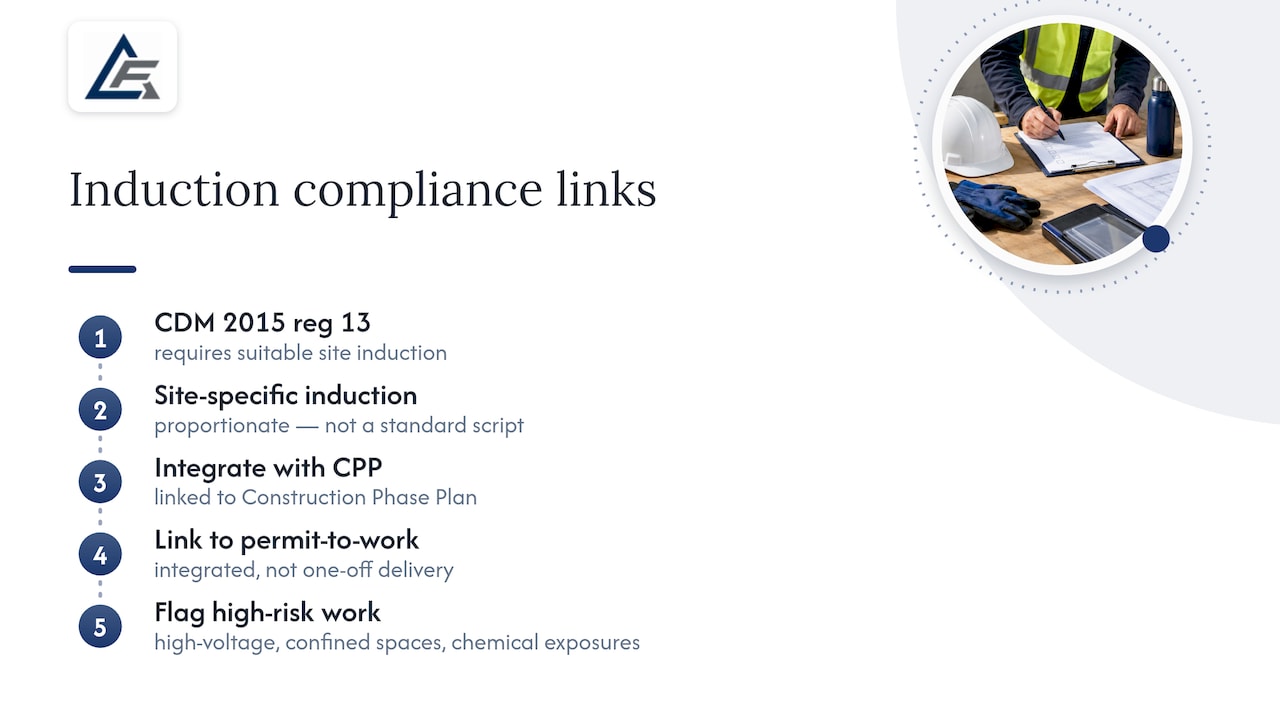
CDM 2015, regulation 13 requires the principal contractor to ensure a suitable site induction is provided. Schedule 3 and regulation 15 of CDM 2015 list particular high-risk work that an induction should flag, including work near high-voltage lines, confined spaces and chemical exposures. HSE’s guidance is explicit that induction must be site-specific and proportionate, not a standard script read out regardless of the job, and should be integrated with the Construction Phase Plan and the permit-to-work system rather than delivered as a one-off event. Our breakdown of CDM 2015 client duties covers the wider set of responsibilities this sits within.
Delta First’s practical checklist notes
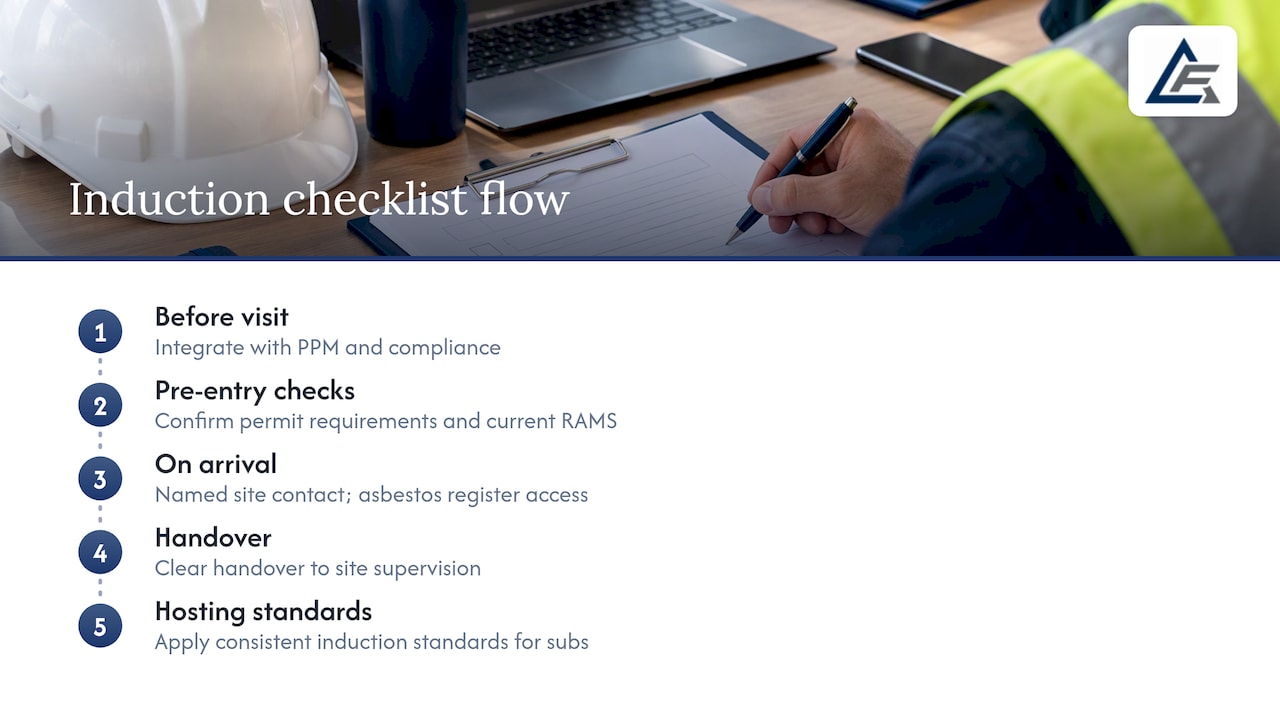
This article was prepared drawing on practical experience working as a contractor on commercial, healthcare, education and industrial sites. Induction checks are integrated with planned preventative maintenance and compliance management work, confirming permit requirements and current RAMS before any engineer sets foot on a client site. On arrival, teams expect a named site contact, access to the asbestos register where relevant, and a clear handover to supervision, applying consistent standards when hosting inductions for subcontractors.
Where inductions usually go wrong
Too many inductions are generic, unverified and disconnected from the permit system, which leaves gaps exactly where risk is highest. The fix is simple: a concise sign-in, a live link to the asbestos register, and a named site contact. Treat induction as continuous, not a box ticked on day one.
— Ashley
How Delta First supports compliance and site safety
Running inductions well takes time that estates teams rarely have spare, particularly on complex sites or where contractors rotate frequently. Commercial building services contractors work alongside facilities and estates teams as a single accountable contractor, covering compliance documentation, planned maintenance and the electrical and mechanical work that inductions often flag as a risk.

- Full Compliance Management to keep certification, permits and inspection records aligned with your induction and audit requirements.
- Planned preventive maintenance (PPM) contracts to reduce reactive call-outs and the number of ad hoc contractor visits needing induction.
- Commercial EICR Testing where an induction raises concerns about ageing or unsafe electrical installations.
- Reactive maintenance and emergency call-out for urgent issues identified during a site walk-round.
If your estates team is managing frequent contractor visits or a complex site with limited in-house resource, get in touch to request a quotation or planned maintenance survey and let us help keep your compliance paperwork and contractor processes in order.
Need a reliable maintenance and compliance partner? Delta First provides planned preventive maintenance, statutory compliance support and reactive repairs from one accountable contractor across Essex, Suffolk and London, with 24/7 emergency cover. Call 01206 237422 or request a quote.
Sources
- Site rules and induction – HSE
- The Construction (Design and Management) Regulations 2015 — regulation 13
FAQ
What are the requirements for a contractor induction?
A contractor induction must be site-specific, cover the hazards and controls relevant to the visit, and be delivered before unsupervised work begins. CDM 2015, regulation 13 places this duty on the principal contractor, and HSE guidance expects it to be proportionate to the nature of the visit and recorded.
What should be included in an induction checklist?
It should cover site rules and PPE, site-specific hazards such as asbestos or confined spaces, emergency arrangements, competence and permit requirements, access and welfare arrangements, and a signed record confirming the contractor understood the briefing. These items reflect the structure recommended in HSE’s induction guidance.
What should be included in a new worker induction checklist?
A new worker induction should cover the same hazard and emergency information as a contractor induction, plus details on reporting lines, who to contact for day-to-day supervision and how incidents or near misses should be reported. HSE’s toolkit guidance recommends keeping this concise so new starters retain the key points.
What are the best forms for contractor induction?
The most effective forms capture name, company, role, date, items covered, signature and the issuer’s name, with a short-form version for drivers and visitors and a fuller version for unescorted contractors. Digital sign-in tools make these records easier to retrieve for an audit than paper logs, as suggested by HSE’s induction guidance.
When is a permit to work required during a contractor induction?
A permit to work is typically required for higher-risk tasks such as hot works, confined space entry or work near high-voltage services, which CDM 2015 Schedule 3 identifies as particular risks to highlight during induction. The induction should name the trigger for a permit and the person responsible for issuing it before work starts.
Recommended
- Five Maintenance KPIs to Make Contractor Data Audit Ready for UK FMs
- Avoid costly dilapidations works, UK tenants, landlords and facilities teams
- 7 key checks: CDM 2015 client duties for UK facilities managers
Talk to Delta First
Delta First Building Services is a Colchester-based M&E contractor working across Essex, Suffolk and London, with commercial work in Norfolk. Our directly employed electrical team is supported by vetted specialist subcontractors where extra certification is needed, and we offer genuine 24/7 emergency cover. Get in touch to arrange a survey or quote.