

Dilapidations are breaches of a tenant’s repair, decoration or reinstatement obligations under a commercial lease, and liability normally falls on the tenant, subject to what the lease actually says. If you have just received a schedule, your first move is to pull out the lease, locate any schedule of condition from day one, and instruct a chartered surveyor before you agree anything or write a cheque.
TL;DR:
- A lease’s schedule of condition at the start can significantly limit repairing liabilities at the end of the tenancy.
- The Landlord and Tenant Act 1927 caps recoverable damages based on property value diminution, often reducing landlord claims.
- Photographing alterations before changes and maintaining accurate records helps tenants defend against inflated dilapidations claims.
- The dilapidations process follows a formal protocol involving inspections, schedules, negotiations, and potential mediation, not just court proceedings.
- Involving surveyors early and focusing on diminution and supersession defenses can prevent overpayment and streamline dispute resolution.
What are dilapidation works? key terms explained
“Dilapidations” covers any disrepair, want of decoration, or unauthorised alteration a tenant leaves behind that breaches their lease covenants. A landlord sets out the alleged breaches in a Schedule of Dilapidations, itemising each defect against the relevant lease clause. Attached to this, or following shortly after, is a Quantified Demand, which puts a monetary figure on the landlord’s claim and the evidence behind it.
Once a tenant responds, the two positions are usually consolidated into a Scott Schedule, a table format that lines up the landlord’s item, the tenant’s response, and the surveyor’s comments side by side. It is the standard working document for negotiation.
Two other terms matter enormously:
- Terminal dilapidations: claims raised at or shortly after lease expiry, covering the property’s condition at handback.
- Interim dilapidations: claims raised during the lease term, often used by landlords to force repairs mid-tenancy rather than wait for termination.
In England and Wales, the two governing references are the Dilapidations Protocol, which sets out expected conduct, and section 18(1) of the Landlord and Tenant Act 1927, which caps what a landlord can actually recover.
What kinds of dilapidation works turn up on a schedule?
Most schedules fall into a handful of recognisable categories, and knowing which bucket an item sits in helps you judge whether it is routine, substantial, or worth challenging.
- Structural and fabric repairs — roofing, windows, doors, brickwork, guttering, anything that has fallen into disrepair against the lease’s repairing covenant.
- Decoration obligations — cyclical redecoration during the term plus a final redecoration at handback, both usually specified by frequency and standard in the lease.
- Reinstatement of alterations — removing tenant-installed partitions, raised floors, or mechanical and electrical changes made without a licence for alterations, and returning the space to its original layout.
- Statutory compliance items — fire safety defects, asbestos register gaps, or overdue periodic electrical testing, which landlords increasingly fold into dilapidations claims because they represent genuine risk exposure.
- Landlord’s own works — where the landlord carries out the repairs itself and claims the cost as a money sum rather than demanding the tenant physically does the work.
Reinstatement items are where disputes cluster hardest, because tenants often assume “we improved the space” counts for something. It rarely does if the lease requires strict reinstatement and no licence was granted.
Pro Tip: Photograph every alteration before you make it and keep the licence for alterations on file. A missing licence turns a straightforward reinstatement into a much harder argument at lease end.
How does the dilapidations process actually run?
The Dilapidations Protocol sets the expected sequence for terminal claims, and courts pay close attention to whether both sides followed it.
- Pre-termination inspection. The landlord’s surveyor inspects near the end of the term and prepares the Schedule of Dilapidations, usually referencing the Protocol’s own Annex forms.
- Quantified Demand served. This sets out the landlord’s estimate of loss, the evidence supporting it, and the basis of the claim, sent alongside or shortly after the schedule.
- 56-day guidance window. The Protocol expects landlords to serve the schedule and Quantified Demand within a reasonable time after termination, and tenants are then expected to respond within a similar reasonable period.
- Meeting and negotiation. Both parties are expected to meet, discuss the Scott Schedule line by line, and narrow the gap before considering court.
- ADR before litigation. RICS guidance and the Protocol both encourage parties to consider alternative dispute resolution, with the courts potentially imposing costs sanctions for unreasonable refusal to attempt settlement.
These timing figures are guidance rather than hard statutory deadlines, but ignoring them without good reason tends to count against whichever party delayed the process if the matter reaches a judge.
How are dilapidations damages actually calculated?
This is where most disputes actually live, and it is also where tenants most often overpay because nobody challenged the landlord’s arithmetic.
A landlord’s claim typically starts from the cost of works: what a contractor would charge to put right every item on the schedule. But that is not automatically what the tenant owes. Section 18(1) of the Landlord and Tenant Act 1927 caps recoverable damages at the diminution in value of the landlord’s interest caused by the breaches, even where repair costs are higher.
- If the property is worth just as much in its current state as it would be fully repaired, damages could be minimal, regardless of the schedule’s total.
- If the landlord intends to demolish, strip out, or substantially redevelop the building, the tenant’s alleged breaches may be superseded, meaning the landlord was never going to spend money fixing them anyway.
- Diminution valuations are prepared by valuation surveyors and can be challenged with a competing valuation.
The statutory cap is the single most valuable protection a tenant has, and it is astonishing how often schedules arrive quoting a full reinstatement cost with no diminution analysis attached at all. Testing the landlord’s redevelopment intentions before agreeing to pay a penny of the headline figure is often more productive than arguing over individual contractor prices.
What should you do if you receive a schedule or quantified demand?
Receiving a Quantified Demand requires a methodical response rather than panic.
- Locate your paperwork. Find the lease, any schedule of condition, past inspection reports, and photographs from move-in and any subsequent works.
- Instruct a chartered surveyor. RICS guidance recommends surveyor involvement precisely because impartial expert analysis carries weight in negotiation and in court.
- Build your response as a Scott Schedule. Line up each item, your response, and the reasoning, ideally endorsed by your surveyor rather than drafted informally.
- Get contractor quotations where the works are genuinely disputed, and bring in a solicitor once the legal interpretation of a lease clause, rather than the physical condition, becomes the sticking point.
- Negotiate on diminution and supersession, not just contractor rates. A cheaper quote wins you little if the landlord was never entitled to the full cost of works in the first place.
Pro Tip: Never let a landlord’s Quantified Demand sit unanswered past the Protocol’s 56-day guidance window. A response endorsed by your surveyor within that period puts you on solid footing if the case ever reaches ADR or court.
How can you reduce dilapidations exposure before the lease ends?
The cheapest dilapidations claim is the one that never happens, and most prevention starts on day one of the tenancy, not the day you hand back the keys.
- Commission a schedule of condition at lease start. A properly drafted schedule, incorporated into the lease, can limit your repairing liability to the property’s condition when you moved in rather than some notional “as new” standard.
- Photograph everything. Time-stamped photographs of every room, fixture and finish are cheap insurance against a landlord’s inflated claim years later.
- Keep statutory testing current. Up-to-date EICRs, fire risk assessments and asbestos registers stop routine compliance items turning into claimable deterioration.
- Get a licence for every alteration. A clear reinstatement clause agreed up front removes ambiguity about what has to come out at lease end.
- Budget for it. Set aside a dilapidations provision through the lease term rather than treating it as a surprise bill in the final year.
Regular building fabric maintenance and a disciplined PPM schedule do double duty here: they keep the building running properly and generate the maintenance records that prove you have not neglected your repairing obligations.
Who does what: surveyors, valuers, solicitors and contractors
A dilapidations claim usually needs more than one professional, and knowing who to call first saves both time and fees.
- Chartered building surveyors prepare and endorse schedules, negotiate on technical points, and provide expert evidence if the matter escalates.
- Valuation surveyors prepare the diminution in value assessment that tests whether the landlord’s headline cost-of-works figure is actually recoverable.
- Solicitors interpret disputed lease wording, advise on litigation risk, and manage costs exposure if the matter cannot be settled.
- Contractors deliver the physical works: reinstatement, mechanical and electrical repairs, compliance testing, and the ongoing PPM that keeps a building compliant during the lease so fewer items ever make it onto a schedule.
Contractors deliver the physical works: reinstatement, mechanical and electrical repairs, compliance testing, and ongoing PPM that keeps a building compliant during the lease so fewer items ever make it onto a schedule.
A pragmatic checklist for estates teams
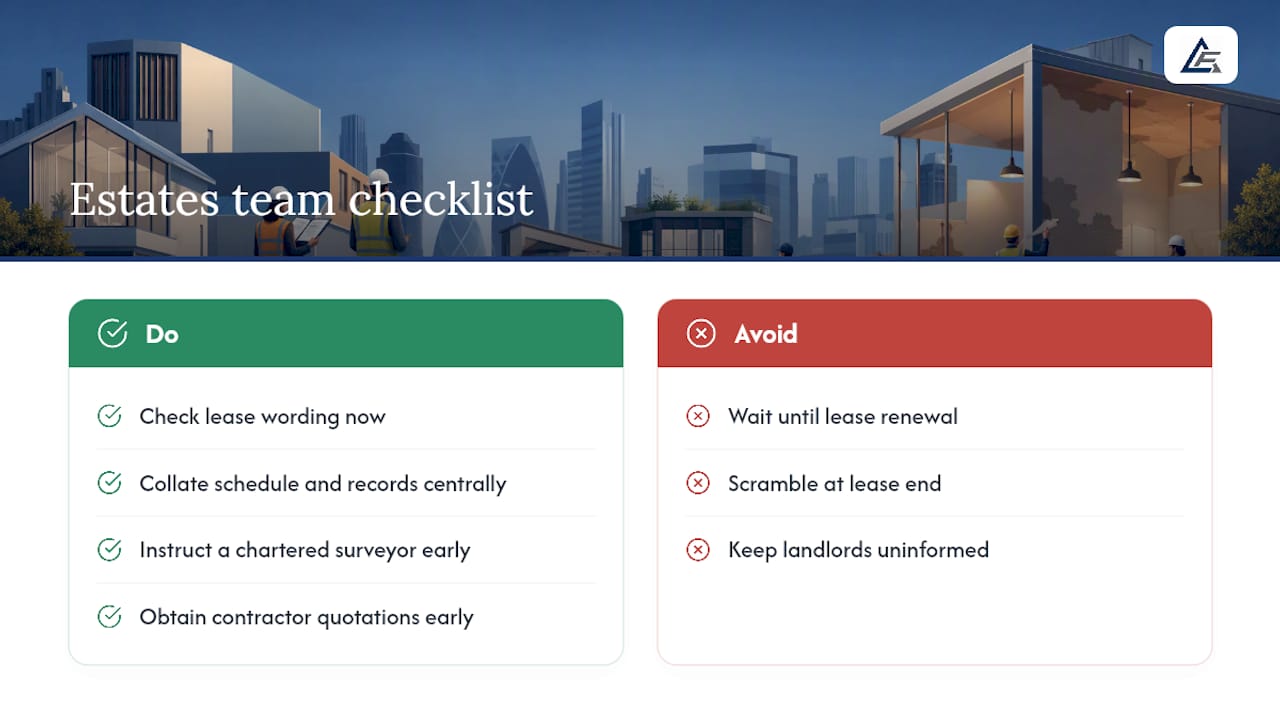
Dilapidations claims rarely surprise us because they follow the same pattern: a lease clause nobody revisited, a compliance gap that quietly grew, and a schedule that lands with a bigger number than expected. Our advice to estates teams is unglamorous but reliable. Check your lease wording now, not at renewal. Collate your schedule of condition and maintenance records into one place. Instruct a chartered surveyor early, and get contractor quotations before you need them, not after.
Prioritise compliance works year round; they are the cheapest items to fix in advance and the most expensive to argue over in a Quantified Demand. Keep landlords informed as you go. Transparent communication and cost control protect your operational continuity far better than a defensive scramble at lease end. If your buildings are due a health check, request a planned maintenance survey and get ahead of it.
— Ashley
How Delta First supports dilapidations and compliance works
Working with a single, accountable contractor can reduce the delays and complexity caused by hiring multiple specialist firms to address electrical testing, HVAC repairs, building fabric works, reinstatement, and planned preventative maintenance.

Whether you are a tenant facing reinstatement obligations or a landlord preparing a property for re-letting, our engineers handle the remedial works, statutory testing, and ongoing PPM that keep dilapidations exposure low in the first place. We serve facilities managers, estates teams and property owners across Essex, Suffolk, Norfolk and Greater London, covering everything from commercial electrical contracting to industrial and warehouse sites. If a schedule of dilapidations or a compliance gap has landed on your desk, request a quotation or a planned maintenance survey and let us scope the works before your next renewal deadline.
Need building fabric repairs or maintenance? Delta First’s directly employed team carries out building fabric maintenance and repairs alongside electrical and mechanical work across Essex, Suffolk and London, with 24/7 emergency cover. Call 01206 237422 or request a quote.
Sources
- Landlord and Tenant Act 1927 — section 18
- Pre-Action Protocol for Claims for Damages in Relation to the Physical State of Commercial Property at Termination of a Tenancy — Justice UK
Recommended
Talk to Delta First
Delta First Building Services is a Colchester-based M&E contractor working across Essex, Suffolk and London, with commercial work in Norfolk. Our directly employed electrical team is supported by vetted specialist subcontractors where extra certification is needed, and we offer genuine 24/7 emergency cover. Get in touch to arrange a survey or quote.