

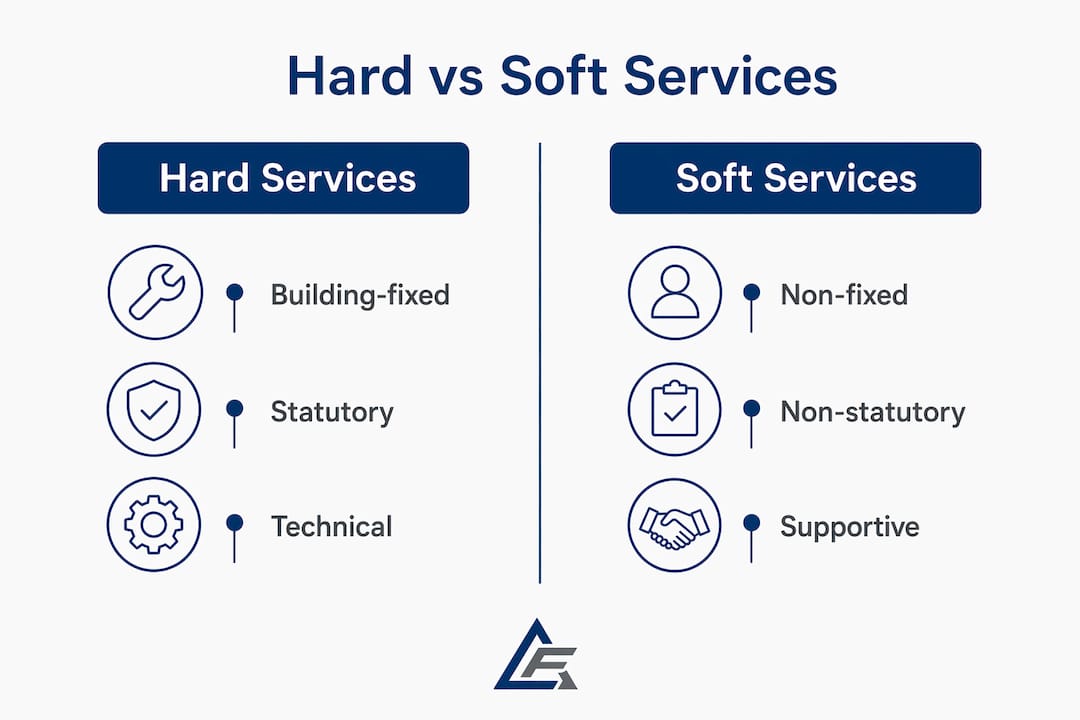
Hard services in facilities management are the technical, building-fixed disciplines that keep a structure safe, operational, and legally compliant. Unlike soft services, which cover people-focused functions such as cleaning or security, hard services are physically integrated into the building fabric and are typically mandatory under UK health and safety law. The core categories include:
- HVAC (heating, ventilation, and air conditioning)
- Electrical systems and lighting
- Gas, plumbing, and heating
- Fire detection and suppression systems
- Lifts and vertical transport
- Building fabric and roofing
- Mechanical plant and drainage
Why does this matter? Failures in any of these systems create immediate safety and compliance risk, not merely inconvenience. The Health and Safety Executive and gov.uk guidance both treat hard services as a statutory responsibility, and the Gas Safe Register governs who may legally work on gas installations. Getting this right protects occupants, preserves asset value, and keeps your building on the right side of the law.
What makes a service ‘hard’ — and how does it differ from soft services?
Hard services are defined by four characteristics: they are fixed to the building fabric, they require specialist technical skills, they are subject to statutory inspection, and their failure carries direct safety or legal consequences. Soft services differ because they are focused on people-facing or operational functions within the building, are not integral to the building structure, and are typically subject to less strict regulation — a useful distinction when allocating budgets and assigning duty holders.
The table below contrasts the two service types across the dimensions that matter most in procurement and compliance planning.
| Characteristic | Hard services | Soft services |
|---|---|---|
| Attachment to building fabric | Fixed and integral | Delivered within the building, not fixed to it |
| Legal / statutory requirement | Usually mandatory (EICR, gas safety, LOLER) | Rarely statutory; often contractual |
| Technical skill required | Specialist engineers, certified trades | Operationally skilled staff |
| Failure consequence | Safety risk, legal liability | Service disruption, reputational impact |
| Typical contract type | Long-term PPM or specialist SLA | Operational service contract |
The gov.uk facilities management standard frames hard services around three priorities: operational availability, statutory compliance, and preventing asset deterioration. That framing is worth keeping front of mind when you are deciding how much of your maintenance budget to allocate reactively versus preventatively. Facilities management is broadly classified into hard services, soft services, asset and space management, and sustainability responsibilities. Thus, hard services sit at the foundation of the entire estate management picture.
The main hard-service categories — with UK compliance notes
Every facilities manager needs a working checklist of the disciplines they are responsible for. The categories below cover the full scope of hard FM, with typical tasks and the statutory or standards framework that governs each one.
HVAC
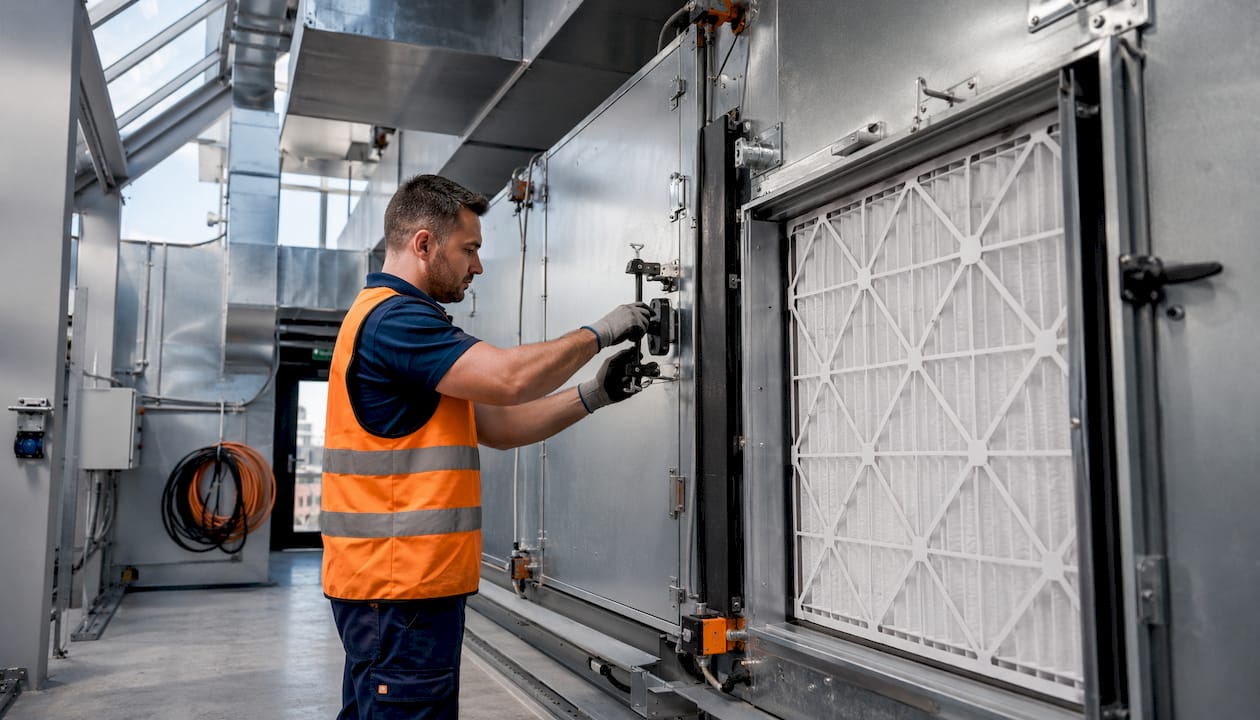
Typical tasks include servicing air-handling units, replacing filters, balancing ductwork, and commissioning seasonal changeovers. Compliance sits under the Health and Safety at Work etc. Act 1974 and the Workplace (Health, Safety and Welfare) Regulations 1992, which require adequate ventilation. F-Gas regulations govern refrigerant handling. Delta First delivers HVAC maintenance and installation across commercial, healthcare, and education estates.
Electrical systems and lighting
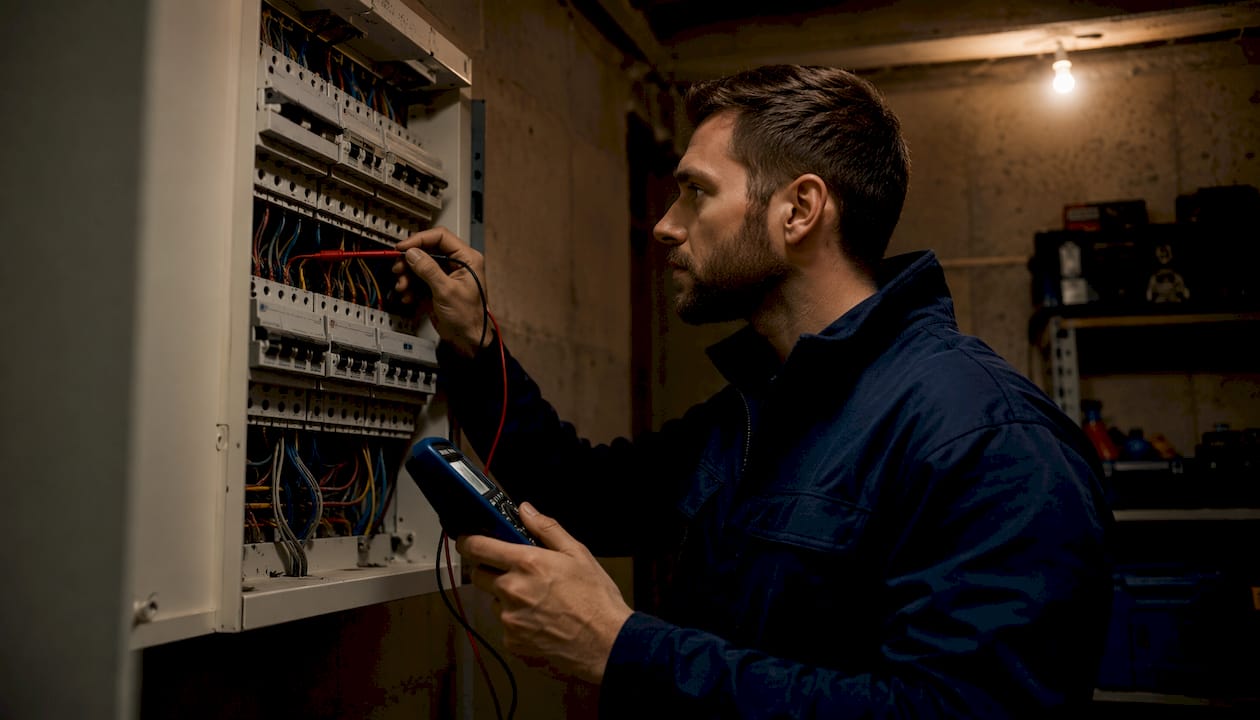
Tasks cover periodic inspection and testing, fault-finding, distribution board maintenance, and emergency lighting checks. The statutory benchmark is the Electrical Installation Condition Report (EICR), required at least every five years for most commercial premises under BS 7671. Delta First’s qualified electricians carry out EICR testing and remedial works.
Gas, plumbing, and heating
Boiler servicing, gas safety inspections, pressure testing, and pipework repairs are the core tasks. All gas work must be carried out by a Gas Safe Register-registered engineer — this is a legal requirement, not a preference. Annual gas safety certificates are mandatory for most commercial premises. Delta First arranges gas work through Gas Safe registered specialist subcontractors.
Fire detection and suppression
Annual servicing of fire alarm panels, weekly call-point testing, six-monthly extinguisher inspections, and sprinkler system checks are standard. The governing standard is BS 5839 for fire detection and alarm systems. BAFE accreditation is the recognised quality mark for fire protection contractors. Delta First supports fire system maintenance as part of its mechanical and compliance services.
Lifts and vertical transport
Thorough examinations are required at least every six months under the Lifting Operations and Lifting Equipment Regulations (LOLER), with records retained and available for inspection. The MHRA also governs certain patient-handling equipment in healthcare settings. Lift maintenance contracts should specify response times and examination frequency.
Building fabric and roofing
Planned inspections of the building envelope, roof drainage, guttering, external cladding, and structural elements prevent water ingress and deterioration. While not always governed by a single statutory test, fabric maintenance underpins compliance with Building Regulations and the Landlord and Tenant Act 1985 for commercial leases. Delta First provides building fabric maintenance and refurbishment services.
Mechanical plant and M&E systems
Chiller servicing, pressurisation unit checks, pump maintenance, and BMS (building management system) calibration keep mechanical plant running efficiently. Poorly maintained plant is one of the leading causes of unplanned downtime in commercial buildings.
Drainage and water safety (including legionella control)
Drainage inspections, CCTV surveys, and descaling are routine tasks. Legionella risk assessments and water temperature monitoring are required under the Health and Safety Executive’s Approved Code of Practice L8, which covers the control of legionella bacteria in water systems. Records of monitoring and remedial actions must be retained.
Specialist systems: boilers and chillers
Large commercial boilers require annual service and periodic pressure vessel inspection under the Pressure Systems Safety Regulations 2000. Chillers need refrigerant leak checks and efficiency testing. Both asset types benefit from condition-based monitoring to catch deterioration before it becomes a failure.
Why PPM and statutory inspections are non-negotiable
Planned preventative maintenance (PPM) is a scheduled programme of inspections, servicing, and testing carried out before a fault occurs, rather than in response to one. The contrast with reactive maintenance is significant: reactive repairs typically cost more per incident, create unplanned downtime, and — critically — do not discharge your statutory duty to maintain safe systems. Moving from reactive repairs to a structured PPM regime is consistently recommended to preserve asset value and reduce emergency call-outs.
The statutory inspections you must hold on file include:
Electrical Installation Condition Reports (EICR): Required at least every five years for commercial premises; more frequently for high-risk environments such as schools and healthcare. The report must be carried out by a qualified, competent electrician.
Gas safety certificates: Annual inspection by a Gas Safe registered engineer is a legal requirement. Certificates must be retained and made available to the relevant authority on request.
Fire alarm and extinguisher testing: Weekly call-point tests, six-monthly extinguisher inspections, and annual full-system service under BS 5839. BAFE-accredited contractors provide the recognised standard of competence.
LOLER examinations for lifts: Thorough examination every six months (or three months for passenger-carrying equipment in some cases), with written reports retained. Failure to hold current LOLER records is a prosecutable offence under the Health and Safety at Work etc. Act 1974.
Legionella monitoring records: Temperature logs, risk assessment reviews, and remedial action records under HSE ACoP L8.
For record-keeping, maintain an asset register, a certificate file (physical or digital), a service history log, and test records for each system. A computerised maintenance management system (CMMS) makes audit preparation significantly faster and reduces the risk of a certificate being mislaid.
Pro Tip: Store scanned certificates directly against the relevant asset in your CMMS, not in a shared folder. When an auditor or insurer asks for the EICR for a specific distribution board, you can retrieve it in seconds rather than searching through filing cabinets.
Key performance indicators worth tracking include your planned-to-reactive maintenance ratio (aim for at least 80% planned), mean time to repair (MTTR) for critical systems, and your compliance pass rate on statutory inspections. These three metrics give a clear picture of whether your PPM programme is working.
How to assess your estate’s needs and build a PPM priority matrix
A facilities needs assessment is the starting point for any credible PPM programme. Without one, you are setting inspection frequencies based on guesswork rather than actual asset condition and risk. The stepwise approach below gives you a practical framework.
Step 1 — Survey your assets. Walk every plant room, roof, and electrical intake. Record each asset: type, age, condition, and last service date. A validated asset register is the foundation for everything that follows.
Step 2 — Risk-assess by safety and business criticality. For each asset, ask two questions: what is the safety consequence of failure, and what is the operational consequence? These two dimensions form the axes of your priority matrix.
Step 3 — Map statutory obligations. Overlay the legal inspection requirements (EICR, gas safety, LOLER, ACoP L8) onto your asset list. Statutory items are non-negotiable; they set your minimum inspection cadence regardless of condition.
Step 4 — Set inspection frequencies. Use the matrix below to assign PPM cadence. Safety-critical assets with high operational impact get the most frequent attention; low-risk, low-impact assets can be inspected less often.
| Safety impact | Operational criticality | Recommended PPM cadence |
|---|---|---|
| High | High | Monthly or quarterly; statutory minimum as floor |
| High | Low | Statutory minimum; condition-monitored |
| Low | High | Quarterly or biannual; reactive cover in place |
| Low | Low | Annual inspection; reactive as needed |
Step 5 — Assign ownership. Every asset needs a named duty holder and a named contractor. Ambiguity about who is responsible for a system is one of the most common causes of missed inspections.
When briefing a contractor during the assessment phase, ask to see a sample PPM schedule for a comparable site, evidence of relevant accreditations, and their process for issuing certificates and updating your asset register. A contractor who cannot produce these promptly is a risk, not a resource.
In-house team, specialist contractor, or managed service — which model fits your estate?
The right delivery model depends on the size and complexity of your estate, your internal technical capacity, and your risk appetite. Each model has a natural fit.
In-house teams suit large, complex estates — NHS trusts, universities, or major local authorities — where the volume of work justifies directly employed engineers and the organisation has the management infrastructure to supervise them. The risk is that in-house teams can develop blind spots; independent audit is still advisable.
Specialist contractors work well for single-discipline requirements or smaller estates where the volume does not justify a full-time engineer. You engage a Gas Safe registered firm for gas, a competent electrical contractor for electrical work, and a third-party certificated firm for fire. The challenge is coordination: multiple contractors mean multiple schedules, multiple certificate formats, and multiple points of accountability.
Managed service providers offer a single point of accountability across all hard-service disciplines, typically under a long-term PPM contract. This model suits commercial property owners, multi-site retail or hospitality operators, and estates teams that want to consolidate supplier relationships and reporting. Delta First operates as a managed service partner across electrical, mechanical, HVAC, and building fabric disciplines.
When procuring any hard-service contractor, require evidence of the following credentials:
- Gas Safe Register registration for all gas engineers
- Qualified, competent electricians working to BS 7671 for electrical work
- BAFE accreditation for fire protection services
- A recognised SSIP health and safety pre-qualification
- Public liability and employers’ liability insurance certificates
- Evidence of a CMMS or equivalent digital record-keeping system
Red flags to watch for: vague PPM schedules with no asset-level detail, reluctance to provide references from comparable sites, no clear process for issuing statutory certificates, and gaps in insurance documentation. Any contractor who cannot answer your procurement questions clearly and promptly is telling you something important about how they will perform once the contract is signed.
Practical questions to put to bidders: What are your emergency response SLAs? How do you notify us when a statutory inspection is due? In what format will you provide certificates and service records? Can you integrate with our CMMS? Who is our named account manager?
Key takeaways
Hard services are the statutory backbone of any building: neglecting them creates immediate legal and safety risk, while a well-structured PPM programme protects assets, reduces emergency costs, and keeps your compliance records audit-ready.
| Point | Details |
|---|---|
| Hard services defined | Technical, building-fixed disciplines — HVAC, electrical, gas, fire, lifts, fabric — that are usually legally mandatory. |
| Highest-priority categories | Electrical (EICR), gas (Gas Safe certificate), fire systems (BS 5839), and lifts (LOLER) carry the greatest statutory weight. |
| PPM over reactive | A planned maintenance programme reduces emergency call-outs, preserves asset value, and discharges your statutory duty of care. |
| Records and certificates | Retain EICR, gas safety certificates, LOLER reports, and fire system test logs; store them against individual assets in a CMMS. |
| Contractor must-haves | Require evidence of competence and the right certification for each trade, plus clear PPM schedules and a digital record-keeping process. |
| Delta First’s role | Delta First delivers PPM, compliance, and hard-service maintenance across electrical, mechanical, HVAC, and building fabric for estates across Essex, Suffolk, Norfolk, and Greater London. |
Hard services demand more rigour than most estates give them
There is a persistent gap between how facilities managers think about hard services and how they actually manage them. Most estates have the certificates. Fewer have a genuinely validated asset register. Fewer still have a PPM schedule that was built from a real condition survey rather than inherited from the previous contractor and never questioned.
The consequence is predictable: inspections happen on a calendar rather than a risk basis, assets age faster than they should, and the first sign of a problem is an emergency call-out rather than a planned intervention. The gov.uk standard is clear that hard services should deliver operational availability and prevent asset deterioration, not simply tick a compliance box once a year.
What actually works is starting with the asset register. Not the one in the filing cabinet from 2019, but a current, surveyed register with condition ratings and last-service dates. From that foundation, a priority matrix becomes meaningful, PPM frequencies become defensible, and contractor briefs become specific enough to hold suppliers accountable. Digital tools, particularly a CMMS with certificates stored against individual assets, close the audit gap that catches estates teams out during inspections.
The other underestimated factor is contractor competence verification. Outsourcing a statutory duty does not transfer the legal responsibility. You remain the duty holder. That means checking accreditations at contract renewal, not just at procurement, and reviewing certificate quality rather than simply filing it. Registration and qualifications are the floor, not the ceiling, of what you should be asking for.
Delta First: your hard-services maintenance partner
Keeping a building compliant across every hard-service discipline is a significant undertaking, and the cost of getting it wrong — enforcement action, insurance disputes, unplanned downtime — far exceeds the cost of a well-structured PPM contract. Delta First gives estates teams, property managers, and building owners a single accountable partner for electrical, mechanical, HVAC, and building fabric maintenance, with qualified engineers, certified trades, and a clear process for issuing and retaining statutory certificates.
We serve commercial offices, NHS estates, schools, retail, hospitality, and industrial facilities across Essex, Suffolk, Norfolk, and Greater London. Whether you need a full planned maintenance programme or a compliance audit to identify gaps in your current arrangements, our team can carry out an asset survey and produce a costed PPM schedule tailored to your estate. For a clear picture of the technical terms used across our services, the building services glossary is a useful starting point before you get in touch. Contact Delta First to request a planned maintenance survey or quotation.
Useful UK sources and standards
These primary references give you the statutory detail and technical rules behind the hard-service categories covered above.
- Health and Safety Executive — ACoP L8: The approved code of practice for legionella control in water systems; sets out the legal duty for risk assessment, monitoring, and record-keeping.
- Health and Safety Executive: The primary UK regulator for workplace health and safety; publishes guidance on electrical safety, gas safety, LOLER, and the Health and Safety at Work etc. Act 1974.
- gov.uk Facilities Management Standard 001: The government’s own standard for facilities management across public-sector property; covers hard services, PPM, compliance, and sustainability obligations.
- Gas Safe Register (gassaferegister.co.uk): The official registration body for gas engineers in the UK; use it to verify any contractor’s registration before work begins.
- BAFE (bafe.org.uk): The independent registration body for fire protection companies; BAFE SP203-1 is the recognised scheme for fire detection and alarm system maintenance.
- BS 5839 (BSI): The British Standard for fire detection and alarm systems in buildings; sets design, installation, commissioning, and maintenance requirements.
- BS 7671 (IET Wiring Regulations): The national standard for electrical installations; the basis for EICR testing and all electrical compliance work in the UK.
- CIBSE (cibse.org): The Chartered Institution of Building Services Engineers; publishes technical guidance on HVAC, energy, and building services design and maintenance.
Recommended
- Integrated facilities management: a practical guide for UK businesses – Commercial Building Services Insights
- Building Services for Industrial & Logistics | Delta First Building Services
Need a reliable maintenance and compliance partner? Delta First provides planned preventive maintenance, statutory compliance support and reactive repairs from one accountable contractor across Essex, Suffolk and London, with 24/7 emergency cover. Call 01206 237422 or request a quote.
Talk to Delta First
Delta First Building Services is a Colchester-based M&E contractor working across Essex, Suffolk and London, with commercial work in Norfolk. Our directly employed electrical team is supported by vetted specialist subcontractors where extra certification is needed, and we offer genuine 24/7 emergency cover. Get in touch to arrange a survey or quote.