

Under UK law, Regulation 6 of the Workplace (Health, Safety and Welfare) Regulations 1992 requires employers to provide every enclosed workplace with a sufficient supply of fresh or purified air. Facilities managers should assess current airflow against HSE benchmarks, monitor CO2 levels where occupancy is steady, and act where readings or commissioning records show a shortfall. Evidence of that process, not just the equipment, is what inspectors expect to see.
TL;DR:
- Ensuring ventilation measurements meet the 5 to 10 liters per second per person benchmark is essential, with CO2 levels above 1,500ppm indicating urgent action.
- Proper commissioning, documented checks, and routine maintenance of ventilation systems are critical for compliance and must be retained for at least five years.
- Common issues like blocked vents or closed windows can cause poor airflow, and simple fixes like increasing fresh-air intake or cleaning grilles can improve indoor air quality quickly.
- Local exhaust ventilation systems must undergo thorough testing every 14 months, with detailed records to demonstrate ongoing performance against original design specifications.
- Conducting regular site audits and creating a prioritized action plan helps identify risks early, ensuring quick repairs and maintaining legal ventilation standards.
Table of Contents
- What the law and primary regulators require
- Ventilation benchmarks every facilities manager should track
- Local exhaust ventilation: legal duties, commissioning and testing
- Commissioning, documentation and ongoing maintenance obligations
- Auditing and monitoring ventilation across your building
- Fixing poor ventilation: quick wins and longer-term upgrades
- Delta First’s perspective on supporting compliance
- Book a ventilation compliance survey with Delta First
- Sources
- FAQ
What the law and primary regulators require
Regulation 6 places a clear duty on employers: every enclosed workplace must be ventilated by a sufficient quantity of fresh or purified air. The regulation also requires that any mechanical ventilation system includes a device to indicate failure, where that failure would pose a risk to health. It does not specify exact airflow figures, which is why HSE guidance and supporting standards fill in the practical detail.
Where a workplace generates dust, fumes or other hazardous substances, the Control of Substances Hazardous to Health (COSHH) Regulations interact directly with this duty. COSHH requires employers to control exposure to hazardous substances, and local exhaust ventilation (LEV) is frequently the control measure specified to meet that requirement. The Health and Safety at Work etc. Act 1974 sits above both, setting the general duty of care that Regulation 6 and COSHH help to discharge.
For new installations, alterations or significant refurbishments, Approved Document F provides the design guidance that supports Part F of the Building Regulations. It becomes relevant whenever building work affects how a space is ventilated, including many fit-out and refurbishment projects.
Together, these sources form a layered framework:
- Regulation 6 sets the underlying legal duty for fresh or purified air in enclosed workplaces.
- COSHH governs ventilation as a control measure wherever hazardous substances are present.
- Approved Document F governs ventilation design at the point of construction or refurbishment.
- The HSW Act provides the general duty of care that ties the other three together.
Our related guide on workplace air quality compliance sets out these duties in more detail for managers building a compliance file from scratch.
Ventilation benchmarks every facilities manager should track
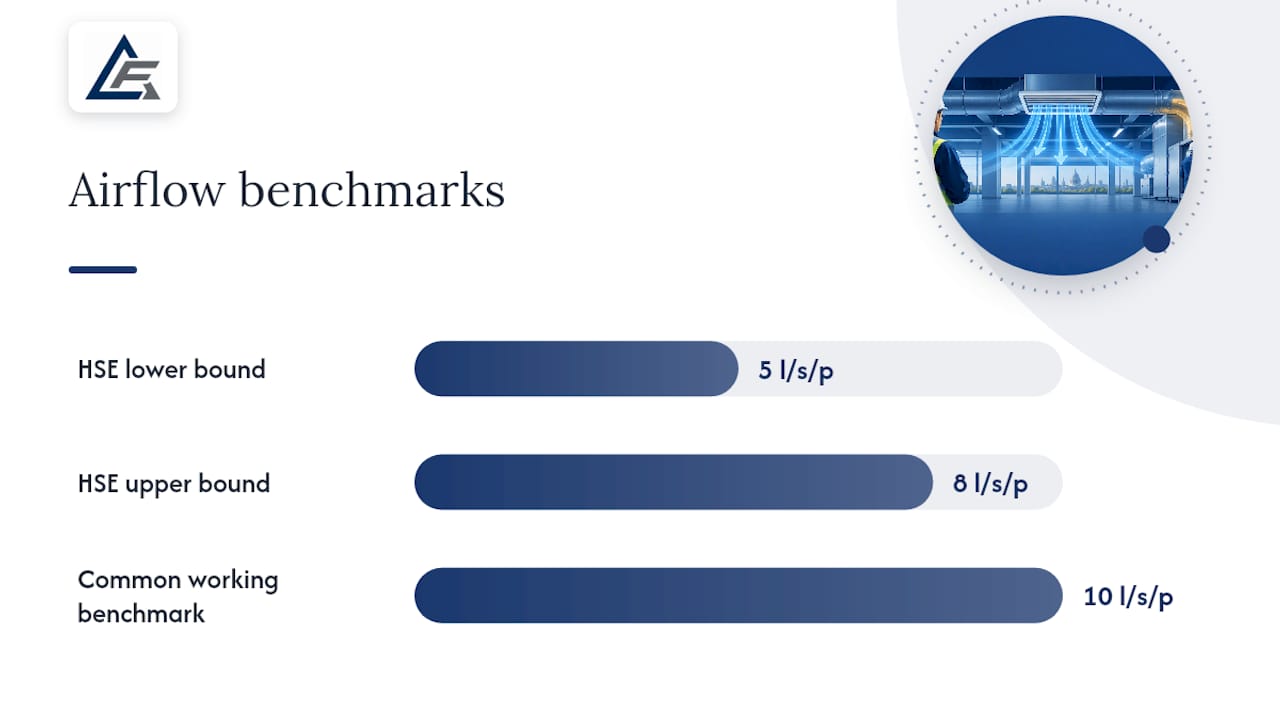
HSE guidance on assessing the risk of poor ventilation recommends fresh-air supply rates normally not below 5 to 8 litres per second per person, with 10 litres per second per person commonly used as a working benchmark for many commercial buildings. These figures give facilities teams a concrete target rather than a vague sense of “stuffy” or “fine.”
CO2 monitoring offers a practical proxy for airflow where direct measurement is impractical. HSE guidance on using CO2 monitors notes that a reading of around 1,000ppm corresponds roughly to 10 litres per second per person, while sustained readings above 1,500ppm indicate poor ventilation that needs corrective action.
CO2 monitors work best in occupied spaces with steady occupancy patterns, such as offices and classrooms. They become less reliable where air purifiers are running, where a process itself emits CO2, or where occupancy swings sharply through the day. A single high reading is less useful than a trend across a working week.
| Indicator | Benchmark | What it signals |
|---|---|---|
| Fresh-air supply rate | 5 to 8 l/s/p minimum guidance | Baseline HSE guidance for most occupied spaces |
| Common working benchmark | 10 l/s/p | Frequently used target for commercial buildings |
| CO2 reading | Around 1,000ppm | Roughly equivalent to 10 l/s/p |
| CO2 reading | Above 1,500ppm | Indicates poor ventilation requiring action |
Pro Tip: Log CO2 readings at the same time each day for at least a week before drawing conclusions: a single spike after a packed meeting tells you far less than a pattern.
Local exhaust ventilation: legal duties, commissioning and testing
Where COSHH identifies airborne hazards, local exhaust ventilation (LEV) often becomes the specified control measure, and the employer carries responsibility for ensuring the system is correctly specified and maintained. HSE’s LEV commissioning guidance sets out what that means in practice.
A properly commissioned system produces three documents that form the compliance baseline for everything that follows:
- A commissioning report, recording design airflows, test points and baseline performance.
- A user manual, explaining correct operation and the checks operators should carry out.
- A logbook, capturing routine checks, maintenance and test results over the system’s life.
Most LEV systems require a thorough examination and test, known as TExT, by a competent person at least once every 14 months, with the examiner testing performance against the original commissioning report (HSE). Records of checks, maintenance and tests must be kept for at least five years. If a system fails its TExT, that failure label is not a formality: it means the control measure cannot be relied on until it is repaired and retested, and continuing to use the process without an alternative control is a compliance gap.
Commissioning, documentation and ongoing maintenance obligations
Commissioning is the reference point every later inspection is measured against. Without it, there is no baseline to test performance against, no way to prove the system ever met its design specification, and no defensible answer when an inspector asks how airflow is verified. Where commissioning data is missing or has been lost, recommissioning is usually the only practical route back to a compliant position.
A working ventilation logbook typically needs to capture:
- Routine checks, dated and signed, showing the system is being monitored between formal tests.
- Maintenance visits, including parts replaced and any performance issues noted.
- TExT results, filed alongside the original commissioning report for comparison.
- Corrective actions, recording what was done in response to any failure or low reading.
- Retention for five years, matching the statutory minimum for LEV test and repair records.
Planned preventative maintenance (PPM) contracts should reference recognised standards, such as SFG20 for building maintenance scheduling or TR19 where ductwork cleanliness applies, so that contract deliverables map cleanly onto what an inspector or auditor will ask to see. Our mechanical services compliance guide covers how to structure that documentation for a wider range of building systems.
Pro Tip: Store commissioning reports, user manuals and logbooks together in one file, physical or digital: scattered records are the single most common reason a compliant system still fails an audit.
Auditing and monitoring ventilation across your building
A short walk-round audit catches many of the common failures before they show up in a CO2 reading. Look for:
- Passive vents painted shut during redecoration, a frequent and easily missed fault.
- Furniture or partitions blocking grilles, especially after office reconfigurations.
- Meeting rooms with high occupancy and long sessions, where CO2 builds fastest.
- Extract fans or grilles showing visible dust build-up or reduced airflow.
- Recent refurbishment changes that altered airflow paths without updating ventilation design.
For ongoing monitoring, NDIR (non-dispersive infrared) CO2 monitors are the type generally recommended, placed at head height away from doors, windows and supply vents where readings can be skewed. A simple sampling routine, checking readings at similar points in the day across a working week, gives a far more reliable picture than a single spot check.
Where an audit or monitoring trend points to a persistent problem, particularly one linked to a hazardous process, escalate to a competent ventilation engineer or occupational hygienist. Ask them to deliver a written report with measured airflows, a comparison against design specification, and a prioritised list of remedial actions rather than a verbal opinion. A useful workplace-wellness reference covering occupancy management alongside monitoring is this workspace wellness checklist for UK offices.
Fixing poor ventilation: quick wins and longer-term upgrades
Some interventions cost nothing and can be actioned the same day. Others need budget, planning and a contractor.
- Open windows and unblock vents wherever practical, and remove furniture or stock obstructing grilles.
- Manage occupancy and meeting length in smaller rooms until mechanical improvements are in place.
- Increase fresh-air intake on existing HVAC plant, where the system has the capacity to do so.
- Recommission ageing HVAC systems that have drifted from their original design performance.
- Consider heat-recovery ventilation for spaces needing higher fresh-air rates without a heating penalty.
HSE’s examples of improving ventilation note that many poor-ventilation cases trace back to simple causes such as painted-over vents or windows kept permanently closed, fixable while longer-term works are scoped and priced.
When procuring remedial work or an upgrade, ask any contractor to confirm three things before work starts: the commissioning deliverables they will hand over, the competencies of the engineers carrying out the work, and how the ongoing PPM scope will tie into the statutory TExT cycle. A written action plan, with dates and named responsibilities, turns a good intention into something an inspector can actually verify.
Pro Tip: Prioritise fixes by risk, not cost: a blocked grille in a busy meeting room deserves attention before a marginal airflow shortfall in a rarely used storeroom.
Delta First’s perspective on supporting compliance
A regional building services partner earns its place by turning these obligations into a manageable routine rather than a recurring headache. That typically means a site survey covering CO2 snapshots and a review of existing commissioning records, remedial commissioning where documentation has gone missing, logbook creation where none exists, and a written action plan ranking issues by risk.
A properly scoped survey should leave you with clear next steps and dated priorities, not just a list of problems. A regional building services partner with regionally deployed engineers can support faster response when a ventilation issue needs attention on site rather than in a report.
— Ashley
Book a ventilation compliance survey with Delta First

If your ventilation records are incomplete, or you simply want a clear picture of where your building stands against HSE benchmarks, a building services contractor can carry out a site survey covering a CO2 snapshot, a review of existing commissioning documentation, and a prioritised list of actions with a written quotation. When teams working under one accountable structure manage electrical, mechanical, HVAC and building fabric services, a ventilation issue that turns out to need electrical or mechanical follow-up does not mean starting again with a second contractor.
This kind of survey sits naturally alongside a planned preventative maintenance contract, giving scheduled checks between statutory tests rather than relying on a single annual visit to catch problems. Visit our planned preventative maintenance page to request a PPM quotation, or head to Delta First to book a site survey and get your ventilation compliance file in order.
Sources
- The Workplace (Health, Safety and Welfare) Regulations 1992 — Regulation 6
- Assessing the risk of poor ventilation — HSE
- Gov
FAQ
What are the legal requirements for workplace ventilation in the UK?
Regulation 6 of the Workplace (Health, Safety and Welfare) Regulations 1992 requires every enclosed workplace to be ventilated by a sufficient supply of fresh or purified air. Where hazardous substances are present, COSHH may also require specific controls such as local exhaust ventilation.
What are the British standards for ventilation?
There is no single mandatory British Standard figure for workplace airflow, but HSE guidance recommends fresh-air rates normally not below 5 to 8 litres per second per person, with 10 litres per second per person as a common working benchmark. Approved Document F provides further design guidance for new work or refurbishments.
Is it illegal to have no ventilation?
Yes. Regulation 6 places a legal duty on employers to ensure every enclosed workplace has a sufficient supply of fresh or purified air, and failing to provide any ventilation would breach that duty.
What are the regulations regarding air quality at work in the UK?
Air quality duties come mainly from Regulation 6, which covers general fresh-air supply, and COSHH, which covers control of hazardous substances including through local exhaust ventilation. HSE guidance recommends CO2 monitoring as a practical indicator, treating sustained readings above 1,500ppm as a sign that ventilation needs improving.
How often must local exhaust ventilation be tested?
Most LEV systems require a thorough examination and test by a competent person at least once every 14 months, according to HSE guidance. Records of checks, maintenance and tests must be kept for at least five years.