

Repair makes sense when the unit is younger, the fault is isolated, and recent EPC or inspection records confirm the system is otherwise performing well. Everything below shows you how to apply that rule with real data rather than guesswork.
TL;DR:
- Repair is most advisable when the system is under 8 years old, has isolated faults, and recent inspections show good overall performance.
- When repair costs exceed 30 to 50% of full replacement, especially on older units, replacement generally offers better lifecycle value.
- Recurring faults within a year, rising energy bills, or refrigerant restrictions are strong signals that replacement will be more cost-effective long-term.
- Comparing repair and replacement quotes side by side, adjusting for age and conditions, helps avoid premature repairs or missed replacement opportunities.
- A comprehensive condition survey and detailed maintenance records are essential to make informed decisions and prevent emergency replacements at higher costs.
Quick decision checklist for HVAC replacement vs repair
Before commissioning any quote, triage the system against these factors. This is the same sequence that professional engineers typically work through on site before recommending a course of action.
- Age band: under 8 years, lean repair; 8 to 15 years, investigate further; beyond CIBSE’s rated life, lean replace.
- Repair cost ratio: if a single repair costs a substantial portion of a full replacement, replacement usually wins on lifecycle value.
- Repair frequency: three or more callouts for the same unit in 12 months signals a system in decline, not a one-off fault.
- Energy and comfort trends: rising bills or complaints despite servicing point to falling efficiency rather than a single fixable defect.
- Regulatory flags: obsolete or restricted refrigerant, missing parts, or an EPC report flagging poor performance all tip the balance toward replacement.
None of these factors is decisive alone. Together, they build a defensible case either way.
When repairing makes sense: what to require before you fix
Repair is the right call when the evidence supports it, not when it is simply the cheaper-looking option on paper. Before signing off on a repair, confirm the following:
- The fault is isolated. A failed capacitor, a seized fan motor, or a control fault is not the same risk category as compressor failure or refrigerant leaks across multiple circuits.
- The unit is still under manufacturer or extended warranty, which changes the economics entirely.
- Recent PPM visits and EPC or inspection reports show no pattern of declining performance. A planned preventative maintenance history with clean records is strong evidence the asset is otherwise healthy.
- The short-term running cost of keeping the existing unit is lower than the capital outlay for full replacement, once you account for likely downtime.
Where the casing and core components are sound but performance has slipped, staged component replacement, such as new controls, coils or a variable-speed drive, can restore capacity without the cost or disruption of a full swap.
Pro Tip: Ask your maintenance contractor for the unit’s fault history before agreeing to any repair. A clean 12-month log is worth more than any single technician’s opinion on the day.
When to replace: the common triggers and strategic reasons
Recurring faults on the same unit, paired with rising energy bills, are the clearest signal that repair has stopped being cost-effective. Frequent repair needs within a year usually indicate the system is declining rather than a one-off fault.
Refrigerant risk accelerates that calculation. Systems still running R22 or other restricted gases face a shrinking pool of parts and servicing options as F-gas phase-down rules tighten, and legacy refrigerant can become difficult or impossible to source at short notice. Waiting for a failure before acting on this risk almost always costs more than planning the replacement on your own timetable.
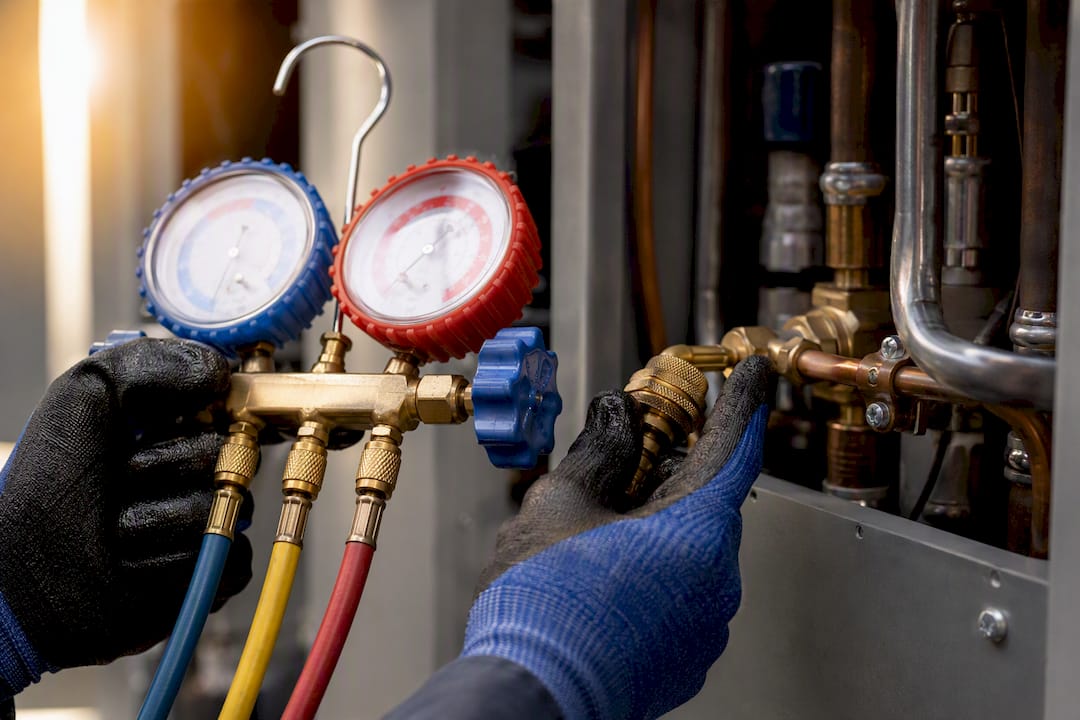
There is a hard efficiency case too. Modern chillers and VRF systems can cut running costs by 20 to 40% against older, inefficient plant, alongside lower maintenance overheads and full manufacturer warranty cover.
Other triggers worth weighing:
- Capacity that no longer matches occupancy or equipment loads, particularly after a fit-out or change of use
- Persistent occupant comfort complaints despite routine servicing
- Physical access or space constraints that make future repairs progressively harder
- Programme timing: aligning replacement with a planned shutdown or refurbishment reduces disruption cost
Rising bills and repeated faults rarely appear in isolation. When they do, they are usually telling you the same thing from two different directions.
How to compare repair cost versus replacement value
A useful starting point, borrowed from wider HVAC industry practice, is to convert any repair quote into a percentage of full replacement cost rather than judging it in isolation. A repair priced at £4,000 sounds manageable until you learn that replacement would cost £9,000, at which point that single repair is consuming close to half the value of a new system.
- Take the repair quote and divide it by the estimated full replacement cost to get a percentage.
- Treat anything above roughly 30 to 50% as a strong signal to replace, adjusted for the unit’s age and remaining life.
- Check the unit’s age against CIBSE Guide M’s reference service life for that equipment type.
- Apply CIBSE’s variation factors, covering maintenance regime, operating hours and environment, to adjust that reference life up or down for your specific site.
- Where the numbers are close, or the estate includes multiple ageing units, commission a formal whole-life cost model rather than relying on rules of thumb alone.
Two visually identical air handling units can carry very different remaining lives once maintenance history and operating hours are factored in through the CIBSE life-expectancy tool. That is precisely why age alone is a weak basis for the decision.
Regulatory and refrigerant risks that change the economics
UK regulations require commercial air conditioning systems above a certain capacity to be inspected by an accredited energy assessor every five years, and those reports carry real weight in a repair-or-replace decision.
- Inspection reports include performance benchmarks and recommended improvements that document decline over successive cycles.
- Non-compliance with inspection requirements can lead to penalties, so missing or outdated reports are themselves a risk flag.
- Legacy refrigerants face shrinking parts availability and rising servicing costs as phase-down rules tighten, closing the repair window faster than plant condition alone would suggest.
- Any new refrigerant charge must meet current safety standards under EN378, which can add unexpected scope to what looked like a simple repair.
Successive EPC reports showing the same recommended actions, cycle after cycle, are one of the strongest indicators that repair spend is being poured into a system with a limited future.
A practical step-by-step decision process
- Pull together the asset register, PPM logs, EPC or inspection reports, and 12 to 24 months of energy bills for the unit in question.
- Commission a scoped condition survey and request two priced options: a repair scope and a full replacement scope, so you are comparing like for like.
- Apply CIBSE’s variation factors and the percent-of-replacement rule to both quotes to see which represents better lifecycle value.
- Plan procurement and programme around the decision, including phasing, temporary cooling or heating provision, and clear communication with tenants or occupants during works.
- Where the numbers are marginal or the estate has several ageing units, bring in a specialist contractor for a full survey before committing budget either way.
Pro Tip: Request quotes for repair and replacement at the same time, from the same site visit. Comparing them side by side, rather than sequentially, avoids the trap of committing to a repair before you have seen the real cost of the alternative.
This is also the point where a mechanical services compliance review or a scoped air conditioning consultation earns its cost. A qualified assessor’s report, of the kind referenced in independent guidance on EPC inspections, also gives you a defensible paper trail if procurement or finance teams query the spend later.
Delta First perspective: how we advise clients and pitfalls to avoid
We build our recommendations on PPM history, EPC data and CIBSE life-expectancy figures together, never on age or gut feel alone. The most common mistake we see is deferring a decision until a unit fails outright, which forces emergency procurement at premium cost and long lead times for parts. The second is ignoring refrigerant risk until it becomes a live problem. One estate we advised had been repairing the same ageing units annually for several years; once the numbers were laid out against CIBSE variation factors, replacement paid for itself through avoided callouts and lower running costs within a few seasons.
— Ashley
How Delta First can help with your HVAC decision
Deciding between repair and replacement is far easier with proper evidence in hand, and that is exactly what a Delta First survey gives you. As a specialist commercial building services contractor across Essex, Suffolk and Norfolk and Greater London, Delta First combines PPM records, condition surveys and lifecycle costing to give facilities managers a clear, evidence-led answer rather than a guess.

A typical site survey covers a full condition assessment of your existing plant, a review of PPM and inspection history, and two priced options so you can compare repair against replacement on equal terms. Engineering teams commonly cover mechanical and HVAC servicing, electrical works, and building fabric projects, meaning the same team can deliver whichever route the evidence supports, without handing the project to a second contractor.
If your estate includes ageing plant, recurring faults, or refrigerant nearing the end of its regulatory life, request a planned maintenance survey and quotation from Delta First and get a data-backed recommendation before your next budget cycle closes.
Need support with mechanical or HVAC maintenance? Delta First delivers planned and reactive mechanical maintenance across Essex, Suffolk and London, using certified specialist partners for gas and refrigerant work, with 24/7 emergency cover. Call 01206 237422 or request a quote.
Sources
Recommended
- HVAC maintenance plan: protect your system and save money
- Summer HVAC maintenance: a guide for facilities managers
- Air conditioning consulting for facilities managers: UK guide
- UK chiller maintenance: PPM schedule that meets F‑Gas and Legionella
Talk to Delta First
Delta First Building Services is a Colchester-based M&E contractor working across Essex, Suffolk and London, with commercial work in Norfolk. Our directly employed electrical team is supported by vetted specialist subcontractors where extra certification is needed, and we offer genuine 24/7 emergency cover. Get in touch to arrange a survey or quote.