

HVAC commissioning proves that installed heating, ventilation and air-conditioning systems meet the design intent and deliver the performance the building actually needs. The immediate steps are straightforward: appoint a commissioning manager, insist on a written Commissioning Plan, and reserve dedicated programme time for testing, adjusting and balancing. These requirements sit within CIBSE, BSRIA and Building Regulations guidance, not optional extras.
TL;DR:
- Properly documenting test conditions at both minimum and maximum loads prevents false positives and ensures the system performs reliably across full seasonal cycles.
- Assigning a dedicated commissioning manager early in the project reduces defects, delays, and gaps in responsibility, especially for complex or integrated systems.
- Conducting functional testing with trend logs and BAS access at each stage verifies control sequences and helps catch faults before handover.
- Systems over 12 kW require inspections every five years under TM44, making thorough commissioning records essential for compliance and future inspections.
- Using a single team for installation, commissioning, and maintenance prevents documentation gaps and streamlines handover with consistent records and effective ongoing support.
Table of Contents
- Why the HVAC commissioning process matters for cost, comfort and compliance
- Standards, regulations and the documentation you must supply
- Who does what: roles across the commissioning team
- Step-by-step: the commissioning process from design to in-use
- Timeline and cost drivers you should plan for
- Common pitfalls and how to fix them quickly
- Delta First’s perspective on getting commissioning right
- Get your HVAC commissioning and handover supported by Delta First
- Sources
- FAQ
Why the HVAC commissioning process matters for cost, comfort and compliance
Skipping commissioning is one of the most expensive false economies in building management. Systems that are installed but never properly proven against design intent tend to run inefficiently for the life of the asset, because nobody checked whether the fans, pumps and controls were actually doing what the design promised.
A properly executed HVAC commissioning process delivers on several fronts at once:
- Energy and running costs: systems set to work against measured design intent avoid the silent waste of oversized pumps or fans running against closed dampers.
- Comfort and indoor air quality: verified airflow rates support occupant wellbeing and, increasingly, infection resilience in shared spaces like schools and healthcare settings.
- Fewer defects at handover: functional testing catches control faults and installation errors before occupants do.
- Stronger compliance position: signed-off records satisfy building control and give you an audit trail if a dispute arises later.
Buildings that skip proper commissioning don’t fail immediately. They just cost more, every single month, for years.
Standards, regulations and the documentation you must supply
UK commissioning practice is governed by a mix of statutory requirement and industry guidance, and knowing which is which matters when you’re negotiating a contract.
CIBSE Commissioning Code A (2024) sets out the setting-to-work, functional testing and regulation processes specifically for air distribution systems, while Commissioning Code M governs how the whole commissioning process should be managed, including early appointment of a commissioning manager and production of a Commissioning Plan. BSRIA BG 49/2024 supersedes earlier guidance and gives practical test methods, documentation templates and updated instrumentation advice for newer ventilation technologies.
On the legal side, Approved Document F requires mechanical ventilation systems to be commissioned using an approved procedure and includes Appendix C completion checklists you’ll need to produce. Building Regulations regulation 44 requires formal notice that fixed building services have been commissioned, with evidence available to building control on request.
Documents to produce at handover:
- Commissioning Plan and commissioning specification
- Completed test sheets and functional performance records
- Signed commissioning notice for building control
- O&M manuals and training records
Pro Tip: Systems over 12 kW also fall under TM44 inspection requirements, which mandate an inspection report every five years. Keep your commissioning records accessible, since inspectors will want to see the baseline your system was set against.
Who does what: roles across the commissioning team
Ambiguity over responsibility is where most commissioning programmes go wrong, so get the roles written into the contract before work starts.
- Commissioning manager (CxM): appointed at design stage, owns the Commissioning Plan, sets acceptance criteria and coordinates every trade touching the mechanical and electrical installation. CIBSE guidance is clear that appointing the CxM early reduces defects and handover delays significantly.
- Commissioning provider (CxP) / installing contractor: carries out setting to work, functional performance tests and testing, adjusting and balancing (TAB), then submits signed test sheets to the CxM.
- Client / building operator: reviews and accepts the handover pack, including signed records, O&M manuals and operator training, then formally takes on the running of the system.
Without a named CxM, these responsibilities have a habit of falling through the gaps between trades. Write the role into your tender documents, not just your snagging list.
Step-by-step: the commissioning process from design to in-use
The HVAC commissioning process runs across the whole project timeline, not just the final week before handover. Treat it as six connected phases.
- Design stage: run a commissionability review, agree the Commissioning Plan, define success criteria in measurable terms, and get commissioning wording written into the construction contract, not bolted on afterwards. Involving a structural or design coordination partner at this stage helps catch clashes between ductwork routes and access requirements before they’re built.
- Pre-commissioning and setting to work: factory acceptance testing, sampling inspections of installed plant, and confirming test points are physically accessible before insulation and ceilings go in.
- Functional performance testing: demonstrate that controls, interlocks and integrated systems (fire, BMS, life-safety interfaces) actually perform as specified, with results recorded against the acceptance criteria.
- Testing, adjusting and balancing (TAB): this is where most shortcuts happen. Insist on multi-condition tests, not a single reading taken on a mild afternoon.
- Handover: assemble signed test sheets, O&M manuals, training sessions and certificates, then obtain formal sign-off from both CxM and client.
- In-use commissioning: seasonal testing through a first heating and cooling season, fine-tuning of BAS setpoints, and ongoing verification rather than a one-off event.
Evidence to demand at each stage:
- Test sheets referencing BSRIA BG 49/2024 methodology
- Trend logs and BAS screenshots comparing design outside-air flows against measured values
- Signed acceptance criteria checklist per system
Pro Tip: Never accept TAB results from a single test condition. Multi-condition testing, comparing performance at minimum and maximum design loads with trend data to back it up, is the difference between a system that passes on paper and one that actually performs through a full season.
Timeline and cost drivers you should plan for
Commissioning duration scales with system complexity, not floor area. A straightforward retail unit with a single air handling unit might need a few days of setting to work and testing. A hospital wing with multiple AHUs, isolation rooms and integrated BMS controls can need several weeks of functional testing alone.
Cost drivers to budget for:
- System complexity: more plant, more controls and more integration points mean more test hours.
- Remedial works: defects found during functional testing often cost more to fix retrospectively than they would have during installation.
- Specialist instrumentation: airflow hoods, data loggers and calibrated test equipment add to day rates.
- Third-party testers: independent verification, sometimes required for larger or public-sector projects, adds cost but strengthens your compliance position.
Structure commissioning fees around staged milestones tied to acceptance criteria, ideally with a capped total cost, rather than an open-ended time-and-materials arrangement that has no incentive to finish.
Common pitfalls and how to fix them quickly
Most commissioning failures trace back to the same handful of causes, and most are avoidable with the right contract wording from the start.
Inaccessible test points are the single most frequent cause of incomplete commissioning. If ductwork was boxed in before a test port was fitted, insist on design-for-commissionability reviews at the drawing stage, not after the ceilings go up.
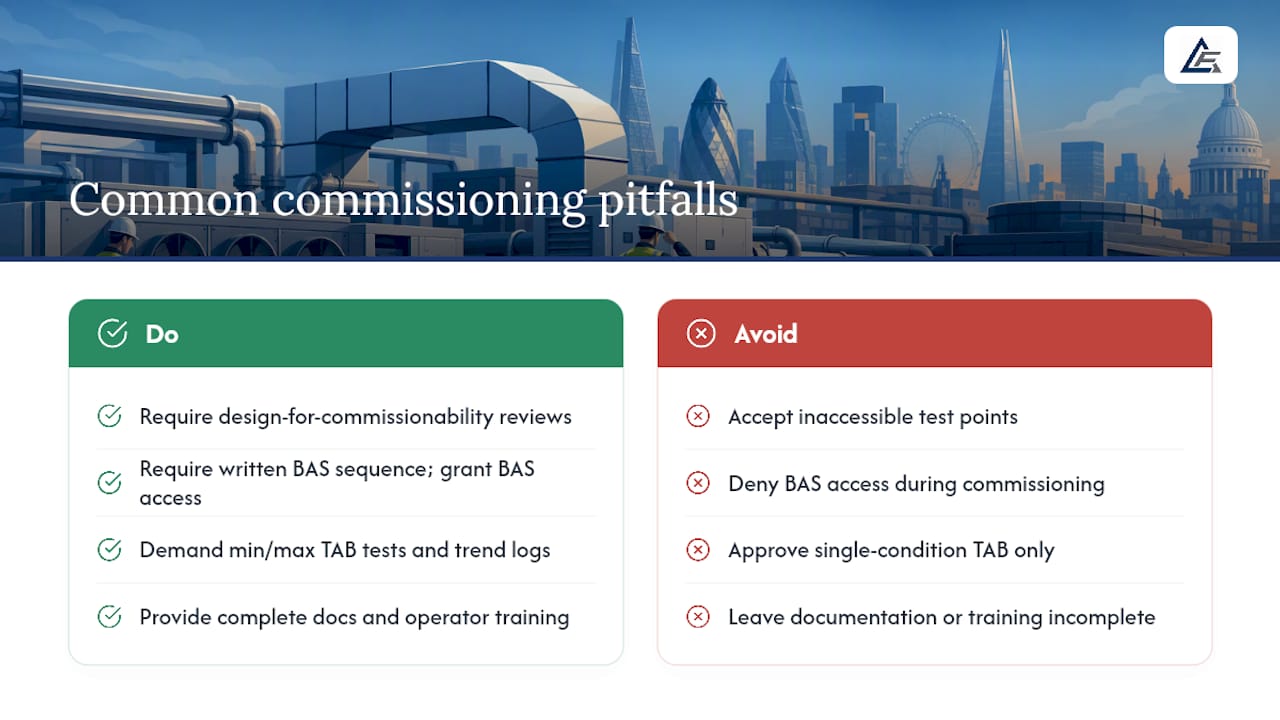
Missing or unimplemented control sequences stall functional testing entirely. Require the contractor to supply a written BAS sequence of operation and grant the commissioning team direct BAS access before testing begins.
Single-condition TAB is a common shortcut that leaves you with no evidence the system performs across its full operating range. Demand tests at both minimum and maximum design conditions, backed by trend logs.
Incomplete documentation or missing operator training leaves your team unable to run the system properly from day one.
Pro Tip: If a contractor resists giving you BAS access during commissioning, treat that as a warning sign, not a technicality. A system nobody can independently verify is a system nobody can be held accountable for.
Delta First’s perspective on getting commissioning right
Across HVAC installation, commissioning and maintenance work, projects that appoint a commissioning lead early and write test-point access into the contract tend to hand over with far fewer defects.
Our engineers recommend scheduling seasonal follow-up visits through the first heating and cooling cycle rather than treating handover as the finish line. For definitions of commissioning terms and roles, our building services glossary is a useful reference, alongside our guide to building an HVAC maintenance plan that protects the investment commissioning has just proven works.
— Ashley
Get your HVAC commissioning and handover supported by Delta First
A single accountable partner for the whole commissioning and handover picture, rather than separate trades working in isolation, is important. Where projects involve separate electrical, mechanical and controls contractors each commissioning their own scope, coordination gaps are where defects hide. Delivering HVAC installation, commissioning and maintenance alongside electrical and building fabric services through one team—with one set of compliance documentation and one point of contact—helps ensure consistency.

That matters at handover, when you need signed test sheets, O&M manuals and commissioning records that all reference the same acceptance criteria rather than three contractors’ worth of inconsistent paperwork. Delta First’s regionally deployed engineers across Essex, Suffolk, Norfolk and Greater London support both the commissioning phase and the planned preventative maintenance that keeps performance locked in afterwards, backed by 24/7 emergency cover for anything that can’t wait.
If you’re planning a new installation, a refurbishment, or need a compliance review of an existing system, request a quotation or planned maintenance survey from Delta First and get a commissioning programme that’s built to hold up under scrutiny.
Sources
- CCA Commissioning Code A: Air distribution systems (2024) — CIBSE
- Approved Document F: Ventilation (2026) — UK Government
- Gov
FAQ
What are the steps of the HVAC commissioning process?
The core phases are design review, pre-commissioning and setting to work, functional performance testing, testing, adjusting and balancing (TAB), handover, and in-use commissioning through the first seasonal cycle. Each phase should follow CIBSE Commissioning Code A requirements for air systems.
What is the process of commissioning an HVAC system?
Commissioning proves that an installed system meets its design intent, moving from factory acceptance testing through setting to work, functional testing and TAB, before formal handover with signed records. Building Regulations require formal notice that this process has been completed using an approved procedure.
How long does HVAC commissioning take?
Duration depends on system complexity rather than building size: a simple single-AHU installation may need only days of setting to work and testing, while a building with multiple integrated systems can require several weeks of functional testing. Seasonal in-use commissioning then continues through the first heating and cooling cycle.
Does Delta First provide HVAC commissioning services?
Yes, Delta First provides HVAC installation, commissioning and maintenance alongside electrical, mechanical and building fabric services for commercial, industrial, education and healthcare clients. Current pricing is available on request through the Delta First website.
What documents should I expect at HVAC handover?
At minimum, expect a signed Commissioning Plan, completed functional test sheets, TAB records showing multi-condition results, O&M manuals and evidence of operator training. These support the completion checklists required under Approved Document F Appendix C.