

An energy audit for buildings in the UK gives you a prioritised, costed action plan covering compliance and savings in one exercise. If your organisation meets the ESOS qualification threshold or operates air-conditioning systems over 12kW, an audit isn’t optional. The deliverables you should expect: a site survey, consumption analysis, a ranked list of measures, and payback estimates for each one.
TL;DR:
- Most UK buildings require a detailed energy audit for meeting ESOS obligations or preparing for capital improvements, which involves a detailed site survey and consumption analysis.
- Air-conditioning systems with a rated output above 12kW must be inspected every five years by an accredited assessor, with reports retained for enforcement requests.
- The most cost-effective savings often come from quick-payback measures like lighting controls or BMS upgrades, rather than large capital projects, with paybacks typically under three years.
- Gathering complete and verified 12-month consumption data, asset lists, and operational schedules before the audit significantly improves accuracy and reduces costs.
- Coordinating audits with planned maintenance schedules or multi-site sampling enhances data quality, cost efficiency, and supports integration with sustainability certifications like BREEAM and LEED.
Table of Contents
- What is an energy audit and which type does your building need?
- What are your ESOS and TM44 obligations?
- What does the audit process, timeline and cost actually look like?
- How do you prepare for an audit and vet your assessor?
- How do you turn audit recommendations into deliverable work?
- How Delta First delivers energy performance audits and follow-through works
- How do EPC ratings and DECs relate to your audit findings?
- What common pitfalls trip up UK energy audits?
- Which qualifications should your assessor hold?
- What government support exists for post-audit measures?
- What have UK building audits typically achieved?
- How do energy audits interact with BREEAM and LEED?
- Facilities management perspective: timing audits with PPM and capital cycles
- Request an energy performance audit from Delta First
- Sources
- FAQ
What is an energy audit and which type does your building need?
An energy audit is a structured assessment of how a building consumes energy and where that consumption can be reduced without compromising operation. UK practice generally follows three levels of depth, mirrored in the standards auditors work to.
- walk-through (desktop/walk-through): A high-level review using billing data and a brief site visit, best for spotting short-payback measures like lighting controls or heating schedule fixes.
- detailed (detailed survey): A fuller site investigation with metered data, sub-system breakdowns, and costed recommendations for medium-cost measures such as BMS upgrades or plant controls.
- investment-grade (technical feasibility): An in-depth engineering study supporting capital projects, typically plant replacement, fabric upgrades, or renewables integration.
Auditors working to BS EN 16247 or ISO 50002 apply consistent methodology regardless of scale, which matters when you’re comparing quotes from different assessors. A single site with modest consumption might only need a walk-through or detailed review. A multi-site portfolio preparing for ESOS will usually need detailed energy audits across a representative sample, escalating to investment-grade wherever capital investment is being considered.
What are your ESOS and TM44 obligations?
Two UK compliance regimes drive most commercial energy audits, and missing either carries real enforcement risk.
ESOS (Energy Savings Opportunity Scheme) applies to large UK undertakings and requires audits based on verifiable energy consumption data covering a full 12-month period, backed by site visits and a written record of energy-saving opportunities identified. The scheme runs on a four-year compliance cycle, and ESOS phase 4 tightened reporting requirements, removing Display Energy Certificates and Green Deal Assessments as qualifying routes and adding a requirement to report progress on measures you’ve actually implemented, not just identified.
Pro Tip: If your organisation already holds ISO 50001 certification covering the qualifying energy use, you may be exempt from the ESOS audit requirement for that scope. Check with your lead assessor before commissioning a full audit.
Air-conditioning systems with an effective rated output above 12kW must be inspected by an accredited assessor at intervals not exceeding five years, with reports retained and produced to enforcement bodies on request.
- ESOS: four-year cycle, 12-month verifiable data, site visits mandatory.
- TM44: systems over 12kW, five-year inspection cycle, accredited assessor required.
- Report retention: both regimes expect documentary evidence held and available for inspection.
What does the audit process, timeline and cost actually look like?
A commercial energy audit follows a fairly predictable sequence, whether you’re auditing one building or twenty.
- Scoping call — confirming site boundaries, ESOS applicability, and which standard (BS EN 16247 or ISO 50002) the audit will follow.
- Data collection — gathering 12 months of consumption data, asset registers, and operational schedules.
- Site visit — physical inspection of plant, fabric, and controls, usually one to three days depending on building complexity.
- Analysis — modelling consumption against benchmarks and identifying savings opportunities.
- Reporting — a written report with prioritised measures, cost estimates and payback periods.
- Action planning — agreeing which measures to progress and in what order.
A single-site audit typically runs several weeks from scoping to final report. A multi-site portfolio audit for ESOS can take several months, depending on sample size and site access.
On cost patterns, Carbon Trust and DECC analysis of thousands of implemented audits found that most realised savings come from energy management, HVAC, and behavioural measures with paybacks under three years, not the big-ticket capital projects. Budget accordingly: expect quick wins to dominate your first year of action, with capital measures following once the business case is built.
How do you prepare for an audit and vet your assessor?
The quality of an audit depends heavily on the data you hand over and the questions you ask before signing off.
Gather these before the assessor arrives:
- Twelve months of energy invoices and metered consumption data.
- Asset lists covering major plant, HVAC, and lighting installations.
- Operations and maintenance manuals for key equipment.
- BMS trend logs where available.
- Occupancy hours, shift patterns, and any process-specific schedules that affect load.
Pro Tip: Pull your BMS logs and O&M records before the audit is scheduled, not during it. Assessors working with clean data upfront often complete the site visit faster and produce a more accurate savings model, which keeps costs down.
Before commissioning, ask your assessor directly: which standard do they audit to, what sample size will they use across a multi-site portfolio, what does the final deliverable look like, and can the report double as ESOS evidence? Confirm their accreditation status too. Scheduling the survey alongside a routine planned preventative maintenance visit can also give the assessor access to O&M records already on file, which tends to improve data quality and lower the overall audit cost.
How do you turn audit recommendations into deliverable work?
An audit report is only valuable once someone actually acts on it. The most effective way to structure delivery is a three-tier prioritisation framework.
- Quick wins — lighting controls, heating schedule adjustments, seals and drought-proofing; usually sub-12-month payback.
- Medium-term works — BMS optimisation, plant controls upgrades, LED retrofit programmes; typically one to three years payback.
- Long-term capital projects — plant replacement, fabric upgrades, decarbonising heating systems; multi-year business cases needing board sign-off.
For ESOS reporting, your programme needs estimated savings in both £ and kWh alongside implementation timescales, mirroring the report content ESOS appendices require. Once measures are implemented, monitoring and verification through sub-metering or BMS trend analysis confirms whether the modelled savings actually materialise, and a follow-up audit every few years keeps the whole cycle honest.
How Delta First delivers energy performance audits and follow-through works
Specialist building services contractors provide electrical, mechanical, HVAC and building fabric services that connect audit recommendations to practical implementation, ensuring measures are acted on rather than remaining theoretical, with practical guidance on cladding choices and ventilation considerations available from Deck Kingdom.
Because our teams cover electrical, mechanical and fabric disciplines under one roof, there’s no handover gap between the assessor identifying a measure and an engineer delivering it. That single-point accountability tends to shorten the path from recommendation to completed project, particularly for measures spanning multiple trades, like a lighting retrofit that also needs electrical distribution upgrades.
When commissioned to audit and implement measures, Delta First’s process includes scoping against ESOS or general efficiency objectives, site surveys carried out by qualified engineers, a prioritised action plan with realistic payback estimates, and support producing the evidence documentation ESOS reporting requires.
How do EPC ratings and DECs relate to your audit findings?
An Energy Performance Certificate (EPC) rates a building’s estimated energy efficiency on an A to G scale and is a legal requirement at the point of construction, sale, or letting for most commercial properties. It’s a useful reference point, but it’s not the same thing as an energy audit.
The distinction matters because an EPC is based on a standardised calculation using building fabric and fixed services, not actual metered consumption or operational behaviour. Your audit, by contrast, works from real 12-month consumption data and captures how the building is actually used, which is why an EPC-rated “C” building can still show significant savings potential once an assessor walks the site and reviews live meter readings.
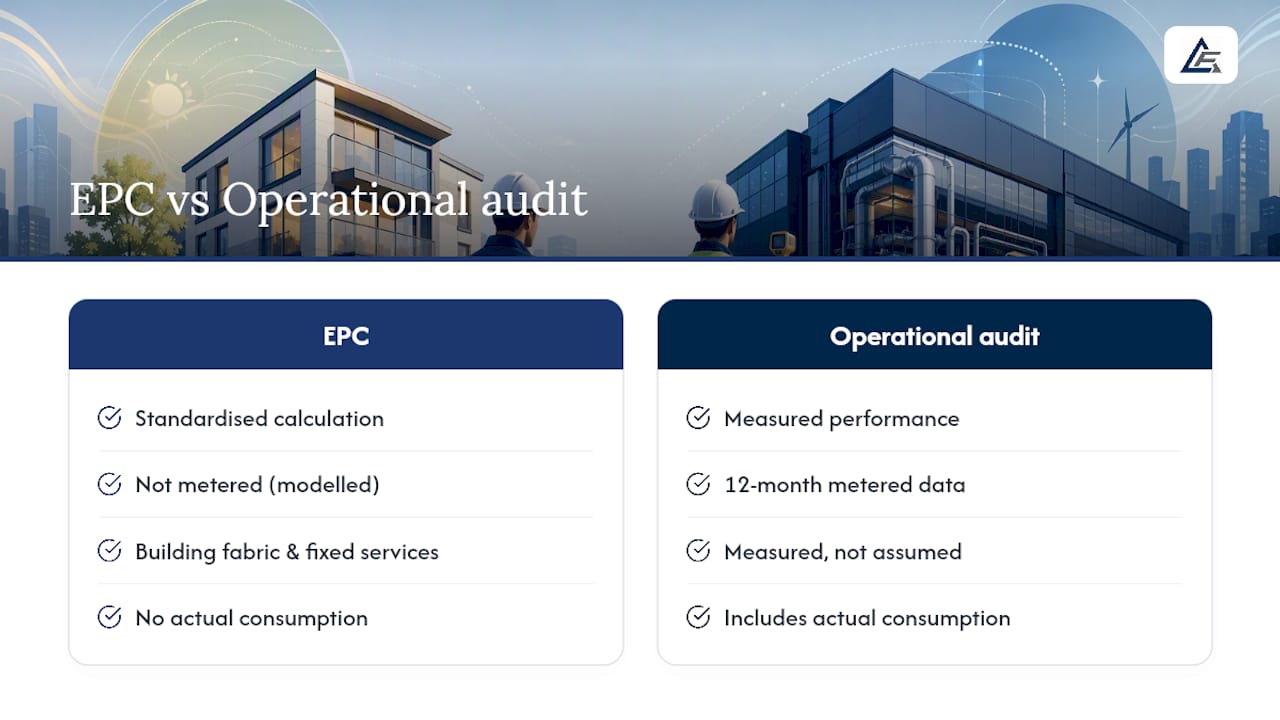
Display Energy Certificates (DECs) previously showed actual measured energy use for public buildings and were once an accepted ESOS compliance route, but ESOS phase 4 removed DECs and Green Deal Assessments as qualifying alternatives, meaning a full audit is now the standard path for most participants.
A good EPC rating for a commercial building generally sits at B or C; anything D or below tends to flag fabric or plant issues an audit will usually confirm and quantify. Use your EPC as a starting benchmark, then treat the audit report as the operational reality check that tells you what to actually fix and in what order.
What common pitfalls trip up UK energy audits?
Several recurring problems undermine audit value, and most are avoidable with the right preparation.
Incomplete or unreliable data is the most common issue. ESOS explicitly requires verifiable 12-month consumption data, and gaps or estimated readings weaken both the audit’s accuracy and its standing as compliance evidence.
Poor site access during the survey phase, particularly for plant rooms or roof-mounted equipment, forces assessors to make assumptions rather than measurements, which shows up later as inflated uncertainty in savings estimates.
Unrepresentative sampling on multi-site portfolios is another frequent misstep. Agreeing the sample size and site selection with your lead assessor early, rather than letting them default to whichever sites are easiest to reach, keeps the ESOS evidence base defensible if it’s ever queried.
Treating the report as an end point rather than a starting point wastes the exercise entirely. A costed action plan that never reaches a capital planning meeting delivers no savings at all, regardless of how thorough the underlying analysis was.
Ignoring operational context produces recommendations that look good on paper but don’t survive contact with how the building actually runs; shift patterns, seasonal occupancy swings, and process loads all need to be captured accurately, not estimated after the fact.
Avoiding these largely comes down to preparation quality and picking an assessor who asks the right questions before, not during, the site visit.
Which qualifications should your assessor hold?
Commissioning the wrong assessor is one of the most expensive mistakes a facilities team can make, because a weak audit either misses savings or produces evidence that won’t stand up under ESOS scrutiny.
Look for an assessor registered with an approved ESOS body, since ESOS explicitly requires audits to be led or reviewed by a qualified lead assessor on an approved register. For TM44 air-conditioning inspections specifically, the assessor must hold accreditation recognised under the Energy Performance of Buildings Regulations, which sets out who is legally permitted to carry out and sign off inspections.
Beyond the regulatory minimum, ask whether the assessor’s team includes chartered engineers with relevant building services experience, since a good audit blends energy modelling skill with a working understanding of HVAC, electrical, and fabric systems in practice. Membership of a recognised professional body (CIBSE or the Energy Institute, for instance) is a reasonable proxy for technical grounding, though it’s not a legal requirement in itself.
Ask to see a sample report before commissioning. A strong audit report should reference the standard followed (BS EN 16247 or ISO 50002), state the data period covered, and separate quick-win measures from capital projects with individual payback figures, not a single blended estimate.
What government support exists for post-audit measures?
Once your audit identifies measures worth implementing, funding support can shift the business case considerably, particularly for capital-intensive plant or fabric work.
The most relevant current mechanisms for commercial and public sector buildings include enhanced capital allowances for qualifying energy-efficient plant and machinery, and sector-specific schemes such as the Public Sector Decarbonisation Scheme for NHS trusts, schools, and local authorities looking to replace fossil-fuel heating systems. Business rates relief may also apply to certain on-site renewable installations, depending on your local authority’s policy.
Availability and eligibility criteria for these schemes change relatively often, so check current terms directly through GOV.UK rather than relying on older guidance, since scheme windows open and close on their own timetables. Your audit report itself is usually the supporting evidence funding bodies want to see, since it demonstrates the baseline consumption, the specific measure proposed, and the projected savings, which is exactly the documentation most grant and incentive applications require.
For measures that don’t attract external funding, treating the audit’s quick-win category as self-funding through year-one savings, then reinvesting those savings into medium-term measures, tends to be the most realistic route for organisations without dedicated capital budgets.
What have UK building audits typically achieved?
While every building’s results depend on its starting condition, the pattern across UK commercial audits is consistent enough to draw practical lessons from.
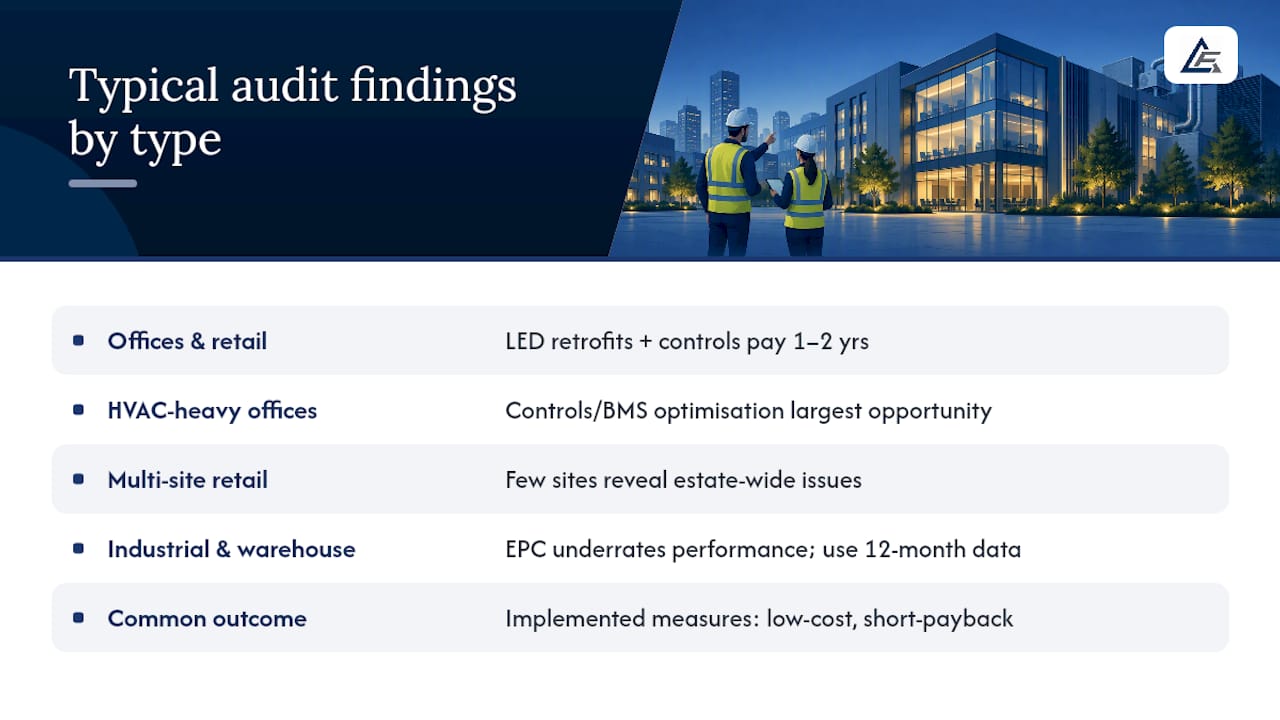
Offices and retail units with ageing lighting installations routinely find LED retrofit and controls upgrades among the fastest-paying measures identified, often recovering the investment within one to two years through reduced consumption alone. HVAC-heavy buildings, particularly older office stock with constant-volume systems, tend to show the largest single opportunity in controls optimisation and BMS recommissioning rather than wholesale plant replacement, since poorly tuned controls waste a disproportionate share of energy relative to their fix cost.
Multi-site retail and hospitality portfolios auditing under ESOS frequently discover that a handful of representative sites reveal issues common across the whole estate, such as refrigeration control settings or heating schedules left on default, meaning a single fix rolled out portfolio-wide can deliver substantial savings beyond just the audited sites.
Industrial and warehouse buildings often show the biggest gap between EPC rating and actual performance, since process loads and extended operating hours aren’t well captured by the standard EPC calculation, which is exactly why an audit based on real 12-month consumption data catches opportunities the certificate alone would miss.
The consistent thread across these patterns: the measures that actually get implemented are overwhelmingly the low-cost, short-payback ones identified early, reinforcing why prioritisation matters more than chasing the single biggest theoretical saving on the list.
How do energy audits interact with BREEAM and LEED?
Energy audits and sustainability certifications like BREEAM or LEED serve related but distinct purposes, and understanding the overlap saves duplicated effort.
BREEAM assessments for existing buildings include an energy category that draws directly on the same data an audit produces: metered consumption, plant efficiency, and identified improvement measures. If you’re pursuing a BREEAM In-Use rating, an existing energy audit report can feed straight into that assessment rather than requiring a separate data-gathering exercise. The same applies to LEED for Existing Buildings, where energy performance credits reward documented consumption data and demonstrated improvement measures.
The relationship works in both directions. RICS guidance on sustainability and ESG treats energy performance as a factor in asset value and obsolescence risk, meaning the recommendations from your audit don’t just support certification scoring, they inform how surveyors and investors assess the building’s long-term worth. For landlords and asset managers, commissioning the audit first and using its findings to inform a BREEAM or LEED strategy is generally more efficient than running the two processes separately, since you avoid collecting the same consumption and plant data twice.
Facilities management perspective: timing audits with PPM and capital cycles
The audits that deliver the most value are rarely commissioned in isolation. Scheduling a survey to coincide with a planned maintenance visit gives the assessor access to current O&M records without a separate site disruption, and phasing audits across a portfolio, a handful of representative sites each year rather than everything at once, spreads cost while keeping the evidence current for ESOS. If you’re due a PPM review, that’s the moment to raise an audit conversation with your maintenance partner.
— Ashley
Request an energy performance audit from Delta First
Delta First is the practical alternative to hiring a standalone energy consultant and a separate contractor to fix what they find. We deliver the audit and the follow-through works, electrical, mechanical, HVAC and fabric, through one accountable team, so recommendations don’t stall waiting for a second contractor to be procured.

If your building qualifies for ESOS, has air-conditioning plant approaching its five-year TM44 inspection, or you simply want a clear, costed view of where savings are hiding, request an energy performance audit or planned maintenance survey from our regionally deployed engineers across Essex, Suffolk, Norfolk and Greater London. For sites already on a maintenance contract, ask about combining the audit with your next planned preventative maintenance visit to reduce disruption. Get in touch through Delta First to request a quotation and take the first practical step towards compliance and lower running costs.
FAQ
Do you need an EPC for building regulations?
Yes, most commercial buildings need an EPC at construction, sale, or letting under building regulations, and it’s a legal requirement separate from any energy audit. An EPC uses a standardised calculation rather than actual metered consumption, so it complements but doesn’t replace an audit.
What is an energy audit of a building?
An energy audit is a structured assessment of a building’s energy consumption that identifies savings opportunities and produces a prioritised, costed action plan. UK audits typically follow BS EN 16247 or ISO 50002 methodology and, for ESOS participants, must use verifiable 12-month consumption data.
What are the three main types of energy audits?
The three levels are walk-through (a high-level desktop review for quick wins), detailed (a detailed site survey for medium-cost measures), and investment-grade (a full technical feasibility study supporting capital projects). Most single-site buildings start with walk-through or detailed, while ESOS portfolios often need detailed across a representative sample of sites.
What is a good EPC rating in the UK?
A good EPC rating for a commercial building generally falls in the B to C range, with anything D or below usually flagging fabric or plant inefficiencies. An energy audit will typically confirm and quantify exactly what’s driving a lower rating using real consumption data rather than the EPC’s standardised calculation.
Does Delta First carry out energy audits?
Yes, Delta First provides energy performance audits alongside retrofit and installation work across Essex, Suffolk, Norfolk and Greater London. Current pricing is available directly through Delta First on request.