

A UK compliance audit checklist must cover six core systems: electrical (EICR and PAT), gas, water hygiene and legionella, HVAC and air conditioning, fire safety, and lifts or lifting equipment, alongside building fabric items. Each check maps to a legal or industry anchor, chiefly Regulation 5 of the Workplace (Health, Safety and Welfare) Regulations 1992, the Building Regulations, BSRIA’s BG 80/2025 and CIBSE Guide M. Work through the system-by-system checklist below, then keep the evidence, because an auditor will ask for it.
TL;DR:
- Statutory compliance requires documented evidence of regular maintenance and inspections for all core systems, with specific intervals varying by system type.
- Certified records must include the name and registration of the competent person, and any deviations from standard frequencies should be justified and documented.
- Key risks such as electrical defects, gas safety failures, and fire safety issues demand immediate action, while lower-risk tasks should be scheduled with clear deadlines.
- Responsibilities lie with the building control person or responsible party, and using qualified professionals is essential to ensure records remain valid and enforceable.
- Managed compliance services from providers like Delta First can centralize inspections and documentation, simplifying ongoing evidence retention and audit readiness.
What does a UK statutory compliance checklist actually cover?
Every statutory compliance checklist boils down to the same question for each system: is it being maintained in a way you can prove? Regulation 5 of the Workplace (Health, Safety and Welfare) Regulations 1992 requires equipment, devices and systems to be kept in efficient working order and good repair, demonstrated through a documented maintenance system and retained records. BSRIA’s BG 80/2025 Statutory Compliance Inspection Checklist turns that principle into a workable task list, mapping each statutory test to its minimum frequency, the skill level required to carry it out, and how long the record must be kept.
Here is the practical breakdown facilities teams should be working through.
- Electrical (fixed wiring and portable appliances): An Electrical Installation Condition Report (EICR) identifies defects coded C1 (danger present, requiring immediate action), C2 (potentially dangerous, requiring urgent remedial work) or C3 (improvement recommended). A registered electrician must carry out the inspection, and fixed wire testing findings should be logged against a remedial timeline. Portable appliances need a risk-based PAT testing regime rather than a blanket annual cycle.
- Gas: Gas appliances and communal flues serving multiple units are the building manager’s responsibility, not just a domestic landlord duty. Annual inspection and maintenance by a Gas Safe registered engineer is the accepted standard, and commercial gas safety records should show engineer details, appliance condition and any remedial work completed.
- Water hygiene and legionella: A legionella risk assessment, monthly sentinel temperature checks, and a flushing regime for little-used outlets are the baseline controls under HSE’s ACoP L8 framework. Cooling towers and evaporative condensers carry a materially higher risk profile and need continuous control regimes, including quarterly cleaning and bacterial sampling.
- HVAC and air conditioning: Systems with an effective rated output of 12kW or above need inspection by an accredited energy assessor at least every five years, alongside F-gas leak checks on refrigerant-containing plant. Wider mechanical services compliance should also cover ventilation performance against Building Regulations Part F.
- Fire safety: A fire risk assessment underpins everything else, backed by weekly call point testing, monthly emergency lighting function checks, and fire door inspections. Alarm systems should meet BS 5839-1 categorisation and testing schedules, tied to Approved Document B’s technical requirements.
- Lifts and lifting equipment: Where LOLER applies, thorough examinations at set intervals (typically six months for passenger-carrying lifts, twelve months for other lifting equipment) must be certified by a competent person, with certificates retained and defects actioned against a deadline.
- Building fabric: Roof coverings, cladding, glazing and drainage checks interact directly with Building Regulations Parts B (fire), F (ventilation), G (sanitation and water efficiency) and P (electrical safety in dwellings), so fabric defects should be cross-referenced against the relevant Part when logged.
For every item above, the minimum evidence is the same shape: a dated certificate or inspection sheet, the name and registration of the competent person, and a clear note of any remedial action with its completion date.
Compliance audit frequencies and evidence retention at a glance
Statutory intervals vary by system, and some are legally fixed while others are industry-recommended best practice. Getting the distinction wrong, treating a guideline as optional or a genuine legal minimum as flexible, is one of the more common gaps auditors find in FM compliance registers.
| System | Typical frequency | Legal or industry status | Minimum record retention |
|---|---|---|---|
| Electrical EICR | 3 to 5 years (commercial) | Industry recommendation under Reg 5 | Until superseded by next EICR |
| Gas appliance servicing | Annual | HSE-recommended in absence of manufacturer guidance | Ongoing maintenance evidence expected |
| Legionella risk assessment | Reviewed within 2 years, sooner if risk dictates | Industry practice under ACoP L8 | Retain until reassessed |
| Air conditioning ≥12kW | Every 5 years | Gov | 5 years for F‑gas records |
| Fire alarm testing | Weekly call point, annual full test | BS 5839‑1 | Retain until next full test cycle |
| LOLER examination | 6 or 12 months depending on equipment | Legal requirement | Until next examination |
Acceptable evidence is rarely just the certificate itself. Auditors and insurers respond well to signed inspection sheets, dated photographs of corrective work, named engineer contact details, and a visible trail from defect identification to close-out. One point worth flagging for any register: where a frequency is departed from, shortening an EICR cycle after early signs of deterioration, for example, record the risk-based reasoning rather than just the new date. That single note is often what separates a defensible compliance file from one that looks arbitrary under scrutiny.
Who is responsible for compliance, and how do you evidence it?
Regulation 5 places the duty squarely on the person in control of the workplace to maintain equipment in an efficient state and good repair, evidenced through a documented maintenance system. Fire safety carries a parallel concept: a named “responsible person” accountable for the fire risk assessment and its ongoing review.
Competence matters as much as frequency. Gas work needs a Gas Safe registered engineer. Fixed wiring inspections need a registered electrician. Air conditioning inspections need an accredited energy assessor, and legionella controls need a competent water hygiene specialist, whether in-house or contracted. Using an unqualified person, even for something that looks straightforward, invalidates the record and exposes the dutyholder directly.
- Maintain a building log book that captures asset inventories, maintenance history and handover information, in line with CIBSE Guide M.
- Map every task against BG 80/2025’s frequency and competence columns so nothing relies on memory.
- Keep corrective action logs with photos and completion dates, not just the original defect notice.
- Store records digitally with date stamps so they can be produced within minutes, not days.
Pro Tip: Build your register around BG 80/2025’s task structure from day one. A digital, date‑stamped compliance file consistently cuts the time it takes to produce evidence during an inspection, and it makes remedial follow‑up far harder to lose track of.
How to run a compliance audit step by step
- Prepare. Pull the asset inventory and every certificate from the last 12 to 24 months before you set foot on site, so gaps are visible before the walkaround starts.
- Inspect on site. Carry out visual checks across all systems, sample test where full testing isn’t due, and prioritise high-risk plant such as cooling towers, gas installations and life-safety systems first.
- Classify defects. Grade each finding (C1/C2/C3 for electrical, similar risk tiers elsewhere), assign a named competent person, and set a remedial timescale proportionate to the risk.
- Close out and hand over. Update the compliance register with completion evidence, set calendar reminders for the next statutory cycle, and file the audit pack where the next inspector or contractor can find it in minutes.
Accessibility compliance and the Equality Act 2010
A compliance audit that stops at plant and wiring misses a legal obligation that applies to almost every commercial and public building: the Equality Act 2010’s duty to make reasonable adjustments for disabled people. This sits alongside, not instead of, the physical access standards in Building Regulations Approved Document M.
For an audit checklist, accessibility items typically include step-free access to main entrances, lift provision or evacuation arrangements for wheelchair users, appropriately positioned handrails and signage, accessible toilet facilities, and clear sightlines and colour contrast for visually impaired visitors. Fire evacuation planning deserves particular attention here: a Personal Emergency Evacuation Plan (PEEP) should exist for any known disabled occupant or regular visitor, and this crosses directly into the fire risk assessment process covered earlier.
Public sector estates and larger commercial premises face closer scrutiny on this point, but the duty applies regardless of size. Recording what adjustments exist, and what has been assessed as not reasonably practicable and why, gives the estate a defensible position if a complaint or tribunal claim arises. Treat accessibility as a standing line in the audit register rather than a one-off project, since building use and occupancy change over time in ways that can quietly erode compliance.
Environmental compliance: waste, energy and resource use
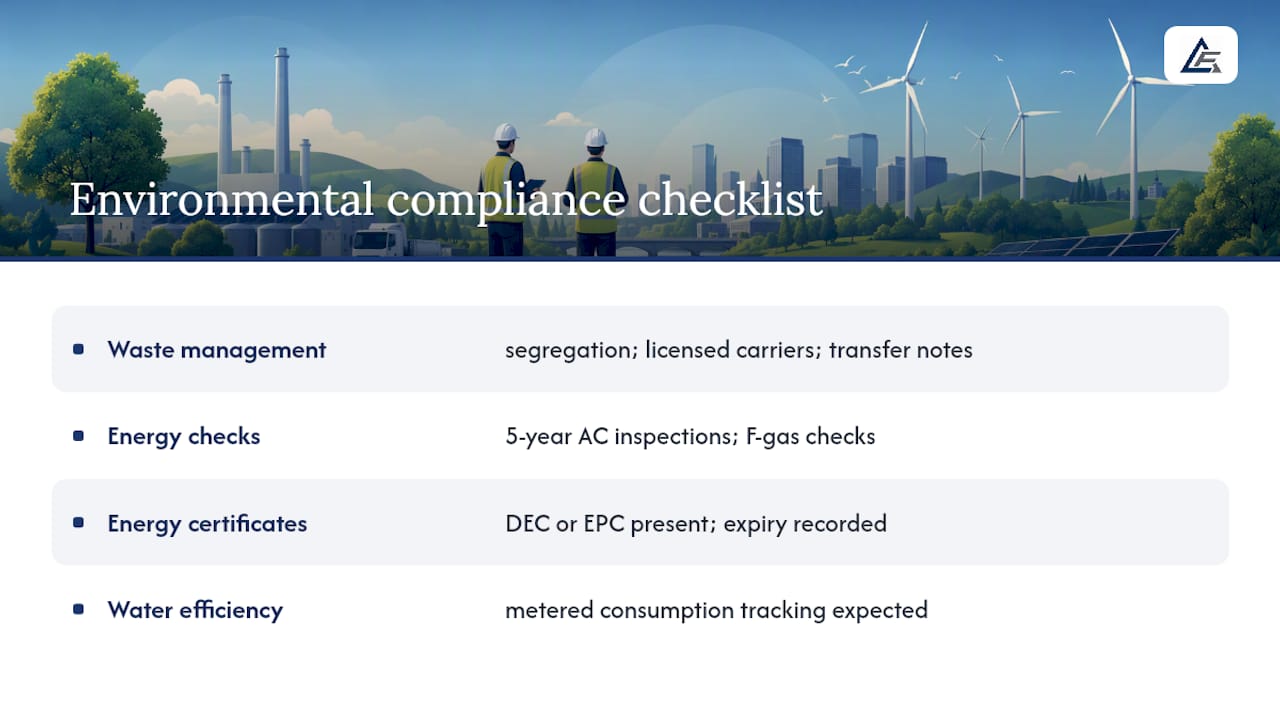
Environmental obligations sit inside most commercial compliance audits now, driven by waste regulations, energy performance requirements and, increasingly, net zero targets set by public sector bodies and larger commercial landlords.
Waste management duties under the Environmental Protection Act 1990 and the Waste (England and Wales) Regulations require correct waste segregation, use of licensed waste carriers, and retention of waste transfer notes or consignment notes for hazardous waste. An audit should confirm these documents exist and are current, not just that bins are labelled correctly.
Energy efficiency compliance overlaps directly with the HVAC and air conditioning checks described earlier. The five-year air conditioning inspection requirement exists specifically to flag underperforming or oversized plant that wastes energy, and F-gas leak checks serve a dual purpose: preventing refrigerant loss (a significant driver of emissions) as well as system failure. Display Energy Certificates (DECs) or Energy Performance Certificates (EPCs), where applicable to the building type, should sit in the compliance file alongside their expiry dates.
For public sector estates and larger commercial portfolios, water efficiency and metered consumption tracking are increasingly expected too. None of this replaces the statutory checks covered elsewhere in this guide, but a compliance audit that ignores environmental documentation leaves an obvious gap for any procurement or regulatory review to find.
Asbestos and wider health and safety duties
Fire and gas dominate most compliance conversations, but asbestos management carries some of the heaviest legal weight of any item on a UK compliance audit checklist, particularly in buildings constructed or refurbished before the 2000 ban.
The Control of Asbestos Regulations 2012 place a duty on those responsible for non-domestic premises to identify whether asbestos-containing materials (ACMs) are present, assess their condition, and maintain an asbestos register that is reviewed regularly and made available to anyone whose work might disturb the fabric, contractors included. An audit should confirm the register exists, that it has been reviewed within a reasonable period, and that any deteriorating ACMs have a documented management plan rather than being left as a static note from years earlier.
Beyond asbestos, a fuller health and safety audit should sweep in areas that sit outside the plant-focused checks covered elsewhere: manual handling risk assessments, control of substances hazardous to health (COSHH) records for cleaning and maintenance chemicals, and confined space entry procedures where plant rooms or risers require it. Each of these needs the same evidence discipline as the statutory building services checks: a dated assessment, a named responsible person, and a review cycle that is actually followed rather than aspirational.
Structural and fabric integrity: what to check and record
Fabric checks are easy to under-resource because failures develop slowly, right up until a leak, a collapse, or a Part B fire compartmentation failure makes the cost of neglect obvious.
A thorough fabric inspection walks the building envelope and structure methodically: roof coverings and flashings for water ingress, cladding and render for cracking or delamination, external glazing and window seals, rainwater goods and drainage for blockages, and internal fire compartmentation, particularly around service risers and ceiling voids where cabling and pipework penetrate fire-rated walls. Fire doors need functional checks on self-closers, seals and signage, not just a visual glance at the door leaf itself.
Structural movement, subsidence cracking, and load-bearing alterations from previous refurbishment work all deserve a specific line in the register rather than a general “fabric satisfactory” note, because that level of vagueness is exactly what an insurer or building control officer will query. Where fabric work interacts with Building Regulations, Parts B (fire), F (ventilation) and G (sanitation and water efficiency) are the ones that come up most often in compliance audits, and any remedial fabric work should be checked against the relevant Part before sign-off.
Photographic evidence earns its place here more than almost anywhere else on the checklist. A dated photo of a crack, a damp patch, or a failed door seal, cross-referenced to its remedial note, does more to demonstrate a working maintenance system than a written description ever will.
How should you prioritise remedial actions after an audit?
Every audit generates a punch list, and the mistake most estates teams make is treating every item as equally urgent, which either paralyses the response or buries genuine risk in administrative noise.
Grade remedial actions by consequence, not by cost or convenience. A C1 electrical finding or a life-safety fire defect needs immediate isolation or same-day action, full stop, regardless of budget cycles. A C2 finding needs a documented plan with a realistic completion date, assigned to a named competent person rather than left as an open line item. Lower-risk fabric or accessibility improvements can sit on a rolling programme, but only if that programme has actual dates attached to it, not a permanent “ongoing” status.
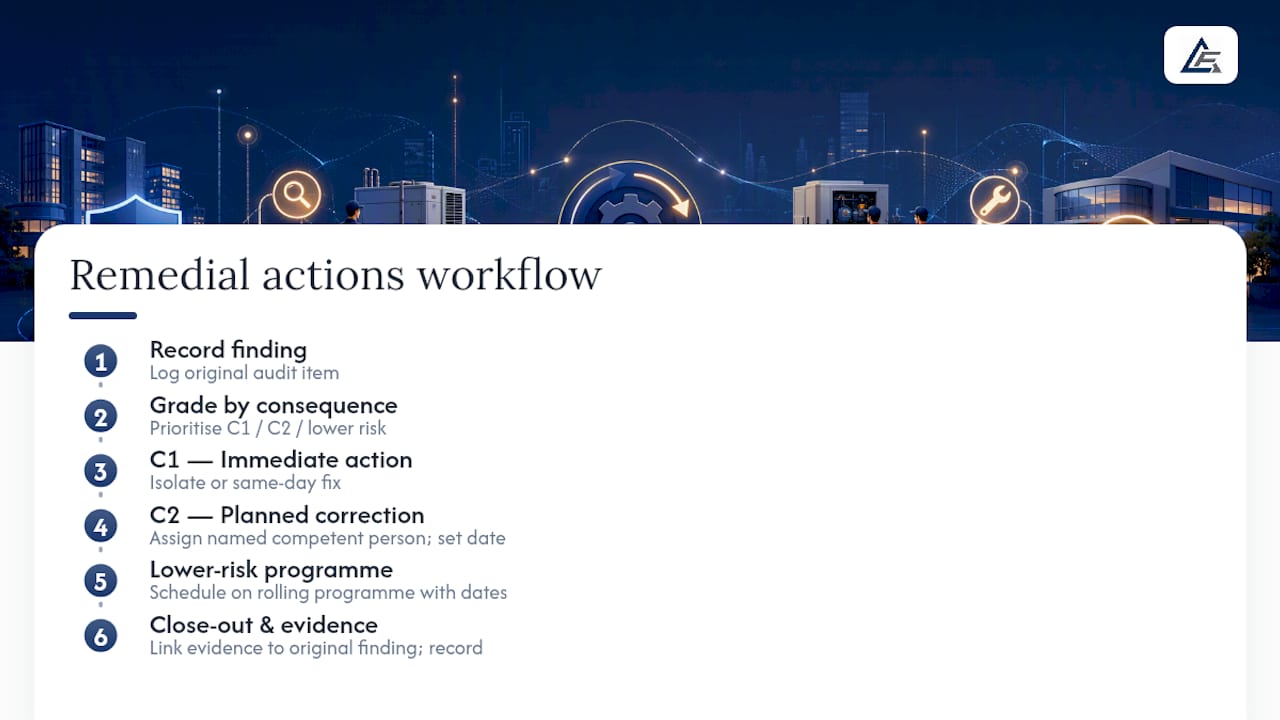
Track every remedial item back to its original audit finding, its competent person, and its close-out evidence, because a defect that gets fixed but never gets recorded as fixed still shows as open risk on your next audit. Where budget constraints genuinely delay a lower-risk item, document the decision and the interim control measure, since an auditor or insurer will accept a managed risk far more readily than an unexplained gap. Building this discipline into the compliance register, rather than a standalone spreadsheet that gets forgotten between audits, is what keeps the process from becoming an annual fire drill in itself.
Delta First’s perspective on managed compliance
A checklist gets a building through one audit. A managed compliance contract keeps it audit-ready every day in between, and that difference is where most estates teams actually lose ground: not from missing a check, but from losing track of dozens of them across different systems and contractors.
Delta First provides electrical, mechanical, HVAC and building fabric services alongside full compliance management, giving one accountable partner instead of a fragmented set of specialists and spreadsheets. A centralised record and a single point of contact means faster remedial turnaround when a C2 finding lands on your desk. If your records are patchy, your plant is complex, or you’re managing healthcare or high-risk public buildings, that’s precisely the point to commission a specialist survey rather than patch the gaps yourself.
— Ashley
Request a compliance survey from Delta First
Reading a checklist is one thing. Getting every system inspected, certified and logged by a single accountable contractor is another, and it’s the difference between hoping your paperwork holds up and knowing it will. Delta First delivers EICR and fixed wire testing, gas servicing, legionella control, HVAC and air conditioning compliance, and full compliance management under one contract, backed by transparent reporting so you can see exactly what’s been checked and what’s outstanding.
Delta First carries out compliance surveys and planned maintenance across Essex, Suffolk, Norfolk and Greater London, working with facilities managers, schools, NHS estates, retail and commercial property owners. Whether you need a one-off gap analysis or ongoing commercial electrical support, the next step is straightforward: request a quotation or book a planned maintenance survey and get a clear picture of where your building actually stands.
Need a reliable maintenance and compliance partner? Delta First provides planned preventive maintenance, statutory compliance support and reactive repairs from one accountable contractor across Essex, Suffolk and London, with 24/7 emergency cover. Call 01206 237422 or request a quote.
Sources
- Gov
- The Workplace (Health, Safety and Welfare) Regulations 1992 — regulation 5
- Gas appliances and landlords (HSE)
FAQ
What must a UK compliance audit checklist cover?
It must cover electrical (EICR and PAT), gas, water hygiene and legionella, HVAC and air conditioning, fire safety, lifts and lifting equipment, and building fabric, each mapped to a legal or industry standard such as Regulation 5 or BG 80/2025.
How often should an EICR be carried out on commercial premises?
Most commercial EICRs run on a 3 to 5 year cycle, though the correct interval depends on the building type, usage and any risk factors identified in the previous report.
What is BG 80/2025 and why does it matter?
BG 80/2025 is BSRIA’s Statutory Compliance Inspection Checklist, mapping each statutory task to its minimum frequency, required competence and record retention period, making it the practical backbone of a UK compliance register.
Who is legally responsible for building compliance?
Under Regulation 5 of the Workplace (Health, Safety and Welfare) Regulations 1992, the person in control of the workplace is responsible for maintaining equipment and systems in efficient working order, evidenced by documented records.
Can Delta First manage compliance across multiple sites?
Yes. Delta First provides full compliance management alongside electrical, mechanical, HVAC and building fabric services for estates across Essex, Suffolk, Norfolk and Greater London.
Recommended
- Fixed wire testing: your commercial compliance duties
- Act now: written scheme of examination for UK facilities managers
- 7 key checks: CDM 2015 client duties for UK facilities managers
- SFG20 maintenance: your guide to UK compliance standards
Talk to Delta First
Delta First Building Services is a Colchester-based M&E contractor working across Essex, Suffolk and London, with commercial work in Norfolk. Our directly employed electrical team is supported by vetted specialist subcontractors where extra certification is needed, and we offer genuine 24/7 emergency cover. Get in touch to arrange a survey or quote.