

Adopt a frequency-based PPM regime for chiller maintenance: daily operator logging plus scheduled certified-engineer visits monthly, quarterly and annually. Watch three measurements above all others: temperature differential (ΔT) across the evaporator, suction and discharge pressures, and refrigerant leak-check results. Consistent recordkeeping against these three prevent most failures and keeps you compliant with F-Gas regulations.
TL;DR:
- Regular monitoring of temperature differential, pressures, and leak-checks is essential to prevent failures and ensure compliance with F-Gas regulations.
- Weekly and monthly inspections should focus on keeping heat transfer surfaces clean, tracking trending data, and inspecting water treatment systems to reduce energy use.
- Critical components such as safety devices, VSDs, and electrical connections require testing at every visit to prevent damage and detect emerging faults early.
- Recording comprehensive data on system performance and refrigerant charge over several years is necessary to maintain F-Gas compliance and identify gradual declines.
- A frequency-based PPM schedule, combined with certified engineer visits and trend analysis, outperforms reactive repairs and lowers operational costs over the system’s lifespan.
Daily, weekly and monthly checks your site team should run
Between engineer visits, your on-site team is the early-warning system. A short daily routine catches drift before it becomes downtime, and it gives whoever attends your next service visit something concrete to work from.
Daily checks should take ten minutes and cover:
- Active alarms and any that have cleared without explanation
- Supply and return water temperatures against setpoint
- Pump and fan operation, listening for unusual noise or vibration
- Visible signs of refrigerant or water leaks around pipework and joints
Weekly and monthly, add condenser and ambient visual inspections, a strainer check, glycol concentration where applicable, and a rough kW-versus-cooling-output comparison against the previous month. Record every reading with a timestamp, the operator’s name, and the machine identifier. Trending matters more than any single figure: a ΔT that has quietly dropped from 6°C to 4°C over eight weeks tells you far more than one low reading in isolation.
Cleaning condensers and evaporators to cut compressor lift
Fouled heat-transfer surfaces force the compressor to work harder to move the same amount of heat. This gap between evaporating and condensing temperature is known as “lift”, and every extra degree of it costs energy. CIBSE’s technical guidance on chiller performance and lift confirms that keeping surfaces clean and optimising condenser water temperature is one of the most reliable ways to cut compressor energy use on plant that runs long hours.
For air-cooled coils, schedule a clean before the cooling season starts, keep the surrounding area free of leaves, fluff and debris, comb bent fins back into shape, and check fan bearings while the unit is accessible. For water-cooled tubes, tube brushing frequency should follow your water chemistry and fouling history, alongside regular waterbox inspection, strainer maintenance, and coordination with cooling-tower cleaning schedules.
Pro Tip: If tube brushing alone hasn’t restored performance after two consecutive cleans, ask your contractor about eddy-current tube testing before the next clean. It catches wall-thinning that a brush clean can mask.
- Air-cooled: pre-summer coil clean, debris clearance, fin combing, fan bearing check
- Water-cooled: tube brushing, waterbox inspection, strainer clean, tower coordination
- Escalate to specialist testing when brushing stops restoring approach temperature
Compressor, refrigerant and lubricant checks that reveal wear early
Suction and discharge pressures, superheat and subcooling, compressor running current, and total running hours together paint an accurate picture of compressor health. A rising discharge pressure alongside a falling suction pressure, for instance, often points to fouling rather than a compressor fault, so these readings should never be read in isolation.
Leak detection uses sniffer or UV methods depending on refrigerant type, and the frequency of statutory checks is set by the system’s CO₂e charge rather than a fixed calendar date, as PM Assist’s chiller maintenance schedule sets out. Oil analysis on larger or critical systems flags acid formation and moisture ingress long before they cause a compressor failure.
- Log suction/discharge pressure, superheat, subcooling and compressor amps at every visit
- Confirm leak-check intervals against nameplate CO₂e, not a generic annual assumption
- Sample oil on critical or high-value compressors on a fixed cadence
- Include VSD checks, starter inspection and electrical thermography in periodic visits
Water treatment and Legionella control for wetted chiller systems
Where a chiller integrates with a cooling tower or other wetted system, water treatment stops being a housekeeping task and becomes a legal duty. HSE’s HSG274 guidance treats maintenance of these systems as safety-critical, requiring a written water management plan and a named competent person accountable for it.
Build the following into that plan:
- Regular water chemistry testing and correction against agreed limits
- Drift eliminator condition checks and make-up/blowdown monitoring
- Cleaning and disinfection frequency based on fouling potential and inspection history, not a blanket annual date
- Specialist water-treatment contractor visits logged alongside your standard PPM records
Our water compliance services page covers how this integrates with a wider mechanical maintenance contract.
Controls, safety devices and VSD checks that prevent damage
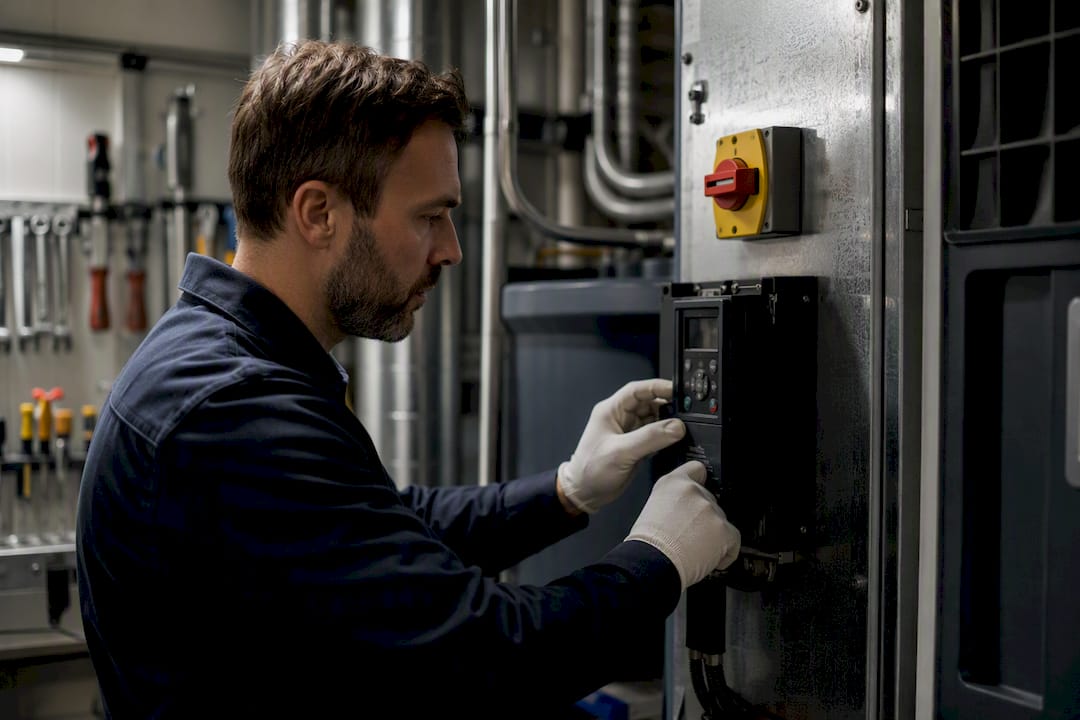
High- and low-pressure cutouts, flow switches and freeze stats need functional testing at every engineer visit, not just a visual check that they’re wired in. Reviewing alarm history alongside these tests often reveals nuisance trips that mask a genuine developing fault.
Set BMS trending alerts for ΔT drift, compressor starts per hour, and kW input per kW of cooling delivered. CIBSE’s research into part-load energy prediction shows how much outdoor conditions and load profile affect these figures, which is exactly why a single spot reading tells you less than a trend line.
- Test HP/LP cutouts, flow switches and freeze stats every visit
- Review alarm history for repeat trips before resetting and moving on
- Check VSD bearings, cabling, parameter backups and harmonic distortion
- Schedule thermography and terminal tightening during periodic visits
A well-configured BMS maintenance programme makes these alerts genuinely actionable rather than noise your team learns to ignore.
What to do when a chiller starts underperforming
Most chiller faults give a warning before they cause a shutdown. Knowing what to check, and what to record, before you call for support speeds up diagnosis considerably.
- Low ΔT usually points to reduced flow, a fouled evaporator, or low refrigerant charge.
- High discharge pressure often means a dirty condenser, blocked airflow, or an overcharged system.
- Frequent short-cycling can indicate a faulty control device or an oversized unit for current load.
- Abnormal vibration or noise warrants an immediate check of mountings, bearings and refrigerant flow before continued running.
- If safety devices trip repeatedly, isolate and switch to standby capacity rather than resetting blind.
- Record every reading, alarm code and action taken, and hand that log to the attending engineer.
For a broader view of failure patterns across commercial HVAC plant, this guide to common commercial HVAC system failures is a useful companion reference.
Recordkeeping and F-gas responsibilities you can’t outsource
F-Gas leak-check frequency is set by your system’s CO₂e charge, confirmed from the nameplate rather than assumed. Larger charges demand more frequent checks, and getting this wrong is a compliance failure, not a paperwork oversight.
Retain service logs, leak test certificates, refrigerant top-up records and the identity of the attending engineer for five years.
The numbers that matter most: track COP, kW per kW of cooling delivered, mean time between failures, and refrigerant loss per year. A system losing more than a few percent of its charge annually needs investigating, not just topping up. PM Assist’s schedule breaks these intervals down by CO₂e band.
- Confirm nameplate CO₂e charge before setting your leak-check calendar
- Keep five years of service, leak test and top-up records for audit
- Track COP, kW/kW cooling and refrigerant loss as ongoing KPIs
- Verify any contractor’s F-Gas qualification before they touch the system
Our mechanical services compliance guide covers dutyholder responsibilities in more depth.
A practical PPM schedule you can adapt today
Manufacturer O&M manuals set the baseline, but your risk profile, whether the chiller supports a comfort system or a continuous production process, should shape how strictly you apply it.
- Daily (operator): alarm check, supply/return temperature, visual leak check, pump and fan condition.
- Weekly (operator): condenser visual inspection, strainer check, glycol concentration where fitted.
- Monthly (operator/technician): parameter trending, kW-versus-cooling spot check, alarm history review.
- Quarterly (certified engineer): pressure and superheat/subcooling readings, safety device testing, VSD inspection.
- Six-monthly (certified engineer): thermography, oil sampling on critical systems, tube or coil inspection.
- Annual (certified engineer): deep condenser/evaporator clean, full electrical inspection, leak test certification.
Set escalation thresholds in advance, a ΔT drop below an agreed point, or a discharge pressure above a fixed limit, that automatically triggers an out-of-hours response rather than waiting for the next scheduled visit. On continuous-process sites with N+1 redundancy, rotate annual deep service between duty and standby units so production never stops for maintenance.
How Delta First runs planned chiller maintenance
Delta First’s PPM contracts for chillers combine scheduled engineer visits with the compliance paperwork facilities teams actually need for audits, F-Gas records, leak test certificates and KPI summaries rather than a bare service report.
After each visit, you receive a digital log of readings taken, any parts replaced, and updated trend data against your previous visits, so drift is visible long before it becomes a fault. Reactive callouts sit alongside the planned schedule, covering the gap when something unexpected happens between visits.
Requesting a survey starts with a site walk to confirm nameplate data, current condition and your existing maintenance history, which then shapes a tailored PPM proposal.
Why partnership beats reactive repairs
Scheduled PPM with continuous monitoring catches drift long before it becomes a shutdown, and that’s the whole argument for it. A chiller maintained on a proper frequency-based schedule, rather than fixed only when it fails, costs less over its working life and keeps you compliant without last-minute scrambling. If you’re weighing up whether your current arrangement is tight enough, a PPM survey with certified engineers covering your region is the honest way to find out.
— Ashley
Request a chiller PPM survey from Delta First
Delta First delivers planned preventative maintenance for chillers and wider mechanical, electrical and HVAC systems across Essex, Suffolk, Norfolk and Greater London, backed by qualified engineers and certified specialist subcontractors who know the difference between a nuisance alarm and a developing fault. Rather than waiting for a breakdown call-out, you get a documented PPM plan built around your actual plant condition and risk profile, not a generic manufacturer template.

If your chillers support production, retail cooling, or critical comfort systems, our commercial electrical maintenance services cover the electrical thermography, starter checks and VSD inspection that sit alongside mechanical PPM. Request a planned maintenance survey and you’ll receive a clear schedule of daily, monthly and annual tasks, the compliance paperwork your audits need, and a fixed point of contact for reactive support when something can’t wait for the next visit.
Need support with mechanical or HVAC maintenance? Delta First delivers planned and reactive mechanical maintenance across Essex, Suffolk and London, using certified specialist partners for gas and refrigerant work, with 24/7 emergency cover. Call 01206 237422 or request a quote.
Sources
Recommended
- Summer HVAC maintenance: a guide for facilities managers
- HVAC maintenance plan: protect your system and save money
- SFG20 maintenance: your guide to UK compliance standards
- Air conditioning consulting for facilities managers: UK guide
Talk to Delta First
Delta First Building Services is a Colchester-based M&E contractor working across Essex, Suffolk and London, with commercial work in Norfolk. Our directly employed electrical team is supported by vetted specialist subcontractors where extra certification is needed, and we offer genuine 24/7 emergency cover. Get in touch to arrange a survey or quote.
[…] UK chiller maintenance: PPM schedule that meets F‑Gas and Legionella […]
[…] UK chiller maintenance: PPM schedule that meets F‑Gas and Legionella […]
[…] slowly claws back the energy savings you refurbished the unit to achieve. The same logic that keeps chiller plant compliant with F-Gas and Legionella requirements applies here: planned inspection beats reactive repair every […]
[…] UK chiller maintenance: PPM schedule that meets F‑Gas and Legionella […]