

Adopt a planned preventative maintenance (PPM) schedule and you will prevent the majority of commercial roof failures before they become expensive emergencies. The industry term for this approach is planned preventative maintenance, though you will also see it called a roof maintenance programme or scheduled roof care. Whatever the label, the principle is the same: inspect regularly, keep drainage clear, and fix small defects promptly. Before anything else, take these four steps now:
- Walk the roof perimeter (from ground level if safe) and note any visible debris, standing water, or damaged flashings.
- Check all visible gutters, downpipes, and outlets for blockages, particularly after autumn leaf fall.
- Photograph any defects with a date stamp and log them in your asset management system.
- Book a professional roof survey with a qualified contractor to establish a baseline condition grade.
If you manage multiple sites or have not had a formal inspection in the past two years, contact Delta First to arrange a planned maintenance survey. Our engineers cover Essex, Suffolk, Norfolk, and Greater London.
Why preventative roof maintenance protects your asset and budget
Reactive roof repairs cost significantly more than planned maintenance over any meaningful time horizon. A 10-year cost comparison between planned and reactive approaches consistently shows that emergency call-outs, temporary weatherproofing, internal damage remediation, and accelerated replacement all compound into totals that dwarf the cost of a structured PPM programme. The financial case is not subtle.
Beyond direct repair costs, reactive failures carry operational consequences that are harder to quantify but equally damaging. A roof leak above a production line, a server room, or a ward forces immediate shutdown, disrupts tenants, and can void insurance claims if the insurer determines that neglect contributed to the damage. Documented maintenance records are increasingly the line between a settled claim and a disputed one.
The leading cause of flat roof failure is blocked outlets and poor drainage, which allows water to pond and degrade the membrane from above. Regular drainage clearance is therefore the single highest-return maintenance task on any flat or low-slope roof. A blocked outlet does not announce itself; it simply holds water until the membrane gives way.
PPM also preserves manufacturer warranties. Most membrane and coating warranties require evidence of periodic inspection and maintenance at defined intervals. Miss those milestones and the warranty lapses, leaving you exposed to the full cost of any subsequent failure.
Key operational benefits of a PPM approach:
- Converts unpredictable emergency spend into a predictable annual budget line.
- Reduces unplanned downtime and the disruption to building occupants.
- Maintains compliance with your duty of care to tenants and employees.
- Produces the documented maintenance history that insurers and warranty administrators require.
- Defers full roof replacement, extending the asset’s productive life.
Core maintenance tasks and how often you should carry them out
Proactive maintenance extends a roof’s service life and reduces annual repair costs. The task list below applies across flat single-ply membranes, profiled metal, built-up felt, and pitched roofs, though the frequencies shift depending on roof type, rooftop plant, and local tree cover.
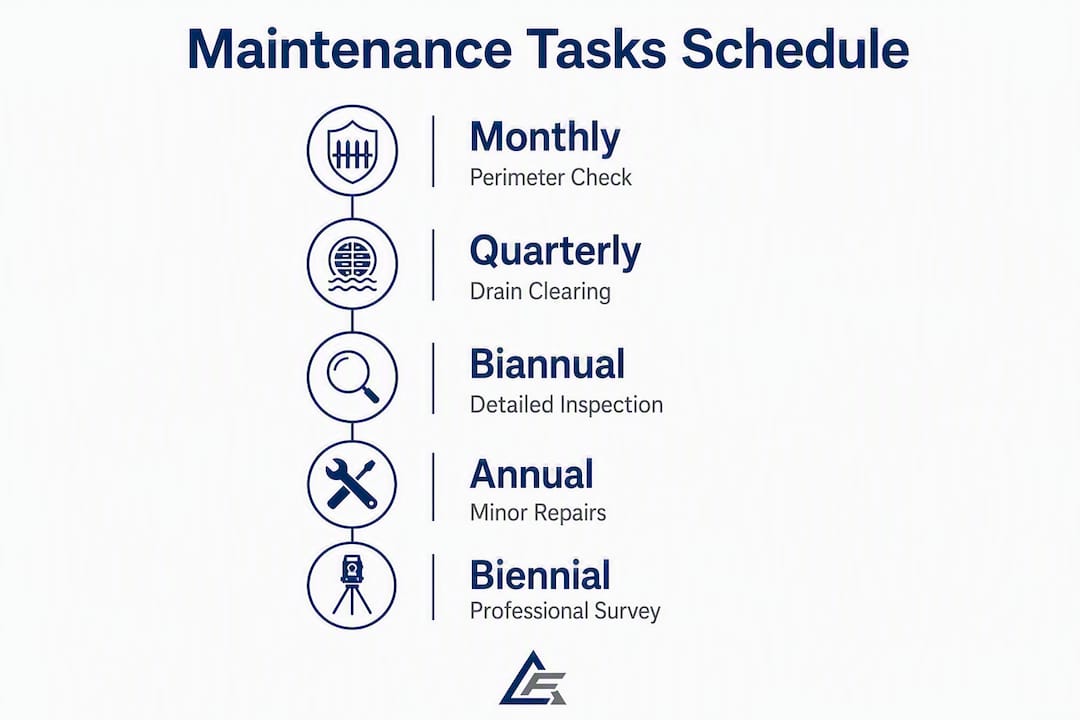
Most commercial roofs benefit from a twice-yearly detailed inspection, with additional checks after significant storms and a targeted drainage clearance in autumn before leaf fall blocks outlets. Roofs carrying rooftop plant, air handling units, or heavy foot traffic from maintenance operatives need more frequent attention, as mechanical penetrations and traffic routes are the most common sources of early membrane damage.
Inspections should be carried out at least every two years as an absolute minimum, but that floor is a risk threshold, not a target. Any roof with overhanging trees, known historic defects, or rooftop equipment warrants quarterly visual checks at minimum.
| Task | Frequency | Who performs it | Why it matters |
|---|---|---|---|
| Visual perimeter check | Monthly | Facilities team (ground level) | Early identification of debris, ponding, or visible damage |
| Gutter and outlet clearance | Quarterly (minimum); monthly in autumn | Trained operative or contractor | Blocked outlets are the leading cause of flat roof failure |
| Detailed professional inspection | Twice yearly | Qualified roofing contractor | Identifies membrane, seam, flashing, and fastener defects |
| Post-storm check | After any significant weather event | Qualified contractor or trained operative | Storm damage often creates immediate leak risk |
| Seam and joint inspection | Twice yearly | Qualified roofing contractor | Seam failure is the primary failure mode for single-ply membranes |
| Flashing and upstand inspection | Twice yearly | Qualified roofing contractor | Flashing separation allows water ingress at roof-to-wall junctions |
| Fastener and fixing check (metal roofs) | Annually | Qualified roofing contractor | Loose fasteners allow wind uplift and water tracking |
| Rooflight and skylight inspection | Twice yearly | Qualified roofing contractor | Rooflights are frequently fragile and a common ingress point |
| Biological growth removal | Annually or as required | Specialist cleaning contractor | Moss and algae retain moisture and accelerate membrane degradation |
| Plant support and penetration check | Twice yearly | Qualified roofing contractor | Mechanical penetrations are high-risk leak points |
Pro Tip: Combine your detailed inspection with minor repairs on the same visit. Addressing small defects, resealing a lifted flashing, clearing a slow outlet, or treating a patch of moss, at the point of discovery costs a fraction of what the same defect costs once water has tracked into the building fabric.
Biological growth removal deserves specific attention on older flat roofs. Moss and algae retain moisture against the membrane surface, accelerating degradation and obscuring underlying defects. A specialist roof cleaning programme removes growth safely and allows a clear visual inspection of the membrane beneath.
What a robust PPM contract for commercial roofs should include
A well-structured PPM contract converts roof maintenance from a reactive cost centre into a managed asset programme. The scope should be explicit, the service levels measurable, and the documentation requirements written into the agreement from day one.
Core components every PPM contract should specify:
- Scheduled inspection visits (minimum twice yearly, with defined dates).
- Drainage clearance at each visit, including gutters, outlets, scuppers, and downpipes.
- Minor repairs carried out on the same visit without additional call-out charges (define the scope, typically up to a specified time allowance or repair area).
- Photographic condition record produced after every visit, with defects graded by priority.
- Written defect schedule with recommended remedial actions and indicative costs.
- Emergency call-out response time for contract holders (typically 4-hour or next-day attendance depending on severity).
- Annual condition summary report suitable for asset management and insurance purposes.
Structured maintenance programmes convert unpredictable emergency costs into a predictable annual budget and often include warranty milestone inspections for coated or specialist membrane systems. If your roof carries a manufacturer warranty, confirm that the PPM scope meets the warranty’s inspection requirements and that the contractor is approved by the manufacturer.
Modern inspection methods add significant value to a PPM contract. Drone surveys and thermal imaging, as part of periodic inspections, identify moisture ingress before it becomes visible as a leak, and produce high-resolution photographic records that carry weight with insurers and warranty administrators. Thermal imaging typically adds a modest cost to an inspection visit but routinely identifies concealed moisture that would otherwise go undetected until significant damage has occurred.
Sample scope checklist for briefing stakeholders or issuing a tender:
- Define the roof area (m²), number of roof levels, and roof type for each building.
- Specify inspection frequency and the minimum scope of each visit.
- Require photographic records with GPS coordinates or building reference numbers.
- Define the defect grading system (e.g. Priority 1: immediate safety risk; Priority 2: repair within 30 days; Priority 3: monitor and schedule).
- Set emergency response SLAs and confirm whether out-of-hours cover is included.
- Confirm whether minor repairs are included within the contract fee or charged separately.
- Require evidence of contractor competence, insurance, and accreditations before works commence.
- Specify that all records are provided in a format compatible with your asset management system.
Understanding how roof maintenance sits within your broader hard services remit helps when presenting the PPM business case to finance teams. Roof maintenance is a statutory and asset-protection obligation, not discretionary spend.

UK health and safety duties for roof access and maintenance
Roof work is regulated by the Health and Safety at Work etc Act 1974 and the Work at Height Regulations 2005. As a client or property owner, you have a legal duty to ensure that anyone accessing your roof is competent, works to a documented safe system of work, and uses appropriate access equipment. That duty does not transfer entirely to the contractor; you remain responsible for the conditions under which work is carried out.
Roof work accounts for a quarter of all deaths in the construction industry, and falls through fragile materials, including rooflights and asbestos cement sheets, are the single largest cause. Critically, not all fatalities involve trained roofers; maintenance workers accessing roofs for non-roofing tasks are equally at risk. Assume any industrial or older roof is fragile until a competent person has confirmed otherwise in writing.
Before any contractor accesses your roof, require the following as a minimum:
- A written risk assessment and method statement (RAMS) specific to your site and roof type.
- A fragile roof assessment, with confirmation of whether edge protection, crawl boards, or safety nets are required.
- Evidence of operative competence (CSCS cards, recognised MEWP operator training where MEWPs are used, relevant training records).
- A permit-to-work where your site procedures require it.
- Confirmation of public liability insurance and employers’ liability insurance, with current certificates.
- Evidence of the contractor’s health and safety management, such as a recognised SSIP pre-qualification.
HSE guidance is clear that planned maintenance programmes with embedded RAMS and photographic records materially reduce liability. A dated inspection log is not just good practice; it is the evidence base that demonstrates compliance with your duty of care if an incident or insurance dispute arises.
Pro Tip: Keep a site-specific roof access register. Log every visit, the operative’s name and competency evidence, the RAMS reference, and the outcome. This register is audit-grade evidence for HSE inspectors, insurers, and warranty administrators.
How to choose the right roofing contractor for your building
The difference between a competent roofing contractor and an inadequate one is rarely visible until something goes wrong. Procurement decisions made on price alone routinely produce the most expensive outcomes over a five-year horizon. Use the criteria below to shortlist and evaluate.
Credentials to require before appointing any contractor:
- Public liability insurance (minimum £5 million for most commercial sites) and professional indemnity cover.
- Employers’ liability insurance with a current certificate.
- CSCS-carded operatives for all on-site personnel.
- Recognised MEWP operator training where mobile elevated work platforms are used.
- A recognised third-party health and safety pre-qualification.
- Manufacturer approval or accreditation where repairs affect a warranted membrane or coating system.
- Demonstrable experience with your specific roof type (single-ply, built-up felt, profiled metal, or pitched).
Questions to ask at tender stage:
- Can you provide examples of PPM reporting formats from current contracts?
- What is your emergency attendance SLA for contract holders, and does it cover out-of-hours?
- How do you handle defects that affect an existing manufacturer warranty?
- What inspection technology do you use, and do you offer drone or thermal imaging surveys?
- How are minor repairs scoped and priced within a PPM contract?
- Can you provide references from clients with similar roof types and building use?
Red flags that should disqualify a contractor:
- Unable or unwilling to produce RAMS before works commence.
- No photographic record practice or vague commitment to “a report after the visit.”
- Insurance certificates that are expired or cover limits that are inadequate for your site.
- Vague or verbal-only response time commitments.
- Refusal to issue a written defect priority schedule after inspection.
- No evidence of third-party health and safety accreditation.
Evaluating contractor competence is a core part of facilities management due diligence. The same rigour you apply to fire system or electrical contractors applies here. For guidance on what good contractor evaluation looks like across building services disciplines, the principles in fire system installer selection translate directly to roofing appointments.
Typical UK costs and how maintenance affects roof lifespan
Cost ranges for commercial roof maintenance vary with roof area, type, access complexity, and the scope of works included. The figures below reflect typical UK market rates and are intended as planning benchmarks rather than quotations.
Typical UK market rates for roof maintenance vary by roof size and complexity, with professional inspections and annual PPM contracts ranging from moderate amounts for smaller buildings up to substantially higher sums for large or complex roofs, often adjusted by scale and service scope.
Routine minor repairs conducted promptly during maintenance visits cost substantially less than the same defects left to progress, which can result in costly damage to the building fabric and structure.
| Roof type | Reactive only (no PPM) | With planned maintenance | Expected lifespan difference |
|---|---|---|---|
| Flat (built-up felt / asphalt) | 15–25 years | 35–40 years | Up to 15 additional years |
| Single-ply membrane (TPO/PVC/EPDM) | 15–25 years | 35–40 years | Up to 15 additional years |
| Profiled metal | 20–30 years | 35–40 years | Up to 15 additional years |
| Pitched (asphalt / slate / tile) | 35–40 years | Up to 40 years | Up to 10 additional years |
The lifespan gains above represent the difference between a roof that is patched reactively until it fails and one that receives consistent inspection, drainage clearance, and timely minor repairs. For a large industrial or logistics building, deferring replacement by even five years on a roof costing £200,000–£500,000 to replace represents a material capital saving.
Treat roof maintenance as capital-protecting expenditure rather than discretionary overhead. The return on a well-executed PPM programme, measured in deferred replacement costs and avoided emergency repairs, consistently exceeds the programme cost over any five-year period. For industrial and logistics estates where roof areas are large and replacement costs are substantial, the case is even stronger. Delta First works with industrial and logistics clients across the region where this calculus is a central part of asset planning conversations.
How Delta First can help you protect your roof asset
Delta First provides planned preventative maintenance surveys, structured PPM contracts, and responsive repair services for commercial roofs across Essex, Suffolk, Norfolk, and Greater London. Our directly employed engineers carry the competency evidence and insurance your procurement team will require, with vetted specialist subcontractors used where a task needs specific certification, and every survey produces a documented condition record you can use for asset management, insurance and planned maintenance.
What a Delta First PPM survey delivers:
- Visual and drone inspection of the full roof area, including drainage, flashings, seams, rooflights, and plant interfaces.
- Photographic condition record with defects graded by priority and recommended remedial actions.
- Written maintenance schedule with indicative costs for any identified works.
- Emergency response terms for contract holders, with defined attendance SLAs.
- Documentation formatted for your asset management system or PPM platform.
Pro Tip: Request a condition survey before committing to a long-term PPM contract. A baseline condition grade gives you an objective starting point, supports budget forecasting, and demonstrates due diligence to your board or finance team.
Whether you manage a single commercial office, a portfolio of retail units, or a large public sector estate, Delta First can structure a maintenance programme that fits your budget and compliance requirements. Commercial office estates and public sector clients benefit from the same rigorous approach: documented, accountable, and delivered by engineers who understand the regulatory environment you operate in.
Key takeaways
A planned preventative maintenance programme is the single most cost-effective action a facility manager can take to extend commercial roof life, prevent leaks, and protect the building asset.
| Point | Details |
|---|---|
| Adopt PPM immediately | Schedule twice-yearly professional inspections plus quarterly drainage clearance as a minimum baseline. |
| Drainage is the priority | Blocked outlets are the leading cause of flat roof failure; clear them every quarter and after every significant storm. |
| Legal duties are non-negotiable | The Work at Height Regulations 2005 and Health and Safety at Work etc Act 1974 place duties on you as the client, not just the contractor. |
| Maintenance extends roof life | A maintained flat roof can reach 35–40 years, compared to 15–25 years with reactive-only management. |
| Delta First delivers structured PPM | Delta First provides condition surveys, PPM contracts, and responsive repairs across Essex, Suffolk, Norfolk, and Greater London. |
A professional perspective on getting roof maintenance right
The pattern we see most often is not dramatic failure. It is gradual neglect: a blocked outlet that goes uncleared for two winters, a lifted flashing that gets noted and not actioned, a rooflight seal that weeps for a season before someone investigates. By the time the leak is visible inside the building, the damage is already in the insulation, the deck, or the ceiling void. The repair bill reflects all of that hidden deterioration, not just the point of entry.
What strikes me about facilities teams that manage roofs well is that they treat the roof the same way they treat their electrical or mechanical plant: as a maintained asset with a documented service history, not as something that gets attention when it fails. The roof maintenance checklist is not a bureaucratic exercise. It is the evidence base that protects the building, the budget, and the facility manager’s own position when something goes wrong.
For teams working with constrained budgets, the prioritisation is straightforward. Spend first on drainage, because blocked outlets cause more failures than any other single factor. Spend second on seams and flashings, because those are where water finds its way in on every roof type. Spend third on plant supports and penetrations, particularly on roofs with rooftop HVAC or communications equipment. Everything else follows from keeping those three areas in good order.
The argument for predictive and planned maintenance is not theoretical. It is visible in the difference between a roof that reaches 30 years with a modest annual maintenance spend and one that needs full replacement at 15 because nobody cleared the outlets or checked the seams. That difference is a six-figure capital decision, and it was made, or not made, in the first few years of the roof’s life.
Useful sources and further reading
The following primary and industry sources underpin the guidance in this article. Keep them accessible for procurement, compliance, and internal training purposes.
- Health and Safety in Roof Work (HSG33) — HSE’s definitive guidance on safe working on roofs, including fragile roof assessment, access systems, and legal duties. Essential reading for any facility manager commissioning roof work.
- HSE Roof Work and Working at Height — Practical HSE guidance on employer and client duties, risk assessment, and safe systems of work for roof access.
- Fragile Roofs: CIS68 — HSE construction information sheet on identifying and managing fragile roof risks; relevant for industrial buildings with older profiled sheeting or rooflights.
- Planned vs Reactive Roof Maintenance: A Cost Breakdown — 10-year cost comparison analysis supporting the financial case for PPM over reactive management.
- Why Proactive Roof Maintenance Saves UK Businesses Money — Practical guidance on inspection frequencies, routine tasks, and modern survey methods including drones and thermal imaging.
- A Guide to Commercial Roofing Preventative Maintenance — Industry guidance on twice-yearly inspection schedules and seasonal maintenance planning.
- How Often Should a Roof Be Inspected? — Practical frequency guidance covering minimum standards and conditions that require more frequent checks.
Keep the HSG33 document on file for any tender process involving roof access work. Insurers and procurement teams increasingly ask for evidence that the commissioning organisation has applied recognised guidance, and HSG33 is the standard they reference.
Delta First: your planned maintenance partner for commercial roofs
Delta First gives facility managers and building owners a single, accountable partner for planned roof maintenance, condition surveys, and responsive repairs across Essex, Suffolk, Norfolk, and Greater London. Where other routes leave you coordinating multiple contractors, chasing photographic records, or managing emergency call-outs without an agreed SLA, Delta First delivers a structured programme with directly employed engineers, documented outcomes, and clear response commitments.
Our directly employed engineers carry the competency evidence and insurance your procurement team requires. Every survey produces a condition-graded photographic record and a written maintenance schedule you can present to your board, insurer, or warranty administrator. For commercial office estates and public sector clients, that documentation trail is as important as the physical maintenance itself.
Request a planned maintenance survey or quotation today. Contact Delta First to discuss your roof portfolio, agree a survey date, and receive a transparent condition report with a recommended maintenance programme. Visit deltafirst.co.uk to get started.
Recommended
Talk to Delta First
Delta First Building Services is a Colchester-based M&E contractor working across Essex, Suffolk and London, with commercial work in Norfolk. Our directly employed electrical team is supported by vetted specialist subcontractors where extra certification is needed, and we offer genuine 24/7 emergency cover. Get in touch to arrange a survey or quote.