

Refurbishment is the right first move for most fan coil units that still have a sound chassis and coil, and the single upgrade that pays for itself fastest is an EC motor and control retrofit. Full replacement only makes sense once coils show serious scaling, fin damage, or the unit is past 7 to 10 years old. Done properly, refurbishment cuts fan energy use, reduces noise, and gets done with minimal disruption to occupied space.
TL;DR:
- Refurbishment is cost-effective for units with a sound chassis and coil, especially when upgrading to an EC motor and proportional controls, which can improve efficiency by up to 82%.
- An in-situ site survey is essential to assess coil integrity, leak history, and age, guiding whether refurbishment or full replacement is the best choice.
- Upgrading to EC motors and proportional control enables significant energy savings, noise reduction, and more stable room temperatures, with paybacks often under four years.
- The total refurbishment process generally takes less time and causes less disruption than full replacement, typically involving overnight scheduling to keep buildings operational.
- Regular preventative maintenance following refurbishment is crucial to preserve energy savings, requiring filter changes, drain checks, and valve calibrations at scheduled intervals.
Table of Contents
- What does fan coil refurbishment actually involve?
- How much energy and comfort can refurbishment save?
- Refurbish, retrofit or replace: how do you decide?
- Which technical upgrades deliver the biggest gains?
- What does the project timeline look like from survey to handover?
- How should you maintain a refurbished fan coil?
- What does refurbishment cost, and how fast does it pay back?
- Why work with Delta First on fan coil refurbishment?
- What a contractor’s perspective adds to the refurbishment decision
- Ready to survey your fan coil units?
- Sources
- FAQ
What does fan coil refurbishment actually involve?
A proper job starts with a site survey, not a van full of parts. An engineer checks each unit against its original operation and maintenance manual, reviews fault history, and records the existing air output and static pressure so any replacement fan or coil gets commissioned to match the design volumes rather than guessed at afterwards.
Typical scope covers:
- Fan and motor replacement, usually swapping AC motors for EC units
- Coil cleaning or, where structurally sound but fouled, chemical descaling
- Drain tray replacement or repair to stop condensate leaks
- Valve and actuator checks, with recalibration where needed
- Controls upgrade to allow proportional signals
- Filter replacement as standard
Because refurbishment works on the existing chassis, most of it happens without draining wider system circuits, and engineers can often schedule the disruptive parts out of hours. Fan coil refurbishment guidance confirms this in-situ approach is standard practice where the coil and casing remain in good condition.
How much energy and comfort can refurbishment save?
The EC motor is where most of the value sits. Eurovent Certita’s testing found fan coil units retrofitted with EC motors improve fan energy efficiency by roughly 46 to 82% at low speed and 52 to 80% at high speed, compared with traditional AC motors.
The numbers behind an EC retrofit: one documented hotel retrofit cut average fan input from 72W to 30W per unit, a saving of around 58% on fan energy, while night mode noise fell by about 7 dB(A) — a genuinely noticeable drop for guest rooms or wards.
Beyond the headline efficiency figure, refurbishment brings several knock-on gains:
- Quieter operation, particularly valuable in patient rooms, classrooms and hotel bedrooms
- More stable room temperatures once proportional control replaces on/off switching
- Lower embodied carbon and less landfill waste than scrapping a working chassis
- Reduced labour and downtime versus a full replacement programme across a building
Refurbish, retrofit or replace: how do you decide?
Not every fan coil is a candidate for refurbishment, and getting this call wrong wastes budget either way. Use the survey findings against a short set of checks:
- Chassis and coil condition. A sound casing with only minor coil fouling is a strong refurbishment candidate.
- Leak history. Manageable, isolated leaks are fixable; widespread pinholing across multiple coils is not.
- Coil structural integrity. Pressure testing should confirm the coil holds, since severe scaling or fin-to-tube failure can make refurbishment only a short-term fix.
- Age against typical service life. Units beyond 7 to 10 years, especially with signs of corrosion, tip the balance towards replacement.
- Wider building plans. If the space is due for a larger fit-out or refurbishment programme anyway, it may be worth aligning FCU works with that project rather than treating it in isolation, a point covered in more detail in Delta First’s guidance on commercial refurbishment planning.
Chemical coil cleaning typically extends serviceable life by around five to seven years, while a full new unit commonly offers 20 to 25 years. That gap matters when you’re modelling whether refurbishment buys enough runway to justify the spend.
Which technical upgrades deliver the biggest gains?
EC motors matter because they allow proportional control rather than the blunt on/off or three-speed switching common on older AC-driven units. Once a motor supports 0 to 10V, PWM, or Modbus/BACnet signalling, the building management system can trim fan speed continuously to match actual demand, which is where the bulk of the energy saving comes from. Control upgrades that enable proportional signalling are a relatively low-cost addition that multiplies the benefit of the motor swap itself.
Coil work needs a more careful call than motors do. Chemical cleaning restores heat transfer on a coil that’s fouled but structurally intact, as explained in dry ice blasting vs chemical cleaning. Replacement is necessary once fins have degraded or a pressure test shows the coil won’t hold. Trying to clean your way past structural failure just delays a more expensive job.
Getting the fan assembly right is as important as the motor choice itself:
- Match the whole fan assembly (wheel, scroll and motor) to the unit’s duty and cabinet depth
- Avoid a motor-only swap without matching the wheel and scroll, which often fails to deliver the predicted energy or noise improvement
- Recalibrate valves and actuators once controls are upgraded, not just the fan
- Commission against the original recorded air output and static pressure, not an assumed figure
Acoustic performance depends heavily on this fan selection. A mismatched assembly can technically run at lower power and still sound worse than the unit it replaced.
Pro Tip: Ask your contractor to record baseline noise and airflow readings before work starts. Without a “before” figure, you can’t prove the “after” improvement to your finance team when the payback report lands.
What does the project timeline look like from survey to handover?
Estates teams need to know how long units will be out of action, especially in occupied buildings. The sequence generally runs:
- Survey and report. An engineer inspects each unit, checks manuals and fault logs, and issues a report with options and a provisional timescale.
- Component work. Fans, motors, coils and drain trays are replaced or cleaned as agreed in the survey.
- Controls and commissioning. Wiring is upgraded for proportional signalling, valves recalibrated, and the system commissioned against original design airflow.
- Handover and testing. Final checks confirm performance before the room or floor returns to normal use.
Refurbishment per unit is typically quicker than a full replacement, since there’s no need to remove and refit a complete cassette or ductwork connection. Many contractors schedule work room by room or floor by floor, often overnight, so a building stays operational throughout rather than closing a wing for weeks.
How should you maintain a refurbished fan coil?
The savings you’ve just paid for evaporate quickly without a maintenance plan behind them. Build these into a PPM schedule:
- Replace filters on a fixed interval rather than waiting for visible dirt or a complaint call
- Check condensate drain trays each service visit to catch blockages before they cause leaks or mould
- Inspect motor bearings and mountings periodically, particularly on units running long hours
- Recheck valve calibration annually, since drift here quietly erodes the comfort gains from the controls upgrade
A structured PPM contract protects the payback calculation you used to justify the project in the first place. Skipping these checks doesn’t just risk a breakdown, it slowly claws back the energy savings you refurbished the unit to achieve. The same logic that keeps chiller plant compliant with F-Gas and Legionella requirements applies here: planned inspection beats reactive repair every time.
What does refurbishment cost, and how fast does it pay back?
Payback in practice: EC motor retrofits in long-runtime settings such as hospitals, hotels and 24/7 offices commonly pay back in 1.5 to 4 years, with the shortest paybacks appearing where units run continuously against high electricity costs.
Costs break down into components (fan, motor, coil if needed), labour, controls, and commissioning time. A coil replacement adds meaningfully to the bill versus a motor-and-controls-only job, so it’s worth confirming coil condition early rather than discovering it mid-project.
A simple payback model just needs: unit running hours per year, measured or estimated power draw before and after retrofit, your electricity rate, and total project cost per unit. Divide project cost by annual energy saving in pounds, and you have a workable payback figure to take to a budget meeting.

Why work with Delta First on fan coil refurbishment?
Delta First delivers electrical, mechanical, HVAC and building fabric work through one accountable team across Essex, Suffolk, Norfolk and Greater London. A fan coil refurbishment survey from Delta First covers unit condition, coil integrity, and a clear set of options with provisional timescales, backed by full compliance documentation. Working with a directly employed core team, with specialist subcontractors managed by Delta First where needed, keeps quality and accountability consistent from survey through to commissioning, whether you’re managing an NHS estate, a school, or a commercial office portfolio.
What a contractor’s perspective adds to the refurbishment decision
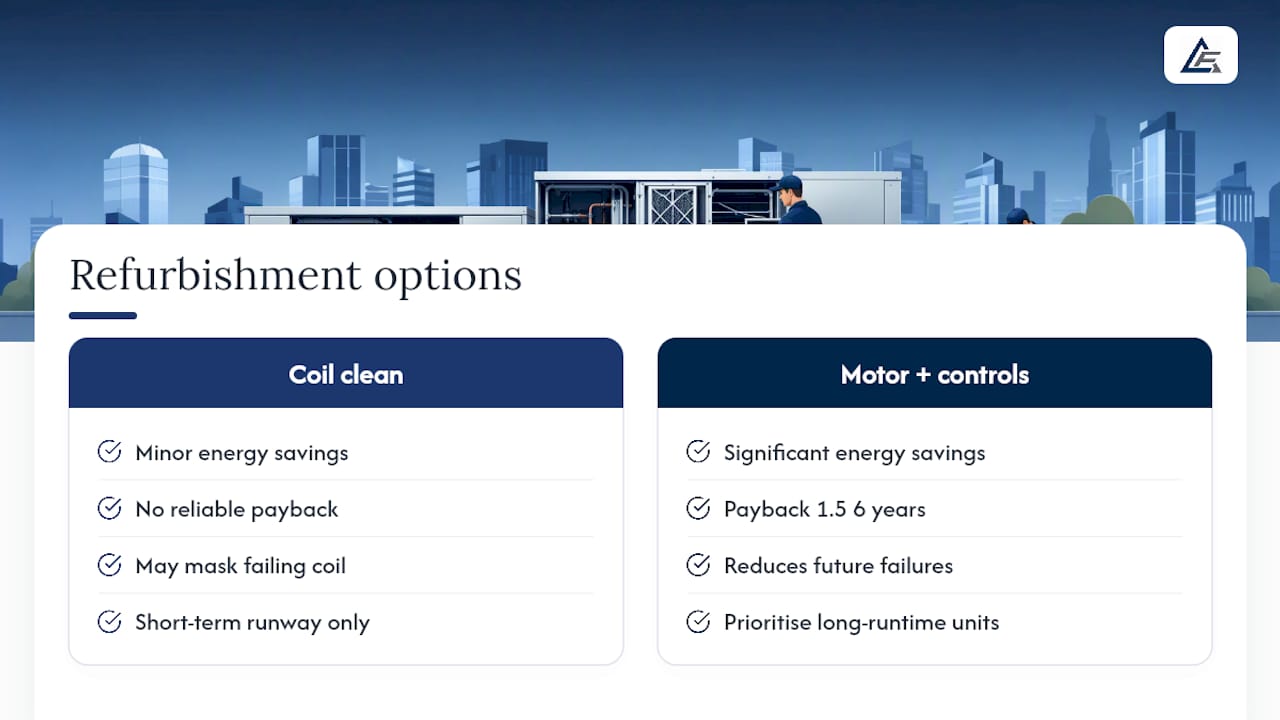
The conventional advice on fan coil refurbishment tends to stop at “clean it or replace it,” which misses where the real money sits. The motor and controls upgrade is where the payback lives, not the coil clean. A coil clean without an EC motor retrofit buys you a few years of runway on an inefficient unit; an EC motor and proportional control upgrade on a coil that’s already sound is what actually moves the energy bill.
Where estates teams go wrong most often is treating the survey as a formality rather than the decision point it is. Skipping the pressure test and structural check on the coil is how buildings end up refurbishing units that needed replacing, then facing the same failure again eighteen months later. The survey isn’t paperwork to satisfy procurement, it’s the only reliable way to separate a five-year fix from a false economy.
If you take one thing from this, prioritise the motor and control upgrade on units with long runtimes first. That’s where 1.5 to 4 year paybacks come from, and it’s the upgrade most likely to justify itself before the next budget cycle even closes.
— Ashley
Ready to survey your fan coil units?
Delta First is the accountable alternative to juggling separate contractors for every building services discipline. One team handles the survey, the EC motor retrofit, the controls commissioning, and the compliance paperwork, so you’re not chasing three different suppliers to explain why a “quick fix” didn’t deliver the promised saving.

A Delta First survey gives you a clear report: unit-by-unit condition, refurbishment versus replacement recommendations, and provisional timescales you can put in front of a budget committee. If your fan coil units are underperforming, noisy, or simply overdue a proper look, request a site survey or a planned preventative maintenance proposal through the Delta First landing page. Most surveys and quotations are returned promptly, giving your team a firm basis for planning works around occupied space rather than guessing at costs.
Sources
- Fan coil unit technology: EC motors (Eurovent Certita Certification)
- EC motor for fan coil units: energy, noise and control guide (Proventofan)
- HVAC fan coils: refurbish, retrofit or replace? | HPAC Engineering
FAQ
What is the typical lifespan of a fan coil unit?
A well-maintained fan coil unit typically lasts several years before major components fail. Chemical coil cleaning as part of refurbishment extends serviceable life by around five to seven years, while a full replacement typically offers 20 to 25 years of service.
How much does it cost to replace a fan coil unit?
Replacement costs vary widely depending on unit size, capacity and installation complexity, and there’s no single published UK figure that applies universally. Refurbishment with an EC motor retrofit is usually the lower-cost route where the coil and chassis remain sound, with paybacks commonly reported at 1.5 to 4 years in long-runtime buildings.
What are common problems with fan coil units?
The most frequent issues are condensate drain tray leaks, fouled or scaled coils reducing heat transfer, worn motors and bearings causing noise, and outdated controls that only allow on/off switching rather than proportional speed control. A site survey with pressure testing identifies which of these are refurbishable and which point towards replacement.
Does Delta First offer fan coil refurbishment surveys?
Delta First carries out fan coil condition surveys as part of its HVAC installation, commissioning and maintenance services across Essex, Suffolk, Norfolk and Greater London. Pricing depends on the scope of the survey and site, so contact Delta First directly through its landing page for a quotation.
Should I refurbish or replace an old fan coil unit?
Refurbish where the survey confirms a sound chassis and coil with only minor fouling or manageable leaks. Replace where pressure testing shows fin-to-tube failure, severe scaling, or where the unit is already beyond 7 to 10 years old with signs of corrosion.