

Use a LOLER inspection checklist to structure the thorough examination of your lifting equipment: statutory default intervals are at least every 6 months for equipment used to lift people and for lifting accessories, and at least every 12 months for other equipment, unless an examination scheme sets different periods. The checklist is a working site tool that captures findings; the legal record is the Report of Thorough Examination (ROTE), and equipment-specific templates make the process faster to run correctly.
TL;DR:
- Equipment used for lifting people or accessories must undergo thorough inspections every six months, while other lifting gear requires yearly checks unless specified otherwise.
- The checklist should include asset details, visual and functional condition, accessory integrity, measurement or load test results, and record immediate defects and actions taken.
- Inspections must be performed by a competent person with the necessary technical knowledge and independence, and results must be documented in a legally required report.
- External events such as accidents, repairs, or relocations trigger immediate inspections regardless of the scheduled interval.
- Maintaining organised records, including the declaration of conformity and inspection reports, is essential for audit readiness and ongoing compliance.
What should a LOLER inspection checklist include?
A working checklist needs to capture enough detail that a competent person can turn it into a valid ROTE without chasing missing information afterwards. Miss a field on site and you either delay the report or leave a gap in your compliance record, neither of which helps if the enforcing authority ever asks to see it.
Start with the paperwork basics, because these anchor everything else:
- Asset ID, location and equipment type
- Declaration of Conformity (DoC) reference, where applicable
- Date and outcome of the previous ROTE
- Recent maintenance or repair history
From there, the checklist moves into physical condition. Visual checks should cover the structure, welds, load-bearing members, and any sign of corrosion, cracking or deformation. Functional tests follow: brakes, limit switches, load indicators, controls and any interlocks need to be exercised, not just looked at. HSE guidance points examiners towards a mix of methods including visual examination, functional checks, measurements of wear, non-destructive testing and load testing depending on what the equipment and its history demand.
Accessories deserve their own line items, because they wear differently to the equipment they’re attached to:
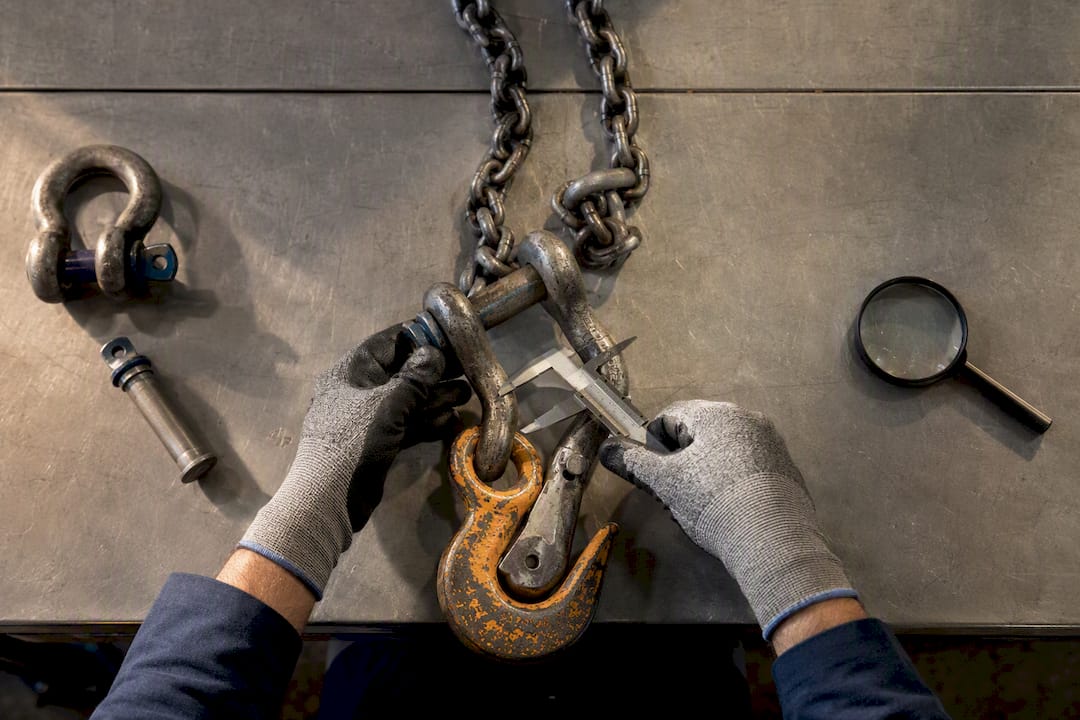
- Sling and chain condition, including marking and legibility
- Hook wear, deformation and safety catch function
- Elongation checks on chains and wire rope
- Shackle and connector integrity
Finally, build in fields for measurements taken, any NDT triggered by a visual concern, load test results, defect descriptions, and immediate action taken. If something is dangerous, the checklist needs a clear space to record isolation or tagging out, who was notified, and the remedial priority assigned.
Equipment-specific check points for common lifting equipment
Different equipment fails in different ways, so a generic checklist only gets you so far. Building out short, focused check blocks for each equipment type speeds up the examination and reduces the chance of missing something that only matters for that specific item.
Overhead and bridge cranes need attention on the hoist unit, runway rails, end stops, limit switches, brake performance and the condition of electrical controls and pendant stations. Runway rail alignment in particular gets overlooked because it degrades slowly, then causes sudden wear on wheels and bearings.
Mobile cranes and telehandlers bring boom integrity, the slewing ring, outrigger condition and deployment, the load moment indicator (LMI) calibration, and hydraulic system checks (hoses, cylinders, leaks) into scope. These machines see more variable ground conditions than fixed cranes, so outrigger and stability checks carry extra weight.
Hoists and winches hinge on drum and rope condition, gearbox performance, and brake holding capacity under load. A rope that looks fine at a glance can still have internal wire breaks, which is where measurement and NDT triggers earn their place on the checklist.
Lifting accessories — slings, chains, shackles and hooks — need marking legibility, elongation measurement, corrosion checks and deformation checks every time, regardless of which piece of primary equipment they’re attached to.
Forklifts sit in a slightly different category: the lifting elements (forks, mast, chains) fall under LOLER, while the rest of the vehicle is checked under PUWER as general work equipment. People-lifting equipment, such as mobile elevating work platforms and passenger hoists, needs the additional checks that come with the 6-month examination interval and a lower tolerance for deferred defects.
How often does LOLER require inspections?
The 6 and 12-month split is the default position under LOLER, not a fixed rule that apply regardless of circumstances. Thorough examinations must happen at least every 6 months for equipment used to lift people and for lifting accessories, and at least every 12 months for other lifting equipment, unless a written examination scheme specifies something different.
An examination scheme is a risk-based document, drawn up by a competent person, that can set bespoke intervals and methods for specific parts of your equipment. A scheme might call for wire ropes to be checked more often than a structural frame, provided that decision is documented and justified rather than assumed. Done properly, a written scheme of examination can reduce unnecessary downtime by targeting inspection effort where the risk actually sits.
Certain events override the calendar entirely and demand an examination regardless of when the last one happened:
- After an accident or dangerous occurrence involving the equipment
- Following a significant repair or modification
- After a long period out of service
- After reassembly or relocation to a new site
Once an examination is complete, record the next due date against the asset and make sure the examination scheme’s decisions are reflected in your asset register, not left in a filing cabinet.
Who can carry out a LOLER thorough examination?
Competence under LOLER isn’t a job title. It means having the technical knowledge, practical experience and independence to judge whether equipment is safe to continue in use, and to say no if it isn’t. A thorough examination is a systematic, detailed check carried out by a competent person; routine maintenance and pre-use checks don’t meet that bar, however diligently they’re done. A common pitfall is letting the same person both maintain the equipment and sign off its safety, which undermines the independence the process relies on.
The ROTE itself has fixed contents under Schedule 1 of LOLER:
- Details identifying the examiner and their employer
- Date of the examination and the date it’s next due
- Information identifying the equipment
- The safe working load (SWL)
- Particulars of any defect found and remedial action needed
If a defect is, or could become, dangerous, notification isn’t optional. The competent person must tell the duty holder immediately and send a copy of the report to the enforcing authority — HSE or the relevant local authority.
Retention periods vary by document type: some records must be kept until the equipment is no longer used, while reports on lifting accessories only need retaining for two years. Keep the DoC and every ROTE in the equipment’s own file so nothing gets lost in a general filing system.
Running the checklist on site: from pre-use checks to remedial work
A checklist only earns its keep if it connects to what happens next. Pre-use checks, examination scheduling and remedial tracking all need to sit on the same thread, or defects get logged and then quietly forgotten.
Before the first lift each shift, operators should run a quick visual and functional check: obvious damage, correct operation of controls, brake function, and any unusual noise or movement. This isn’t a thorough examination and shouldn’t be treated as one, but it catches the kind of deterioration that can appear between formal examinations.
The workflow from finding a defect to closing it out should run in a consistent order:
- Capture the defect on the checklist with a clear description
- Tag the asset out of service if there’s any doubt about safety
- Raise a work order for the remedial repair
- Confirm the repair and retest where relevant
- Attach the completed record to the ROTE and asset file
Pro Tip: Keep digital copies of every checklist and ROTE as immutable attachments against the asset record, not as loose files on a shared drive. When an inspector or insurer asks for history, you want a complete audit trail in seconds, not an afternoon of searching.
A sample LOLER checklist template you can copy
Here’s a compact block you can lift into a form, spreadsheet or paper pad and adapt to your own equipment register.
Header fields:
- Asset ID / description
- Location / site
- DoC reference (if applicable)
- Previous ROTE date
- Examination type (thorough / interim)
- Inspector name and date
Checks to complete:
- Visual condition (structure, welds, corrosion, deformation)
- Functional test (brakes, limit switches, controls)
- Accessory condition (slings, chains, hooks, shackles)
- Measurements taken (elongation, wear, NDT results)
- Load test result, where required
- Defects found and immediate action taken
Finish with a signature block and the next-due date, then attach the completed checklist to the asset file and the ROTE. That link between the working document and the statutory report is what turns a good habit into a defensible compliance record.
Delta First’s practical note on LOLER compliance
Delta First supports facilities teams across Essex, Suffolk and Norfolk and Greater London with PPM, compliance surveys and remedial repairs carried out by qualified engineers. We help clients establish and maintain examination schemes, and we manage the remedial work that follows a ROTE, closing the loop between finding a defect and fixing it.
Author perspective: compliance shouldn’t fight uptime
Triage matters more than volume: examine your highest-risk assets on the tightest schedule and let a well-documented examination scheme handle the rest. An independent competent person and prompt remedial work protect safety without grinding your operation to a halt.
— Ashley
Get LOLER-compliant checklists and support from Delta First
We provide a practical alternative to juggling LOLER compliance alone across multiple sites, delivering planned maintenance, compliance surveys and remedial repairs from a single accountable partner, rather than clients coordinating separate contractors for each stage.
Our teams help facilities managers across Essex, Suffolk and Norfolk and Greater London build examination schemes that fit their actual risk profile, respond quickly when a ROTE flags a defect, and keep records in order for audits and inspections. Whether you’re managing warehouse cranes, hoists or lifting accessories across an industrial site, a commercial office or a retail unit, having engineers who already know your building speeds up every remedial job. For specialist testing capacity beyond our own teams, we can also point clients towards independent engineering support for structural or NDT work where needed.
If your lifting equipment is due an examination scheme review, or you’ve had a defect flagged that needs fixing fast, request a quotation or planned maintenance survey from our commercial electrical contractors in Essex team and we’ll get back to you with next steps.
Need a reliable maintenance and compliance partner? Delta First provides planned preventive maintenance, statutory compliance support and reactive repairs from one accountable contractor across Essex, Suffolk and London, with 24/7 emergency cover. Call 01206 237422 or request a quote.
Sources
- Thorough examinations and inspections of lifting equipment
- LOLER 1998 — Schedule 1: information to be contained in a report of a thorough examination
FAQ
What does a LOLER inspection checklist include?
It covers asset identification, visual and functional checks, accessory condition, measurements or test results, and a section for recording defects and immediate actions, feeding directly into the ROTE.
What are LOLER inspection requirements?
Equipment needs a thorough examination by a competent person at statutory intervals, with results recorded in a ROTE containing the items listed in Schedule 1, including identification, dates, SWL and defects.
What are the LOLER regulations in the UK?
The Lifting Operations and Lifting Equipment Regulations 1998 require lifting equipment to be strong and stable enough for its use, examined by a competent person, and accompanied by records including the DoC and ROTE.
Is LOLER 6 months or 12 months?
Both, depending on the equipment: 6 months applies to equipment used to lift people and to lifting accessories, while 12 months applies to other lifting equipment, unless an examination scheme sets a different interval.
Recommended
- Act now: written scheme of examination for UK facilities managers
- Three tiers of UPS maintenance checklist for UK facilities managers
- Permit to work system: a facilities manager’s guide
Talk to Delta First
Delta First Building Services is a Colchester-based M&E contractor working across Essex, Suffolk and London, with commercial work in Norfolk. Our directly employed electrical team is supported by vetted specialist subcontractors where extra certification is needed, and we offer genuine 24/7 emergency cover. Get in touch to arrange a survey or quote.