

DEFRA confirmed in May 2026 that it will not change the HFC phasedown steps due from 1 January 2027, so the existing Annex 5 schedule stands. For UK operators, that means one thing: stop waiting for reform and start auditing refrigerant assets, service contracts and capital budgets this quarter, before the 2027 quota reduction tightens supply and pushes up prices.
TL;DR:
- UK operators should audit their refrigerant assets, service contracts, and budgets now to prepare for the 2027 quota reduction, which is a sharp 22.6% cut.
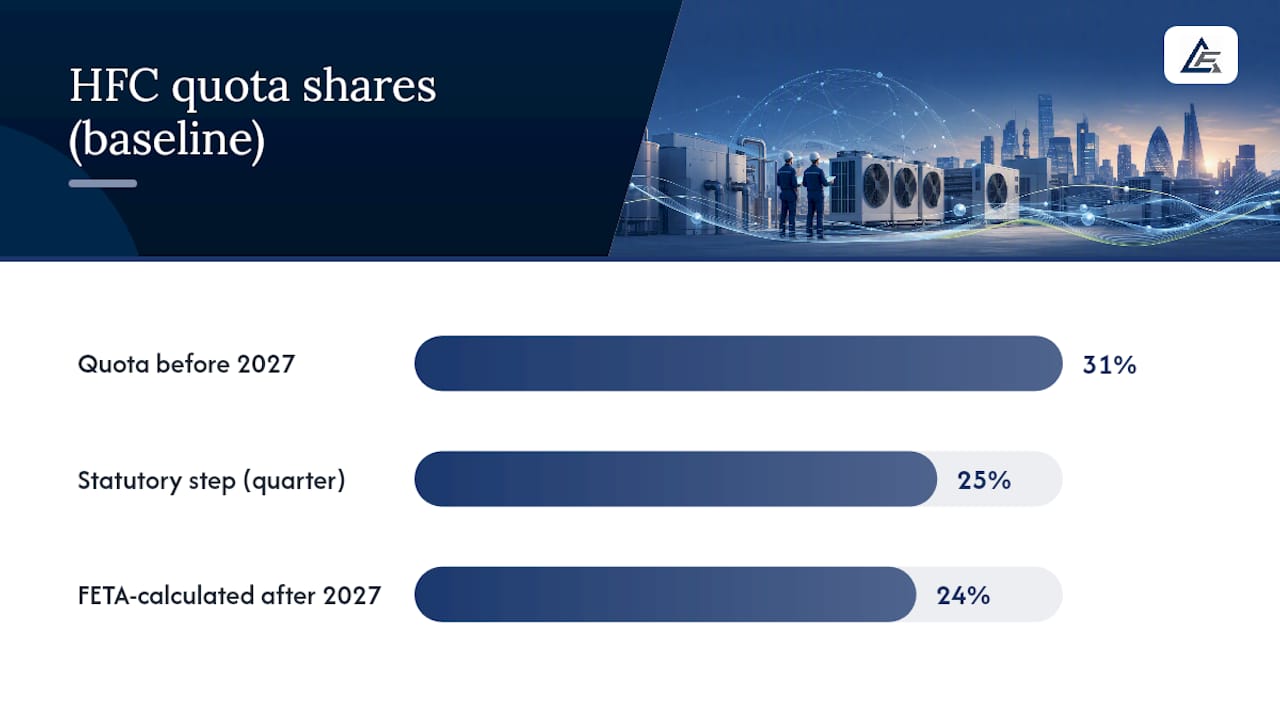
- The 2027 phasedown limits HFCs to 24% of the 2015 baseline, with supply mainly tightening for high-GWP refrigerants like R404A and R507A.
- Compliance obligations such as leak checks, record keeping, and technician certifications remain enforceable regardless of future regulation changes.
- Reclaimed refrigerant is becoming a vital supply route, but operators should avoid large speculative stockpiling and instead secure targeted reclaim agreements.
- A site audit before the next PPM renewal helps establish an evidence-based plan for retrofitting, replacing, or servicing equipment in line with upcoming supply constraints.
The 2026 regulatory position and the official timeline
DEFRA ran a consultation on amending the hydrofluorocarbon phasedown schedule and, in May 2026, ruled out legislating this year to alter the step due on 1 January 2027. Industry commentary from ACR News confirmed the same reading and urged operators to treat the outcome as clarity rather than delay. Whatever DEFRA eventually decides for future years, 2027 is locked in under current law.
That leaves Annex 5 of the GB F-Gas Regulation as the operative reference for anyone managing refrigerant assets.
- From 1 January 2027, the quantity of HFCs placed on the GB market drops to a quarter of the 2015 baseline.
- A further phasedown step is scheduled for early 2030 under current law.
- Both steps apply under the current schedule; DEFRA’s 2026 decision does not soften or defer either one.
In practice, that 2027 step represents a sharp contraction. FETA calculated it as a 22.6% reduction in refrigerant availability, moving quota allocation from 31% down to 24% of baseline in a single step. That is not a gradual taper, it is a cliff edge for anyone still relying heavily on virgin high-GWP gas.
There is a further wrinkle for multi-site operators. Northern Ireland continues to follow the EU F-Gas Regulation timeline rather than the GB schedule, which creates a genuine dual-compliance scenario. If your estate spans both jurisdictions, map which sites sit under which regime early, because procurement, servicing and record-keeping obligations can differ even where the equipment is identical.
Refrigerant supply, pricing and availability: what changes from 2027
Reduced quota availability tends to move through the market in a predictable pattern: gas gets scarcer, prices rise, and suppliers prioritise long-standing customers over one-off buyers. The 24% baseline step due in January 2027 will squeeze supply of the highest-GWP HFCs first, since quota allocation is weighted by CO2 equivalent, not physical volume.
Reclaimed refrigerant is becoming a genuine supply route rather than a fallback. As quota tightens, facilities that have secured reclaim contracts ahead of time avoid competing for scarce virgin gas on the spot market. That said, speculative bulk stockpiling carries real risk: capital gets tied up in cylinders that may not match future system requirements, and sourcing from unverified suppliers can leave you holding non-compliant stock. A smaller, targeted reclaimed-stock agreement covering your highest-GWP shortfalls generally delivers better operational resilience than a warehouse full of speculative purchases.
Sensible procurement steps for this quarter:
- Talk to your refrigerant supplier now about 2027 allocation and lead times, not next winter.
- Explore reclaim contracts for high-GWP refrigerants used in ageing plant.
- Stagger orders across the year rather than relying on a single bulk purchase before the step hits.
Pro Tip: If your estate runs several chillers on R404A or R507A, get reclaim pricing locked in before Q4 2026. Suppliers typically prioritise existing contract customers once the 2027 quota bites, and spot-market buyers are left last in the queue.
Compliance duties you must maintain through 2026 and beyond
None of the quota mechanics change your day-to-day legal obligations. Leak checking, record keeping and technician competence remain enforceable regardless of what happens with future phasedown steps.
- Calculate CO2e correctly. Leak-check frequency depends on the CO2 equivalent tonnage of the refrigerant charge, not the physical kilograms. Gov you need to determine which threshold your system falls into.
- Check refill legality before every service. Certain F-gases are already banned for refilling equipment above specific GWP thresholds. Gov, and it is worth checking before every service visit, not just annually, since restrictions have moved in stages.
- Keep auditable records. Leak-check dates, quantities added, technician certification numbers and equipment identification all need to be logged and retained for inspection.
- Verify technician competence. Anyone handling F-gas refrigerants must hold the appropriate F-Gas certification. Ask for evidence of current certification before any engineer works on your plant, particularly if you use multiple contractors across a large estate.
Falling behind on any of these exposes you to enforcement action independent of the 2027 quota step, so treat compliance as the baseline, not the finish line.
Servicing, retrofitting, refurbishing or replacing: which route fits your plant?
Every ageing refrigeration or HVAC asset eventually forces a decision between four routes, and the right answer depends on specifics rather than a blanket policy.
- Continue servicing where the system is younger, charge size is modest, and reclaimed or existing stock covers foreseeable top-ups.
- Retrofit where the plant has years of useful life left but runs on a high-GWP refrigerant facing supply pressure. Note that many drop-in alternatives carry lubricant or capacity penalties, so check compressor and oil compatibility before committing.
- Refurbish where mechanical components are sound but controls, seals or heat exchangers are limiting efficiency and reliability.
- Replace where the system is near end-of-life, downtime tolerance is low, or whole-life cost modelling favours a new, lower-GWP unit over repeated interim spend.
Weigh system age, charge size, acceptable downtime and whole-life cost together rather than in isolation, and build in realistic procurement lead times. Equipment orders and specialist retrofit parts are already taking longer to arrive as suppliers manage the run-up to 2027, so schedule disruptive work outside peak occupancy periods wherever you can.
Delta First’s practical audit checklist for facilities managers
A rapid site audit gives you the evidence base for every decision above. On each visit, our engineers capture:
- Refrigerant type and total charge per system, converted to CO2e.
- Current leak-check status and next due date.
- Service history, including any refill events and technician records.
- System age, condition, and realistic remaining service life.
- Immediate risks: banned refill exposure, missing records, or unverified reclaim sourcing.
From there, the priority order is straightforward: secure reclaimed supply for at-risk systems, schedule any overdue leak tests, and update your PPM schedule and capital plan to reflect what the audit found.
Pro Tip: Run this audit before your next PPM renewal, not after. It gives you real numbers to take into budget conversations, rather than a rough estimate based on system age alone.
Delta First supports clients across Essex, Suffolk, Norfolk and Greater London, with structured chiller and HVAC maintenance programmes built around exactly this kind of evidence. A site survey typically delivers a full asset register, compliance status summary and a phased retrofit or replacement roadmap you can take straight into next year’s budget round.
Industry perspective: plan in phases, not in one leap
The temptation after a “no change” announcement is to relax. That would be a mistake. The smarter response is phased: audit now, retrofit the highest-risk systems next, and hold full replacement in reserve for plant that genuinely needs it. Spreading investment this way limits disruption and keeps capital flexible while the post-2027 landscape settles.
— Ashley
Get ahead of the 2027 quota step with a Delta First survey
Delta First gives facilities teams something the phasedown timeline doesn’t: a fixed, evidence-based plan instead of a guessing game about which systems to fix first. Where generic contractors quote reactively per callout, our site surveys map your entire refrigerant estate against the 2027 step before you commit budget, so you retrofit or replace only what genuinely needs it.

Our engineers deliver planned preventative maintenance for chillers that keeps leak-check and record-keeping obligations current, alongside HVAC maintenance planning that factors refrigerant risk into your capital forecasting. A survey typically covers your full plant list, current compliance status, and a prioritised retrofit or replacement roadmap you can act on this financial year. For sites where equipment-specific service data matters, our partners at Conexcool provide further technical detail on serviceable equipment types.
If you manage commercial, industrial, education, healthcare or retail premises across Essex, Suffolk, Norfolk or Greater London, request a quotation or planned maintenance survey, from Delta First and get a clear, costed view of what the 2027 phasedown step means for your estate.
Authoritative guidance and primary sources
- DEFRA consultation and 2026 update on the HFC phasedown schedule
- Gov
- Gov
- FETA’s May 2026 F-Gas update
Need support with mechanical or HVAC maintenance? Delta First delivers planned and reactive mechanical maintenance across Essex, Suffolk and London, using certified specialist partners for gas and refrigerant work, with 24/7 emergency cover. Call 01206 237422 or request a quote.
Sources
FAQ
What refrigerant is being phased out in 2026?
No specific refrigerant was newly banned in 2026. DEFRA confirmed it would not legislate to change the existing phasedown schedule, so high-GWP HFCs continue their scheduled decline toward the 2027 quota step.
Is R32 refrigerant being phased out in the UK?
R32 has a lower GWP than many legacy refrigerants and is not subject to the same refill bans, so it remains in active use for new installations. It still counts toward overall HFC quota under Annex 5, but its lower CO2e makes it less exposed to the 2027 squeeze than higher-GWP gases.
What are the current refrigeration regulations in the UK?
Operators must comply with leak-check frequencies based on CO2e charge, keep auditable service records, use only certified technicians, and check the banned refill list before any service involving refrigerant top-up.
Is R-410A refrigerant available in the UK?
R-410A remains available but is increasingly constrained by quota reductions, since it carries a higher GWP than some newer alternatives.
What should facilities managers do before the 2027 quota step?
Audit refrigerant assets now, covering charge size, service history and leak-check status, then prioritise reclaim contracts or retrofit projects for the highest-GWP systems. A structured survey from a qualified contractor gives you the evidence to plan procurement and budget ahead of the tightening.
Recommended
- UK FMs: Decarbonise Building Heat with BMS First and Lifecycle Timing
- Summer HVAC maintenance: a guide for facilities managers
- Air conditioning consulting for facilities managers: UK guide
- UK chiller maintenance: PPM schedule that meets F‑Gas and Legionella
Talk to Delta First
Delta First Building Services is a Colchester-based M&E contractor working across Essex, Suffolk and London, with commercial work in Norfolk. Our directly employed electrical team is supported by vetted specialist subcontractors where extra certification is needed, and we offer genuine 24/7 emergency cover. Get in touch to arrange a survey or quote.