

Whether a lighting upgrade delivers a positive return depends on three things working together: energy savings, maintenance savings and any incentives you can claim. A generic calculator will give you a rough figure, but the reliable answer comes from a site-specific survey and a whole-life costing appraisal. That is the single most effective step before committing budget, and it is exactly what Delta First provides for facilities teams weighing up an LED retrofit.
TL;DR:
- Site-specific surveys and whole-life costing are essential for accurately evaluating ROI rather than relying on generic calculators.
- Lighting controls, operating hours, and product quality significantly influence payback periods, with occupancy sensors increasing savings by 30 to 50 percent.
- Whole-life costing using net present value offers a more reliable assessment than simple payback, especially for long-term, multi-site projects.
- Monitoring and measurement protocols, including sub-metering and contractual protections, are crucial to verify actual savings and prevent performance drift.
- Delta First’s integrated approach reduces risks by combining installation, maintenance, and ongoing performance verification within a single accountable team.
Table of Contents
- Step-by-step calculation: energy savings, maintenance savings and total annual benefit
- How to use online calculators safely and what they miss
- Key factors that materially change ROI: controls, hours and product quality
- Whole-life costing and NPV: the right way to appraise a lighting project
- Verify and lock in savings: monitoring, measurement and contractual protections
- Delta First perspective: how we protect your projected ROI
- Request a site survey or LED lighting quotation
- Sources
- FAQ
Step-by-step calculation: energy savings, maintenance savings and total annual benefit
Before you calculate anything, collect these figures for the space you are assessing:
- Existing wattage per fitting and the proposed LED wattage.
- Number of fittings in the area or zone being upgraded.
- Operating hours per day and days per year the lights run.
- Electricity tariff in pence per kWh, taken from a recent bill.
- Annual maintenance cost, including lamp replacements, access equipment and labour.
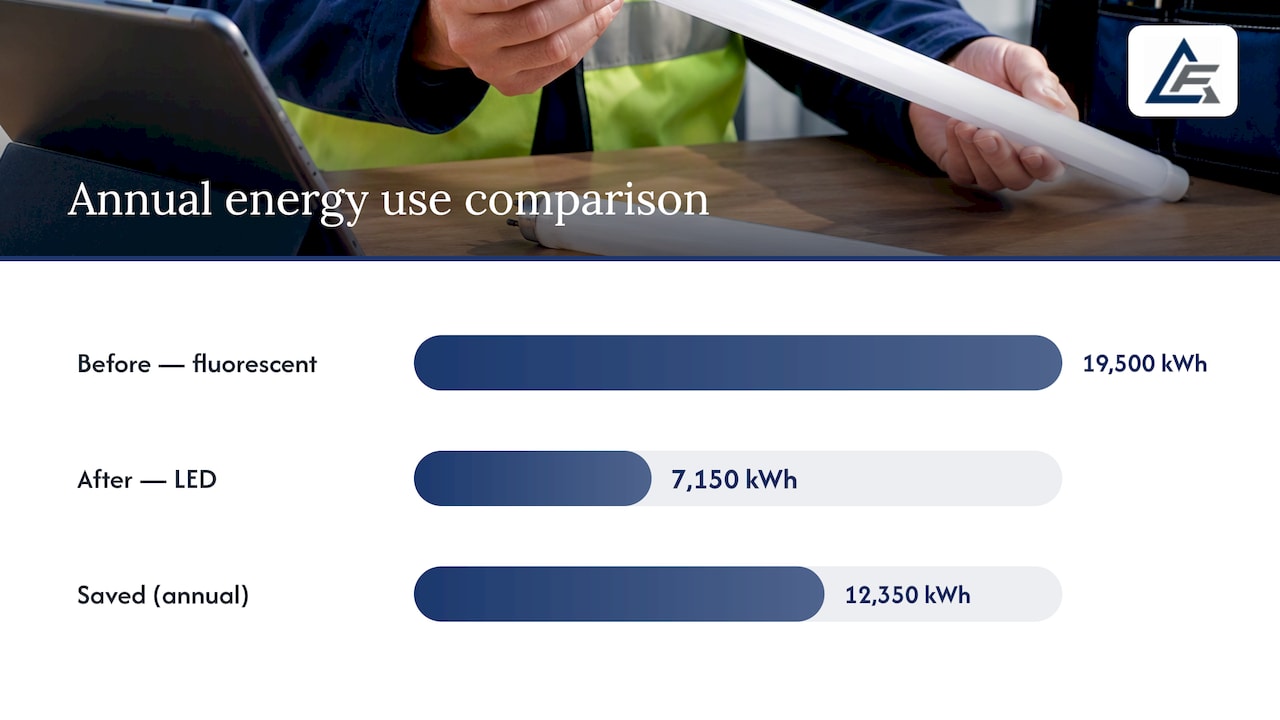
The core energy saving formula is: (existing wattage minus proposed wattage) multiplied by number of fittings, divided by 1,000, multiplied by operating hours, multiplied by the kWh tariff. This gives your annual energy saving in pounds. Add to that the maintenance saving, which usually comes from fewer lamp changes, less need for access equipment such as scissor lifts, and reduced call-out labour, since LED fittings typically outlast fluorescent tubes by a wide margin.
LED upgrades can cut lighting energy use by a large margin compared with older fluorescent technology, according to government lighting guidance, which gives you a sense of the ceiling on savings before you run your own site numbers.
Take a conservative worked example: 50 fittings currently at 150W, replaced with 55W LED equivalents, running 10 hours a day, 260 days a year, at 20p per kWh. That is (150-55) x 50 / 1,000 x 2,600 x £0.20, which comes to £2,470 a year in energy savings alone. Add some reduction in maintenance costs and you have a total annual benefit before incentives are even considered.
How to use online calculators safely and what they miss
Generic ROI calculators are a useful starting point but rarely tell the whole story. They tend to be accurate on inputs you control directly, such as kWh tariff and estimated operating hours, but far rougher on installation cost, controls integration and existing baseload assumptions, which vary enormously between sites.
Before you trust a calculator’s output enough to take to a budget holder, work through this checklist:
- Cross-check tariff and hours against your last twelve months of energy bills, not estimates.
- Get an installation quote that reflects your actual building, not a generic per-fitting rate.
- Add VAT, contingency and disposal costs for old fittings, none of which most calculators include by default.
- Compare the adjusted figure against a supplier quote before approving spend.
Pro Tip: Treat any online calculator result as a draft business case, not a final figure, until it has been checked against a site survey and a supplier’s itemised quote.
Key factors that materially change ROI: controls, hours and product quality
Several site-specific factors move the payback calculation more than people expect, and most are within your control at the design stage.
- Lighting controls: occupancy sensors and daylight dimming commonly add a further 30 to 50% in savings in appropriate zones such as corridors, storerooms and daylit offices.
- Operating hours: a warehouse running lighting 24/7 will typically see payback far sooner than a nine to five office, since the same wattage reduction is multiplied across many more hours.
- Product quality: fittings with longer warranties and higher lumen efficacy cost more upfront but reduce failure rates and replacement costs across the life of the asset.
- Incentives: grants, capital allowances and choosing ETL-listed products can reduce net capital cost and simplify procurement, since ETL compliance gives some assurance that a product performs as the supplier claims.
Whole-life costing and NPV: the right way to appraise a lighting project
Simple payback tells you how many years it takes to recover your outlay, but it ignores energy price inflation, the time value of money and what happens to the asset after payback. Net present value, or NPV, addresses this by discounting future savings back to today’s terms, which is why the Carbon Trust recommends NPV and life-cycle costing over simple payback for accurate appraisal.
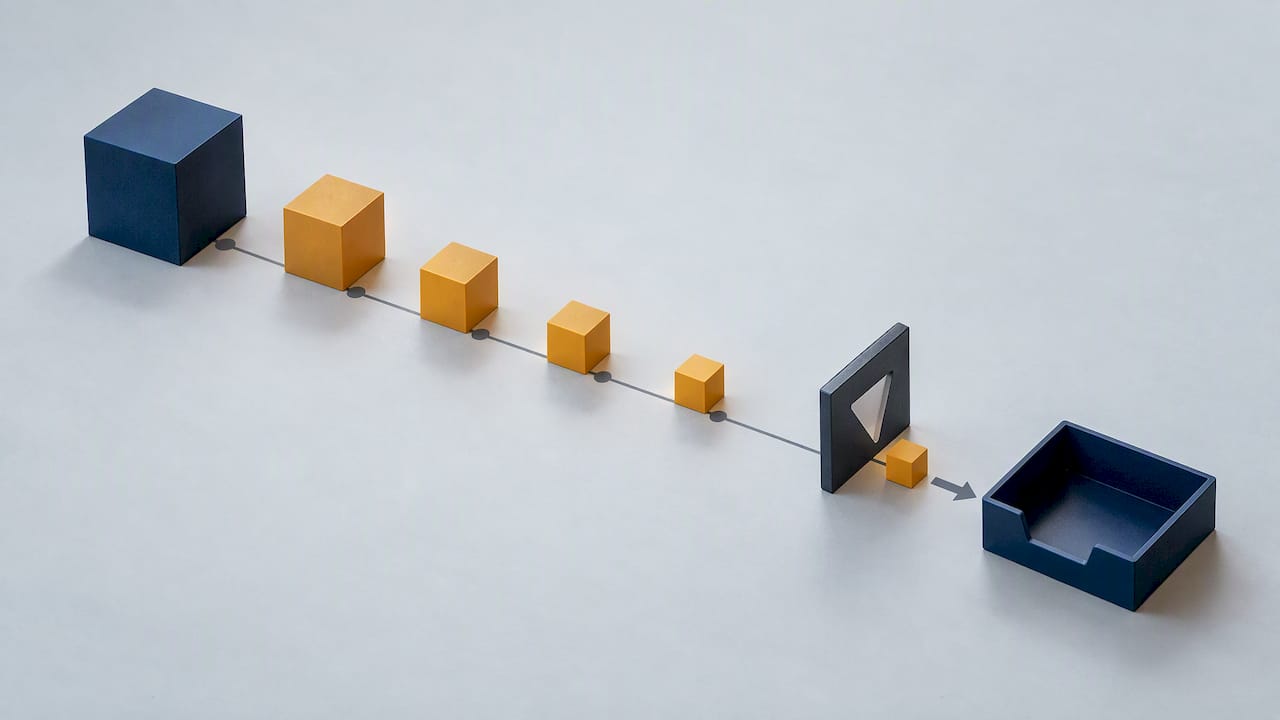
Use whole-life costing when the decision involves multi-site procurement, long-term asset planning, or when the upgrade is one part of a wider refurbishment. Simple payback is usually sufficient for a small, low-risk, single-area project.
To build a life-cycle cost, work through these additions to your simple payback figure:
- Add projected maintenance and lamp replacement costs across the expected asset life.
- Factor in disposal costs for old fittings and any residual value of the new ones.
- Apply a discount rate to future savings to reflect the time value of money.
As an illustration, a project with a four-year simple payback and a ten-year asset life might show a materially stronger NPV once ten years of discounted energy savings are included, rather than just the initial four.
Verify and lock in savings: monitoring, measurement and contractual protections
A projected saving only becomes a real one once it is measured. Carbon Trust commissioning guidance recommends pre and post-installation metering, agreed measurement and verification protocols, and ongoing monitoring to confirm that a project delivers what was promised.
- Sub-meter the zone before and after installation rather than relying on whole-site averages.
- Agree acceptance tests and staged payments tied to measured performance, not just completion.
- Set a review point at three and twelve months to catch any drift from projected savings.
- Keep planned maintenance in place afterwards, since dirty diffusers, faulty sensors and ageing drivers erode savings over time.
Pro Tip: Build a remediation clause into your contract so any shortfall against agreed savings triggers a supplier review, not a dispute.
Delta First perspective: how we protect your projected ROI
The biggest false economy in lighting upgrades is treating the retrofit as a one-off transaction rather than an asset decision. We approach every lighting upgrade as part of a building’s ongoing performance, starting with a site survey and LED lighting design, upgrade and retrofit service that produces a whole-life costing appraisal before any commitment is made.
Because Delta First delivers electrical installation and planned preventative maintenance through the same accountable team, there is no handoff between the contractor who installs the fittings and the one who maintains them afterwards. That reduces the risk of savings eroding through neglected servicing, and it means handover reporting and verification data sit with the same partner you can return to if performance needs checking.
— Ashley
Request a site survey or LED lighting quotation
A site survey checks operating hours, current tariff, existing wattage and fitting condition, then builds a whole-life costing model with a draft payback figure before you commit to anything.

Visit our LED lighting design, upgrade and retrofit page to request a quotation or a planned maintenance survey, and ask for an itemised business case alongside a measurement plan so you know exactly how savings will be confirmed once installation is complete.
Sources
For further reading beyond this guide, the Carbon Trust’s lighting overview guide covers appraisal methods in more depth, while the government ETL leaflet lists qualifying products and typical savings ranges. A real project example worth reviewing is Dorset Council’s Canford manufacturing LED case, which shows a net project cost of about £7,000 repaid in just over two years. Non-energy benefits, including staff wellbeing, are covered in this workplace lighting and productivity article.
FAQ
What is the depreciation life of lighting?
Depreciation schedules vary by accounting policy and jurisdiction, so there is no single fixed figure that applies universally. For appraisal purposes, most facilities teams pair the asset’s expected working life with a whole-life costing model, as recommended in Carbon Trust guidance, rather than relying on depreciation alone.
How much area will 2,000 lumens cover?
Coverage depends heavily on ceiling height, fitting type and the light level required for the task, so there is no single area figure that applies to every space. A site survey measures actual lux levels against the relevant task requirement rather than working from lumen output alone.
How do I calculate the ROI rate on a lighting upgrade?
Simple payback divides the net project cost by the total annual savings from energy and maintenance combined. For a more accurate long-term figure, the Carbon Trust recommends using NPV or life-cycle costing, which accounts for energy price changes and the asset’s full working life.
How much does it cost to run an LED light for 24 hours?
Running cost depends on the fitting’s wattage and your electricity tariff, so it is calculated by multiplying wattage in kilowatts by hours run and by the tariff in pence per kWh. Sector guidance has shown a 150W LED costing considerably less annually to run than an equivalent 150W discharge fitting at the same tariff, illustrating the scale of savings from switching technology.