

Fixed wire testing produces the Electrical Installation Condition Report (EICR), the recognised evidence that a commercial electrical installation is safe to keep operating. If yours is overdue, or the last report carried a C1 or C2 code, you have a live duty to act. Under Regulation 4(2) of the Electricity at Work Regulations 1989, duty holders must maintain electrical systems so far as reasonably practicable to prevent danger, and the HSE treats periodic inspection and testing as the accepted way to prove that duty is being met.
Three things to check today:
- Locate your current EICR and read the “next inspection date” field.
- If that date has passed, or the report was marked Unsatisfactory, book testing now rather than waiting for a renewal reminder.
- If the last report flagged C1 or C2 observations with no evidence of remedial work, treat that as an open compliance gap, not paperwork.
Key takeaways
Fixed wire testing produces the EICR duty holders need to prove compliance with Regulation 4(2), and treating its recommended next inspection date as fixed, not flexible, is what keeps that compliance defensible.
| Point | Details |
|---|---|
| Duty holder responsibility | Legal accountability for maintenance stays with the property or facilities manager, even when testing is contracted out. |
| Treat C1 and C2 as urgent | C1 needs immediate isolation; C2 needs urgent remedial work, ideally completed within 28 days. |
| Frequency is risk-based | No fixed legal interval exists, but BS 7671 guidance commonly treats 5 years as a commercial maximum. |
| Verify contractor competence | Check qualifications, insurance and registration scope, and request a sample EICR before appointing anyone. |
| Delta First as compliance partner | Delta First runs planned EICR surveys, remedials, retesting, and PPM contracts across Essex, Suffolk, Norfolk, and Greater London. |
What does fixed wire testing actually cover?
An EICR examines the fixed parts of your electrical installation, not appliances or portable equipment. That means consumer units and distribution boards, the fixed wiring itself, earthing and bonding arrangements, protective devices, and specialist circuits such as emergency lighting, fire alarm supplies, and UPS feeds.
The competent electrician combines several methods to build the picture:
- Visual inspection of accessible wiring, enclosures, and terminations.
- Dead testing (circuits isolated) for continuity and insulation resistance.
- Live testing for earth loop impedance and RCD operation.
- Three-phase checks on larger commercial and industrial installations.
The output is the EICR itself: a formal document listing observations against codes (C1, C2, C3, FI) alongside a recommended date for the next inspection. Commercial surveys are inherently more complex than domestic ones because of the scale of distribution and specialist circuits involved.
Who is legally responsible for fixed wiring testing?
Responsibility sits with the duty holder, and that role cannot be outsourced away. If you’re the property manager, facilities manager, or business owner with control over an electrical installation, the legal duty stays with you even when a contractor physically carries out the testing.
Two pieces of legislation sit behind this. The Electricity at Work Regulations 1989 require systems to be maintained to prevent danger, and the Health and Safety at Work etc. Act 1974 places a broader duty on employers to maintain a safe working environment. Neither piece of law hands you a certificate template, but both expect you to demonstrate maintenance, and an EICR is how that gets proven.
Most duty holder obligations under EAWR 1989 relate to ongoing maintenance rather than one-off installation checks, which is why periodic testing carries significant legal weight.
- The duty holder role covers whoever controls the premises, not just the freeholder.
- Contracting out the physical testing does not transfer legal accountability.
- HSE guidance treats a current EICR as your primary evidence if an incident or audit occurs.
Is fixed wire testing a legal requirement in the UK?
The law does not set a fixed number of years between tests. EAWR 1989 requires maintenance “so far as is reasonably practicable” to prevent danger, but the actual interval is risk-based, not a statutory countdown.
That’s where BS 7671 and IET guidance come in. Industry practice, referenced in HSE’s own guidance material, treats five years as a typical maximum interval for commercial premises, with industrial sites, higher-risk environments, or heavily used installations often needing shorter cycles. The technical standard behind these assessments is BS 7671, maintained by the IET.
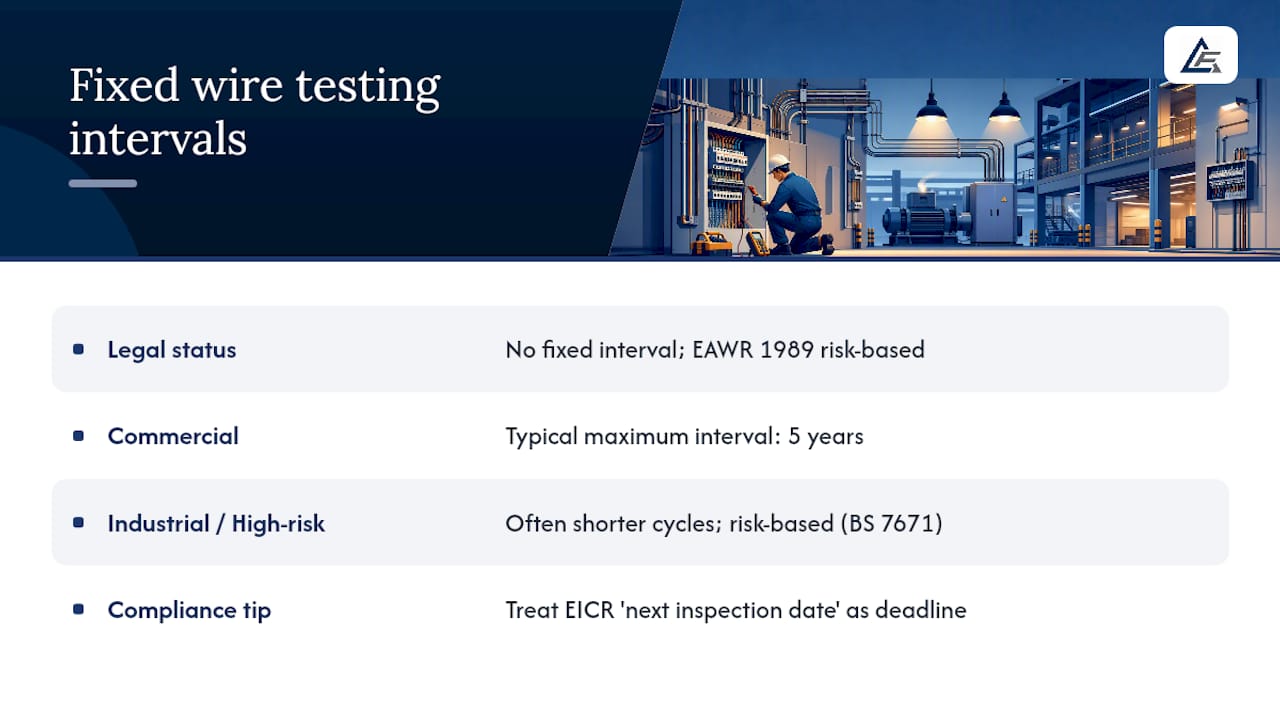
Pro Tip: Once your competent electrician writes a “next inspection date” on the EICR, treat it as a compliance deadline rather than a suggestion. Auditors and insurers increasingly read a missed recommended date as evidence of neglect, not an administrative oversight.
Who can carry out fixed wire inspections and testing?
Competence is a legal threshold, not a preference. EAWR 1989 requires that anyone carrying out this work has the skill, knowledge, and experience to do it safely and accurately, which is why relying on self-certification is a genuine liability gap.
Verify competence through the relevant scheme or qualification records rather than taking a contractor’s word for it. Before appointing anyone, ask for:
- A sample EICR so you can judge report quality and clarity.
- Proof of qualifications, insurance and any current scheme registration.
- Public liability insurance documentation.
- A proposed access plan for isolations, risers, and plant rooms.
- Realistic timescales for quoting and completing any remedial work.
What do EICR observation codes mean?
The codes on your report tell you how urgently to act, and getting the priority order wrong is the single most common compliance mistake among duty holders. C1 means danger is present now: the electrician should isolate the circuit immediately, and the installation may not be safe to keep energised. C2 means a potentially dangerous condition exists that needs urgent remedial work, even though it isn’t an immediate hazard. C3 is advisory, an improvement recommendation rather than a defect. FI means further investigation is needed before a code can even be assigned.
- C1: stop use of the affected circuit and rectify immediately.
- C2: arrange urgent remedial works; don’t let this drift into “next year’s budget”.
- C3: schedule as part of routine improvement, no immediate action required.
- FI: commission further investigation before assuming the installation is safe.
An EICR carrying any C1 or C2 observation is marked Unsatisfactory, which has real implications for insurance cover and continued use of the premises. Keep Minor Electrical Installation Works Certificates and updated EICR entries as proof once remedial work is complete, because sector guidance treats these codes as the framework insurers and auditors expect you to follow.
What happens during a fixed wire testing visit?
Good planning prevents most of the disruption commercial testing causes. Poor access planning around ceilings, risers, and plant rooms is one of the most frequent causes of delay on commercial sites, so agree isolation windows and gather your asset list and previous EICR before the electrician arrives.
- Pre-visit: compile the asset list, prior EICR, and access arrangements for restricted areas.
- Visual inspection of accessible wiring, enclosures, and circuit labelling.
- Dead testing on circuits that can be safely isolated.
- Live testing, including RCD operation and earth loop impedance, where isolation isn’t required.
- Three-phase testing on larger distribution systems where applicable.
- Issue of the EICR with a walkthrough of findings and any immediate isolations.
Pro Tip: Ask your contractor to flag any C1 finding verbally on the day, not just in the written report. A circuit that’s genuinely dangerous shouldn’t wait for the paperwork to reach your inbox.
How much does fixed wire testing cost?
Cost scales with complexity rather than floor area alone. The number of distribution boards and circuits, the presence of three-phase supplies, and how difficult access is (out-of-hours work, restricted risers, occupied areas) all drive the quote up or down.
- Build contingency into your budget for urgent C1 or C2 remedials, which are common enough to plan for rather than treat as a surprise.
- Ask for fixed-price retest quotes once remedial work is agreed, rather than open-ended day rates.
- If you manage several sites, consider block contracting to smooth costs across a portfolio.
The cheapest quote is rarely the right choice for compliance work. A contractor’s evidence of prior commercial EICR experience matters more than shaving a few pounds off the invoice.
What to do if your EICR comes back unsatisfactory
An Unsatisfactory result means at least one C1 or C2 observation, and each carries a different urgency.
- C1 findings: isolate the affected circuit straight away and, where necessary, take that part of the installation out of service until emergency remedial work is complete.
- C2 findings: get remedial quotations promptly and schedule the work; best practice is completion within 28 days where practicable, with progress documented as you go.
- Evidence: once work is finished, obtain a Minor Electrical Installation Works Certificate or a retest EICR entry, and retain both for HSE and insurer scrutiny.
Skipping the documentation step is a common mistake. Completing the physical repair without recording it leaves you unable to prove compliance if questioned later.
What records should you keep for future inspections?
Keep every current and historical EICR, Minor Electrical Installation Works Certificates, electrical installation certificates, PAT records, and emergency lighting test logs together, not scattered across departments.
- Build your inspection schedule around the competent person’s recommended next date and the installation’s actual risk profile.
- Centralise everything in a single compliance folder or asset management system linked to your wider PPM contracts, so testing doesn’t get missed between renewals.
How Delta First supports your compliance programme
Delta First is the practical route to closing that compliance gap without juggling multiple contractors for surveys, remedials, and retests. We run planned EICR surveys, remedial works, retesting, and full PPM contracts as one coordinated service, with compliance record management included rather than left to you to piece together afterwards.

Our engineers work across Essex, Suffolk, Norfolk, and Greater London, which means local response times and testing teams who already understand commercial and industrial distribution systems, including three-phase installations. Where an EICR uncovers wider capacity or load issues, we manage the end-to-end project so isolations, remedial work, and retesting happen with minimal disruption to your operation, supported by tools like the Commercial EV Charging ROI calculator to assess technical and load considerations. If a technical term in your report needs clarifying, our building services glossary is a quick reference point. For larger sites with complex distribution, our industrial and logistics services team has the scale to match. Get in touch through Delta First to request a quotation or book a planned maintenance survey before your next inspection date arrives.
Why we push duty holders to treat next inspection dates as fixed
Most compliance failures we see don’t come from ignorance of the law. They come from treating the EICR’s recommended next inspection date as a soft target rather than a deadline. Facilities teams get busy, budgets get reprioritised, and a five-year cycle quietly slips to six or seven.
The problem is that EAWR 1989 doesn’t care about your budget cycle. It cares whether the installation is being maintained to prevent danger, and an overdue EICR with no documented reasoning behind the delay is exactly the kind of gap an insurer or HSE inspector will seize on after an incident. The regulation itself is flexible on intervals precisely because it expects duty holders to make a reasoned, risk-based decision, not because it’s giving you licence to ignore the schedule your own contractor set.
The other pattern worth naming: businesses that shop purely on price for retest work after a C2 finding. A contractor who quotes low but has never handled a commercial three-phase distribution board is a false economy. You end up paying twice, once for the incomplete fix and again for the electrician who has to unpick it.
Frequently asked questions
How often does fixed wire testing need to happen for commercial premises?
There’s no fixed statutory interval. Industry guidance built on BS 7671 commonly treats five years as a maximum for typical commercial premises, though your competent electrician sets the actual date based on the installation’s risk profile.
What’s the difference between an EICR and a periodic inspection?
They’re the same process described two ways. Periodic inspection and testing is the activity; the EICR is the certificate produced once that activity is complete.
Can I use any electrician for fixed wire testing?
No. EAWR 1989 requires a competent person, so verify qualifications and any registration rather than relying on a contractor’s own claims of experience.
What happens if I ignore a C2 observation?
The installation remains classed as Unsatisfactory until the work is fixed and evidenced. That leaves you exposed if an incident occurs, and it can affect your insurance position in the meantime.
Do I need to keep old EICRs once a new one is issued?
Yes. Retaining historical reports alongside Minor Electrical Installation Works Certificates builds a maintenance history that HSE and insurers may ask to see.
Need help with your electrical installation or compliance? Delta First’s directly employed electricians provide testing, maintenance, installations and upgrades for commercial and residential properties across Essex, Suffolk and London, with 24/7 emergency cover. Call 01206 237422 or request a quote.
Sources
Recommended
Talk to Delta First
Delta First Building Services is a Colchester-based M&E contractor working across Essex, Suffolk and London, with commercial work in Norfolk. Our directly employed electrical team is supported by vetted specialist subcontractors where extra certification is needed, and we offer genuine 24/7 emergency cover. Get in touch to arrange a survey or quote.
[…] of your recording template now. Fixed wire testing that already shows separated observations](https://deltafirst.co.uk/blog/fixed-wire-testing) will save you a re-inspection […]