

Yes: fire door inspections are a legal duty for Responsible Persons across the UK, not an optional extra. If you manage a multi-occupied residential building over 11 metres, the Fire Safety (England) Regulations 2022 set firm minimum checks, and every other premises must follow a schedule set by its fire risk assessment under the Regulatory Reform (Fire Safety) Order 2005.
The minimum legal position breaks down like this:
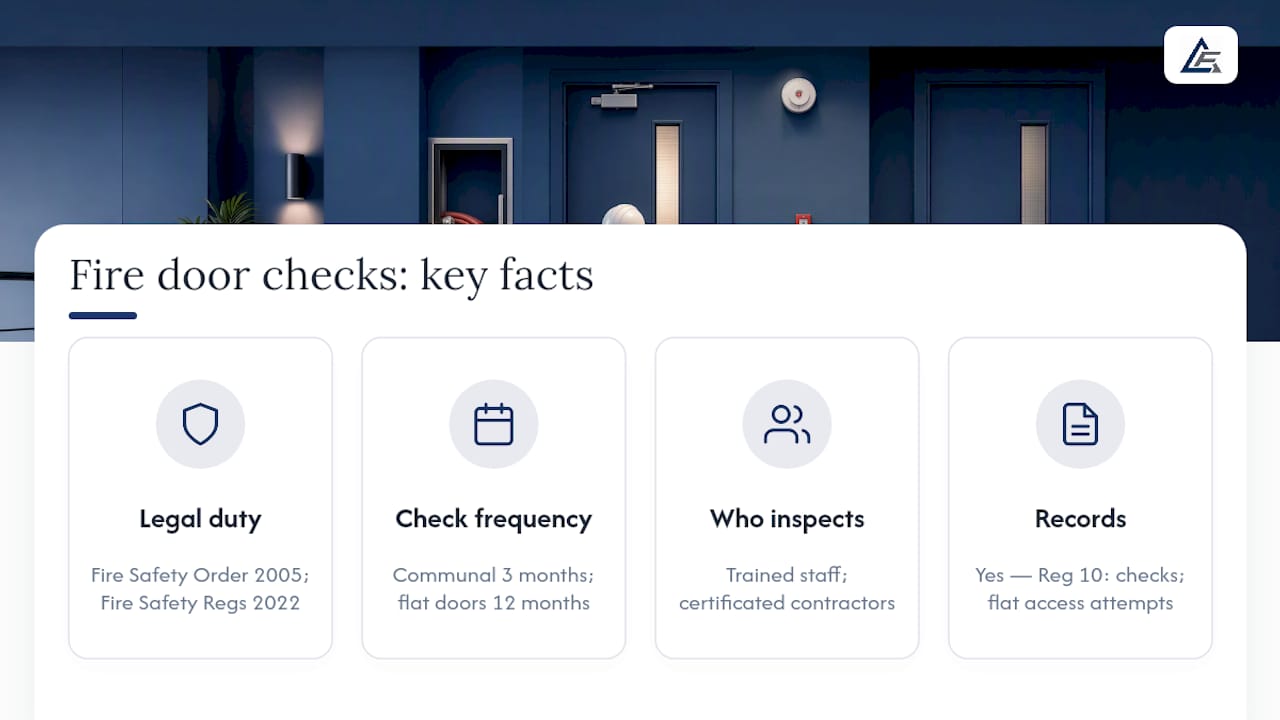
- Communal fire doors in qualifying blocks: checked at least every three months.
- Flat entrance doors: checked using “best endeavours” at least every 12 months.
- All other premises: frequency set by the fire risk assessment, informed by usage and risk.
- Enforcement: local fire and rescue services audit compliance and can prosecute serious breaches.
Pro Tip: Log every inspection and every failed attempt to access a flat, even when nobody answers the door. Regulation 10 makes that record-keeping a statutory requirement, not good practice.
Key takeaways
Fire door inspection is a statutory duty under the Fire Safety (England) Regulations 2022 and the Regulatory Reform (Fire Safety) Order 2005, and missing the required checks or records can lead to enforcement action.
| Point | Details |
|---|---|
| Statutory minimums are fixed | Communal doors need checks every 3 months; flat entrance doors need best-endeavours checks every 12 months. |
| Records are a legal requirement | Log every check outcome and every failed access attempt, not just successful inspections. |
| Match competence to the job | Routine visual checks suit trained in-house staff; structural or certification issues need a specialist. |
| Fix critical faults immediately | A door that fails to close or latch should be treated as out of service until repaired. |
| Delta First supports the full cycle | Delta First combines routine PPM checks with certificated survey commissioning across Essex, Suffolk, Norfolk and Greater London. |
What UK fire door inspection law requires
The Regulatory Reform (Fire Safety) Order 2005 places a general duty on the Responsible Person, usually the employer, building owner, or managing agent, to ensure fire doors are correctly installed and properly maintained. That duty applies to virtually all non-domestic premises in England and Wales, from offices and schools to warehouses and care homes.
The Fire Safety (England) Regulations 2022 sharpened that duty for a specific, high-risk category: multi-occupied residential buildings over 11 metres in height. These came into force on 23 January 2023 and introduced the time-bound checks above.
Who counts as the Responsible Person matters here. It is not always the person on-site day to day. Ownership, the terms of a lease, and management arrangements all determine who carries legal liability.
- Landlords and freeholders of qualifying blocks carry direct duties under Regulation 10.
- Employers and occupiers of commercial premises carry equivalent duties under the 2005 Order.
- Non-compliance that places people at risk can be treated as a criminal offence, with fire and rescue authorities empowered to issue enforcement notices or prosecute.
If you are managing several sites, the compliance burden scales quickly. Our mechanical services compliance guide covers how door inspections fit into a wider statutory maintenance programme.
Who can carry out a fire door inspection?
Routine visual checks do not always require a specialist. A trained caretaker, building manager, or facilities officer can competently spot closed doors held open, missing seals, or damaged hardware, provided they have had proper instruction and follow a consistent checklist.
Specialist competence comes into play for anything technical: assessing whether a door still meets its original fire rating, producing a remedial specification, or issuing formal certification. That level of judgement typically sits with a certificated inspector trained to at least BFC Level 3, or with a contractor holding BWF-CERTIFIRE accreditation.
- In-house is acceptable for: routine visual checks, closure tests, and hardware operation on a defined schedule.
- Escalate to a specialist when: you find structural damage, recurrent failures on the same door, missing certification labels, or evidence of unauthorised alterations.
- Record what “competent” means for your team: training received, dates, and the checklist used, so it stands up under audit.
The complete fire door inspection checklist
A thorough inspection treats the door as a complete system, known as the doorset, rather than a single leaf. GOV.UK guidance sets out the components an inspector must examine, and each one has a specific failure mode worth knowing.
- Door leaf: check for splits, holes, or delamination, particularly along the bottom edge.
- Frame and surrounding structure: look for gaps in fire-stopping between the frame and the wall.
- Hinges: minimum of three, correctly fixed, with no missing or worn screws.
- Self-closing device: must close the door fully from any open position without manual assistance.
- Latch and lock: must engage securely every time the door closes.
- Intumescent and smoke seals: continuous, unpainted, undamaged around the full perimeter.
- Glazing and beads: fire-rated glass held with the correct fixings, no cracks or loose beading.
- Signage: “Fire door keep shut” or equivalent, clearly visible.
- Gaps and thresholds: within tolerance around the leaf and frame.
Measuring the gaps. Industry checklists, including RiskFire’s inspection template, point to a typical acceptable range of around 2 to 4mm around the door leaf, with a tighter bottom gap where smoke seals are fitted. A £1 coin is roughly 3mm thick and makes a quick, if informal, field check; a proper gap gauge gives a more reliable reading and should be the standard tool for any formal inspection.
Testing the closing action. Run this sequence every time:
- Open the door fully and release it. It should close and latch without sticking.
- Open to roughly 45 degrees and release. Same result expected.
- Open to around 15 degrees and release. The door must still close and latch fully from this position.
- Record a pass only if the latch engages securely at every angle tested.
Check hinge screws are the correct length and grade for a fire door, not generic woodscrews, and look for signs of tampering, such as extra holes, non-standard hardware, or evidence the door has been planed down. Any of these can invalidate certification even if the door still closes.
Fire door check frequency: the rules you must follow
The statutory minimums are not guidance, they are the legal floor. For qualifying multi-occupied residential buildings over 11 metres, communal fire doors must be checked on a quarterly basis, and flat entrance doors must be checked using best endeavours on a regular annual basis.
For every other type of premises, whether that is an office block, a school, or a retail unit, the fire risk assessment sets the frequency. There is no single number that applies everywhere.
- Communal doors in qualifying blocks: three months, non-negotiable.
- Flat entrance doors: twelve months minimum, more often if the risk assessment or resident feedback suggests it.
- High-traffic doors (plant rooms, kitchens, loading bays): many facilities teams inspect these every six months, since heavy use accelerates hinge and seal wear.
- After building works: any door affected by refurbishment, redecoration, or nearby construction should be re-checked before it is relied on again.
Pro Tip: Don’t let quarterly checks drift into “roughly every quarter.” Fire and rescue inspectors expect dated evidence against a fixed schedule, and gaps in the record are treated the same as missed checks.
How to carry out a routine fire door check on site
A site visit runs more smoothly with a fixed sequence. Follow the same order every time and you reduce the chance of missing something.
- Identify which doors are on the schedule for that visit and confirm their door ID or location reference.
- Inspect the door in its closed state: seals, gaps, glazing, signage, and general condition.
- Operate the door through a full closure test at 45 and 15 degrees, checking the latch engages each time.
- Test the handle, latch, and any access control hardware for smooth operation.
- Photograph any defect and log it immediately against the door reference.
Tools worth carrying: a torch for checking seal continuity in poor light, a gap gauge or set of feeler gauges, a tape measure, a smartphone camera, and a paper or digital checklist form.
On the spot, some issues warrant immediate action: tag a door out of use if the latch fails to engage at all, or apply a temporary fix if a seal has come loose but the door still closes correctly. Anything involving the frame, glazing, or certification markings should go straight to a specialist rather than a quick fix.
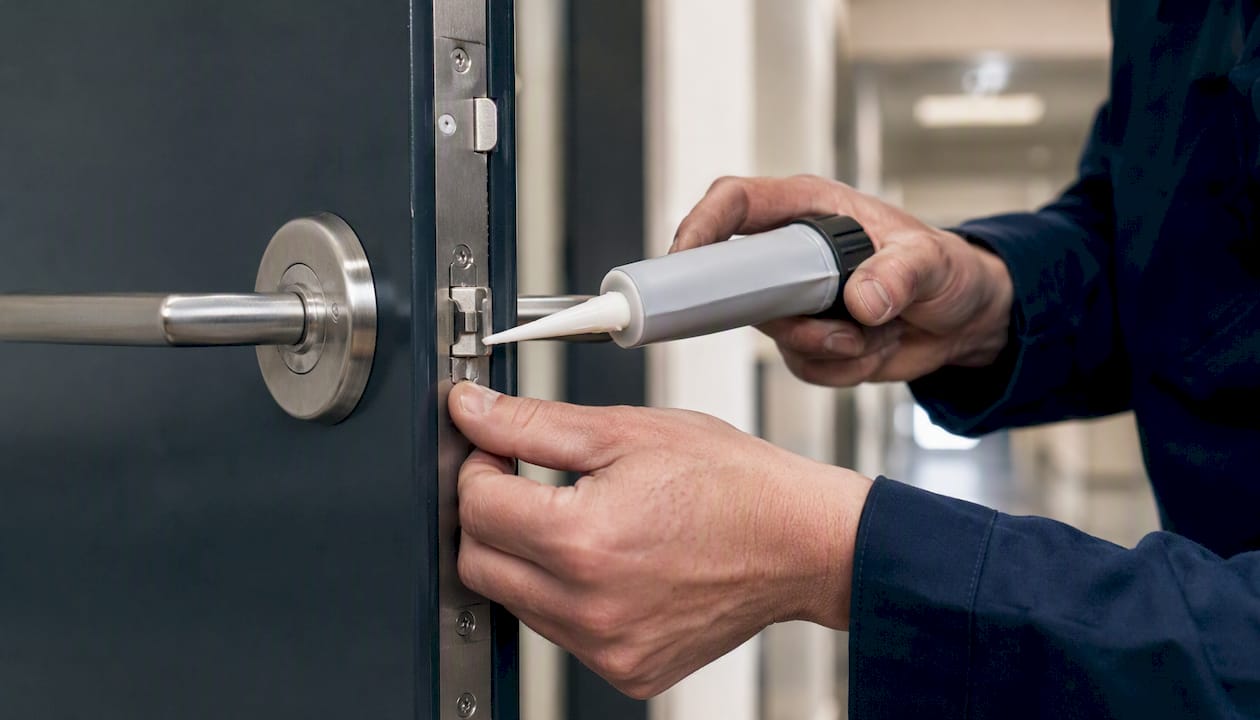
For flat entrance doors, resident engagement matters. Schedule visits with advance notice where possible, offer a witnessed check if a resident wants to be present, and always log the outcome, including any failed attempt to gain access.
Recording results and managing remedial work
Every inspection needs a written record, and Regulation 10 makes this an explicit legal requirement, not a best-practice suggestion. A workable record should capture:
- Date of check and door ID or location.
- Name of the person carrying out the inspection.
- Checklist outcomes against each component (leaf, seals, closer, latch, glazing).
- Defects identified, with photographs where possible.
- Remedial action owner and target completion date.
- For flat entrance doors, a log of every access attempt, including refusals.
The Cheshire Fire & Rescue Service guide is a useful practical reference here, and its access-record approach aligns closely with GOV.UK’s own guidance for Responsible Persons.
Remedial work should happen “as soon as reasonably practicable,” a phrase that carries real weight if challenged. A door with a failed latch or a missing seal on a protected escape route is not a job for next month’s maintenance round, it is a same-week priority. Treat any door that fails a closure test as out of service until it is repaired.
Pro Tip: Build a simple three-tier priority system: critical faults (door won’t close or latch) get same-week action, moderate faults (damaged seal, loose hinge) get scheduled within 30 days, and cosmetic issues get logged for the next planned round.
Common fire door faults and how to fix them
Most defects fall into a handful of repeatable categories, and knowing which ones your own team can fix saves time and avoids unnecessary call-outs.
- Missing or painted-over intumescent strips: replace with the correct certified strip; painting over is a common but serious oversight.
- Loose hinge screws: tighten or replace with the correct grade of screw, in-house.
- Misadjusted closer: reset closing speed and latching force, usually a five-minute job for trained staff.
- Oversized letterboxes or cat flaps: these compromise fire resistance and typically need a specialist assessment.
- Damaged or perished seals: replace like-for-like; cleaning alone rarely restores performance.
- Cracked fire-rated glazing: always a job for a certificated glazier, never a DIY repair.
Pro Tip: If you’re not certain whether a repair will affect the door’s certification, treat it as a specialist job. The BWF Fire Door Alliance is clear that improper repairs using the wrong materials or methods can invalidate a doorset’s fire rating entirely.
Arranging a full survey: what it costs and what to ask for
When routine checks reveal recurring problems, or you simply want a baseline audit across a building, a full doorset survey from a certificated inspector is the right step.
Before you commission one, run through a short procurement checklist:
- Confirm the inspector’s certification and ask to see a sample report.
- Agree the scope in writing: full doorset survey versus a lighter routine-check programme.
- Request an itemised remedial cost estimate with realistic timescales.
- Ask whether third-party certification will be provided on completion.
Costs vary with building size, door count, and access difficulty. A ground-floor commercial unit with a handful of doors is a very different job to a high-rise residential block with hundreds of certificated doorsets and limited access windows. The extent of remedial work required, and whether replacement doors need re-certifying, is usually the biggest swing factor in the final invoice. The FPA’s inspection survey guidance is a good starting point for understanding what a proper survey deliverable should look like.
A compact checklist for routine fire door checks
Print this or paste it into a mobile inspection form for quick site use:
- Door ID and location recorded.
- Door closes fully from open, 45°, and 15° positions.
- Gaps around leaf within tolerance (roughly 2 to 4mm, tighter at the bottom where sealed).
- Intumescent and smoke seals intact, unpainted, continuous.
- Self-closer operates smoothly with no manual assistance needed.
- Latch engages securely on every closure test.
- Glazing and beads secure, no cracks.
- Signage present and legible.
- Outcome recorded: pass, fail, or remarks, with photo if a defect is found.
- For flat entrance doors: access attempt logged, including refusals.
Delta First’s approach to fire door compliance
We treat fire door checks the way the regulations intend: not as a one-off tick-box exercise but as a scheduled discipline built into a wider planned preventative maintenance programme. Combining routine in-house checks with certificated surveys where needed keeps buildings compliant and occupants safer.
Delta First supports facilities teams across Essex, Suffolk, Norfolk, and Greater London with exactly this kind of scheduled compliance work. If your inspection programme needs a second look, we’re a call away.
Get your fire door inspection programme on a proper footing
Running fire door checks against a fixed schedule, with proper records and a repair path that actually closes out defects, is where most in-house programmes start to slip. Delta First is a single contractor for the whole job: planned preventative maintenance that covers your fire doors alongside the rest of your building fabric, qualified engineers to carry out remedial repairs without a second contractor visit, and certificated inspection commissioning arranged on your behalf where a full doorset survey is needed.

Working with one contractor across electrical, mechanical, HVAC and fabric compliance means fewer gaps between suppliers and faster response when a door fails a check. Delta First covers Essex, Suffolk, Norfolk and Greater London, with a directly employed core team of engineers, supported by specialist subcontractors where needed, a genuine advantage when you need someone who knows your building’s history. If you manage a multi-occupied residential development, our residential building services page sets out how we structure PPM contracts for exactly this kind of statutory compliance work. Request a survey or a PPM quotation and we’ll come back to you with a scope tailored to your building count and door schedule.
Frequently asked questions
Is a fire door inspection a legal requirement in the UK?
Yes. The Regulatory Reform (Fire Safety) Order 2005 requires Responsible Persons to maintain fire doors, and the Fire Safety (England) Regulations 2022 add specific check frequencies for qualifying residential blocks over 11 metres.
How often should fire doors be checked?
Communal doors in qualifying blocks need checks at least every three months. Flat entrance doors need best-endeavours checks at least every 12 months. All other premises follow the frequency set by the fire risk assessment.
Who is allowed to carry out a fire door inspection?
Trained staff can carry out routine visual checks. Technical surveys, remedial specifications, and certification work should go to a certificated contractor, often holding BWF-CERTIFIRE accreditation or BFC Level 3 training.
What happens if a fire door fails an inspection?
Log the defect immediately, treat the door as out of service if it fails to close or latch, and arrange repair as soon as reasonably practicable using a competent contractor for anything affecting certification.
Do I need to keep written records of fire door checks?
Yes. Regulation 10 requires records of checks carried out and, for flat entrance doors, records of any access attempts, including refusals.
This article is general information, not a substitute for advice from a qualified lawyer. Consult a qualified legal professional about your own circumstances before acting on anything here.
Need help with fire safety compliance? Delta First coordinates fire safety maintenance and remedial works across Essex, Suffolk and London, working with certified specialist partners where a system requires them, so you have one accountable contractor. Call 01206 237422 or request a quote.
Sources
Recommended
- Best fire system installers in the UK: 2026 guide
- ESOS UK: the 2026 compliance guide for large organisations
Talk to Delta First
Delta First Building Services is a Colchester-based M&E contractor working across Essex, Suffolk and London, with commercial work in Norfolk. Our directly employed electrical team is supported by vetted specialist subcontractors where extra certification is needed, and we offer genuine 24/7 emergency cover. Get in touch to arrange a survey or quote.