

Any commercial premises with a gas supply used for business purposes requires an annual gas safety check and a valid certificate under the Gas Safety (Installation and Use) Regulations 1998 (GSIUR). The Health and Safety Executive (HSE) and Gas Safe Register set the standards; the duty holder, whether employer, property manager, or landlord, carries the legal responsibility. If your certificate is due or overdue, the immediate next step is to book a Gas Safe-registered engineer with the correct commercial qualifications, or contact Delta First to arrange a compliance survey or planned preventative maintenance (PPM) visit.
Before you book, confirm the following:
- Appliance inventory: compile a full list of gas appliances, boilers, catering equipment, and associated plant on site.
- Access constraints: identify any locked plant rooms, restricted-hours kitchens, or areas requiring permits to work.
- Recent works: note any modifications, new installations, or repairs since the last certificate was issued.
- Existing records: locate the most recent gas safety certificate or inspection record so the engineer can review previous findings.
Which types of commercial gas safety certificate do you need?
The term “commercial gas safety certificate” is widely used, but the technical records are appliance-specific forms. HSE’s Approved Code of Practice L56 confirms that the correct form must match the appliance type, and using the wrong record is a common trigger for non-compliance findings during audits. The most frequently encountered categories are:
- Heating and boiler plant (CP15-type records): applies to commercial boilers, heating systems, and hot water plant, typically in offices, schools, healthcare premises, and industrial units.
- Catering appliances (CP42-type records): covers commercial ovens, ranges, fryers, and associated catering equipment in restaurants, hotel kitchens, and staff canteens.
- LPG and mobile catering units: separate competency and record requirements apply to liquefied petroleum gas systems and mobile catering trailers or vehicles.
- Industrial plant: larger process plant and high-output systems, particularly those above approximately 70kW, require engineers with specific industrial competencies beyond standard commercial heating qualifications.
Mixed-use sites present a particular challenge. A hotel with both a commercial kitchen and a central boiler plant, for example, will need catering-specific records for the kitchen appliances and separate heating plant records for the boiler. A retail unit with a staff-room combi boiler and a small catering operation in the same building may require two distinct certificate types issued by engineers holding the relevant competencies for each. Combining these into a single PPM visit, where the contractor holds all the necessary qualifications, is the most efficient approach.
GSIUR and L56 cover commercial premises broadly, including offices, shops, public buildings, schools, and hospitals, though certain plant types and premises may fall under different or additional regulations.
Who can legally issue a commercial gas safety certificate?
Only a competent person with the correct commercial-specific qualifications and a current Gas Safe registration may carry out commercial gas safety checks and issue valid records. HSE guidance is explicit: domestic-only qualifications do not cover many commercial systems, particularly plant above approximately 70kW output. A certificate issued by a domestic-only engineer for commercial plant is invalid for compliance purposes and will not satisfy an HSE inspection or insurer audit.
Carbon monoxide risk is not theoretical. HSE data shows that around 14 people die every year from carbon monoxide poisoning caused by gas appliances and flues that have not been properly installed or maintained. In commercial premises with higher occupancy, the consequences of a poorly maintained system are proportionally greater.
Before any engineer attends site, verify the following:
- Gas Safe ID card: check the card is current and not expired.
- Qualification scope: read the reverse of the ID card, which lists the specific appliance categories the engineer is registered to work on (e.g. CCN1 for commercial catering, CIGA1 for industrial gas appliances).
- Commercial competencies: confirm the engineer holds the relevant commercial categories for your appliance types, not just domestic categories.
- Company credentials: check the contracting firm’s Gas Safe registration, public liability insurance, and any sector-specific accreditations.
Pro Tip: Use the Gas Safe Register online engineer lookup to verify any engineer before they attend site. Enter the licence number from their ID card and confirm the listed competencies match your appliance types. Never rely on a verbal assurance alone.
How do you obtain a commercial gas safety certificate?
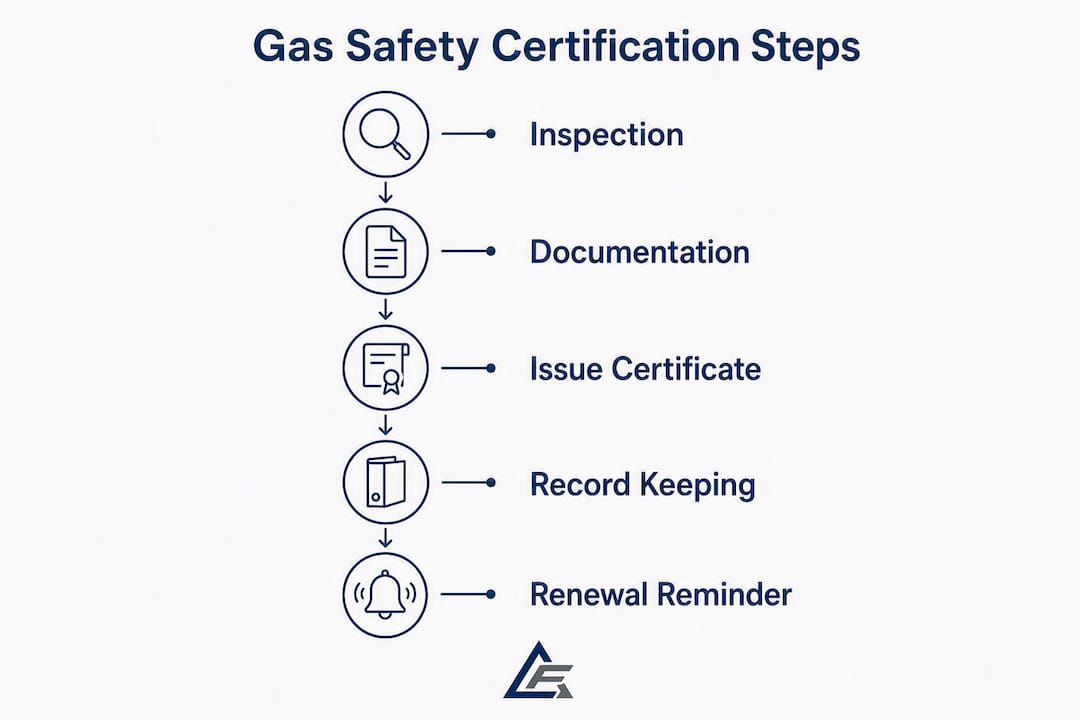
The gas safety certification process for commercial premises follows a clear sequence. Rushing any stage, particularly the appliance inventory and access planning, is where most delays occur.
- Compile your appliance inventory. List every gas appliance, boiler, catering item, and associated pipework on site, including output ratings where known.
- Identify access requirements. Note any areas requiring permits, out-of-hours access, or specialist access equipment.
- Request a quote specifying commercial competency. Provide the appliance list and site details to your contractor and confirm they hold the relevant Gas Safe categories for every appliance type on site.
- Schedule the inspection. Agree a date that allows sufficient time for a thorough check without operational pressure. For complex sites, allow a full day.
- Prepare the site. Clear access to all appliances, meters, and flue terminals. Have previous certificates and modification records available for the engineer.
- On-site inspection. The engineer carries out the checks and completes the relevant forms on completion.
- Receive the certificate. The written record is issued on the day or shortly after, depending on the contractor’s process. Request a digital copy for your compliance records.
What does the engineer inspect on site?
A thorough commercial gas safety inspection covers best practices for commercial plumbing maintenance:
- Appliance condition, age, and general state of maintenance
- Flue integrity and termination points
- Ventilation adequacy for each appliance
- Gas pressure and leakage checks across the installation
- Combustion analysis and CO testing
- Interlock testing for commercial kitchens, confirming the gas supply shuts off if extraction fails
- Emergency control valve and isolation point accessibility
- Correct appliance installation against manufacturer and regulatory requirements
Interlock testing is frequently overlooked in catering compliance audits. HSE guidance requires that ventilation interlocks are tested during the safety check and documented on the certificate. If your previous certificate does not record interlock testing, raise this with your engineer before the next visit.
What does the certificate record?

| Field | Purpose |
|---|---|
| Site address and duty holder details | Identifies the premises and the responsible person |
| Engineer name, Gas Safe licence number, and competency categories | Confirms legal authority to carry out the check |
| Appliance list with make, model, and location | Provides an auditable record of what was inspected |
| Test results and defects found | Documents the condition of each appliance at inspection |
| Remedial actions required and urgency | Distinguishes immediately dangerous (ID) from at-risk (AR) findings |
| Inspection date and next due date | Sets the renewal timetable |
If the inspection identifies an immediately dangerous appliance, the engineer will advise you to stop using it and disconnect it where safe to do so. Obtain a remedial quote promptly and arrange a re-inspection once the work is complete.
What does a commercial gas safety inspection typically cost?
Pricing for commercial gas safety certification varies considerably. A single-appliance office boiler check is a very different proposition from a full catering kitchen and plant room inspection across a multi-site estate. Understanding the cost drivers helps you budget accurately and evaluate quotes on a like-for-like basis.
Key pricing factors:
- Number and type of appliances (catering equipment is more time-intensive than a single boiler)
- Site complexity and access difficulty (plant rooms requiring permits, out-of-hours access, or confined space entry)
- Commercial competency categories required (industrial plant specialists typically command higher day rates)
- Travel and regional factors
- Remedial works identified during the inspection (quoted separately)
- Re-inspection fees if a follow-up visit is required after remedial work
Illustrative price ranges (example guidance only, not guaranteed quotes):
| Site type | Typical range | Notes |
|---|---|---|
| Simple office or retail unit (1–2 appliances) | — | Single boiler or combi unit, straightforward access |
| Medium commercial site (3 appliances, mixed) | — | Mixed heating and catering, standard access |
| Complex or multi-appliance site (9+ appliances or industrial plant) | — | Large plant, specialist competencies, extended inspection time |
These figures are illustrative. Always request an itemised quote that specifies the appliances to be inspected, the competency categories required, and the rates for any post-inspection remedial work or re-inspection.
Pro Tip: Ask your contractor to include re-inspection fees and post-inspection remedial labour rates in the original quote. Discovering these costs only after a failed inspection creates budget pressure at exactly the wrong moment.
What are your legal responsibilities as a duty holder?
GSIUR places the legal responsibility on employers and duty holders to maintain gas appliances, pipework, and flues in a safe condition and to arrange formal safety checks at intervals of no more than 12 months. Records must be retained for at least two years. These obligations cannot be delegated away: even where a third-party contractor manages inspections, the ultimate responsibility for ensuring competency and record retention remains with the business or property manager.
“It shall be the duty of every employer or self-employed person to ensure that any gas appliance or installation pipework installed at any place of work under his control is maintained in a safe condition so as to prevent risk of injury to any person.” — The Gas Safety (Installation and Use) Regulations 1998
Duty holder checklist:
- Arrange annual gas safety checks using engineers with the correct commercial qualifications for each appliance type
- Retain all gas safety certificates and inspection records for a minimum of two years
- Maintain an up-to-date appliance inventory and update it after any installation, modification, or decommissioning
- Act promptly on remedial recommendations, particularly any immediately dangerous or at-risk findings
- Verify engineer qualifications and Gas Safe registration before each visit
- Keep records of interlock testing for commercial kitchens as a separate documented item
HSE inspectors focus on qualification evidence, retained records, interlock documentation, and CO hazard management. Non-compliance can result in enforcement notices, prohibition of plant, and financial penalties. Insurers conducting audits apply similar scrutiny, and a missing or invalid certificate can affect your cover.
Pro Tip: Digitise your certificates immediately on receipt, store them in a centralised compliance management system with metadata (site, appliance, date, engineer licence number), and link them to your PPM schedule. An auditable digital trail is your practical defence in any enforcement or insurance review.

How do you keep your gas safety certification current?
The renewal frequency is straightforward: gas safety checks must take place at intervals of no more than 12 months. The 2018 amendment to GSIUR introduced a practical scheduling flexibility: you may carry out the annual check up to two months before the due date while retaining the original expiry date. This means you can schedule early without losing time on the certificate’s validity period.
Scheduling tips:
- Align certification visits with low-occupancy windows (school holidays, hotel off-peak periods, planned shutdowns) to minimise operational disruption.
- Group multiple appliances or sites into a single contractor visit where the engineer holds all required competencies.
- Set calendar reminders at the three-month and one-month marks before each certificate’s expiry date.
- Use a centralised PPM system or facilities management platform to track expiry dates across your estate.
Pre-inspection preparation checklist:
- Confirm access to all appliances, flue terminals, and meter locations
- Notify relevant staff or tenants of the inspection date and access requirements
- Have previous certificates, modification records, and appliance manuals available
- Check that any recent works have been signed off and documented
If a certificate expires without a renewal inspection, you are in breach of GSIUR. Arrange an inspection immediately and document the gap in your records along with the reason and the remedial steps taken. If an inspection fails, obtain a remedial quote the same day and schedule re-inspection as soon as the work is complete.
Pro Tip: Use the two-month early-inspection window proactively. Booking eight to ten weeks before expiry gives you time to resolve access problems, accommodate engineer availability, and address any remedial work before the certificate lapses.
How Delta First supports your gas safety compliance
Delta First provides commercial gas safety compliance support as part of a broader building services offering covering electrical, mechanical, HVAC, and building fabric. For duty holders managing complex estates, the practical advantage of a multi-discipline partner is that interlock systems, extraction plant, and gas appliances can be checked and coordinated in a single PPM visit, rather than requiring separate contractors for each discipline.
Services relevant to gas safety compliance:
- Planned preventative maintenance (PPM) contracts covering gas safety checks, interlock testing, and associated mechanical plant
- One-off compliance surveys and certification for new clients or gap-fill inspections
- Remedial repairs and post-inspection works following identified defects
- Centralised record management with digital certificate delivery
- Emergency reactive support where plant is taken out of service following an immediately dangerous finding
Delta First serves clients across Essex, Suffolk, Norfolk, and Greater London, working with education estates, healthcare and NHS premises, hotels and hospitality, industrial and logistics sites, retail, and local authority portfolios.
When you engage Delta First, you can expect Gas Safe registration checks on every attending engineer from our specialist subcontractor network, confirmation of commercial competency categories before the visit, written and digital certificate delivery on completion, and a clear remedial schedule if defects are found.
To arrange a compliance survey or PPM quotation, have the following ready:
- Site address and a contact for access
- Appliance inventory or best estimate of appliance count and types
- Copy of the most recent gas safety certificate, if available
- Preferred access windows and any site-specific restrictions
Key takeaways
Every commercial premises with a gas supply must have an annual gas safety check carried out by a Gas Safe-registered engineer with the correct commercial qualifications, with records retained for at least two years under GSIUR.
| Point | Details |
|---|---|
| Annual check is mandatory | Gas safety checks must occur at intervals of no more than 12 months under GSIUR. |
| Use commercially qualified engineers | Domestic-only Gas Safe registration does not cover commercial plant; an invalid certificate creates legal and insurance exposure. |
| Retain records for two years | Keep all certificates and inspection records for a minimum of two years as required by GSIUR. |
| Use the two-month scheduling window | The 2018 GSIUR amendment allows checks up to two months early while retaining the original expiry date. |
| Delta First for PPM and compliance | Delta First arranges commercial gas safety surveys, PPM contracts and remedial works across Essex, Suffolk, Norfolk and Greater London, carried out by Gas Safe registered engineers from our vetted specialist subcontractor network. |
Why proactive gas safety management pays for itself
The facilities managers who treat gas safety as a once-a-year administrative task tend to be the ones who discover an immediately dangerous finding the week before a major event, or who face an insurer query about a certificate that was issued by a domestic-only engineer for a commercial boiler. The cost of that moment, in downtime, remedial spend, and reputational risk, is always higher than the cost of a structured PPM programme.
The annual check is the regulatory minimum, not the ceiling. HSE guidance frames gas safety as part of ongoing risk management, and the evidence supports that framing. Appliances that are inspected and serviced regularly fail less often and produce fewer CO incidents. Interlock systems that are tested annually are the ones that actually shut off the gas supply when extraction fails.
Two pitfalls appear repeatedly in commercial compliance audits. The first is using a domestic engineer for commercial plant, often because they were already on site for another job. The certificate they issue is not valid, and the duty holder carries the liability. The second is missing interlock testing, either because it was not included in the original scope or because the engineer did not hold the catering competency. Both are avoidable with a properly scoped PPM contract and a contractor who holds all the relevant qualifications.
Delta First’s multi-discipline approach means that gas, electrical, and extraction systems can be checked in a coordinated visit, with a single set of records and a single point of accountability. For estates teams managing multiple sites, that coordination is where the real compliance value lies.
- Structured PPM reduces emergency call-out costs and unplanned downtime.
- Centralised digital records simplify HSE and insurer audits.
- Coordinated multi-discipline visits reduce access disruption and contractor management overhead.
- Early identification of at-risk appliances allows planned remedial spend rather than emergency replacement.
Arrange a gas safety survey with Delta First

Delta First works with facilities managers, estates teams, and property owners across Essex, Suffolk, Norfolk, and Greater London to keep commercial gas compliance on track. Whether you need a one-off certification survey, a structured PPM contract, or remedial works following a failed inspection, Delta First provides a single accountable point of contact with Gas Safe registered engineers from our specialist subcontractor network and the commercial competencies your site requires.
Before contacting us, have the following ready: site address, appliance count and types, your most recent gas safety certificate (if available), and preferred access windows. Response times are prompt, and all attending engineers carry current Gas Safe ID with commercial qualification categories confirmed in advance.
Request a quotation or arrange a compliance survey with Delta First today.
Useful sources
- The Gas Safety (Installation and Use) Regulations 1998: the primary statutory framework for gas safety duties in commercial and domestic premises; the governing legislation for all duty holder obligations.
- Gas safety for employers (HSE): HSE’s core guidance for employers and duty holders on commercial gas safety obligations, engineer competency requirements, and CO risk management.
- Safety in the installation and use of gas systems and appliances, L56 (HSE): the Approved Code of Practice covering GSIUR in detail, including the 2018 amendment on scheduling flexibility and appliance-specific record requirements.
- L56 full document (PDF): the complete L56 text, useful for confirming scope, exclusions, and specific plant categories.
- Landlords: a guide to duties, INDG285 (HSE): HSE guidance covering annual check requirements and CO fatality data; relevant for landlords of commercial premises.
- Gas Safe Register: the official registration body for gas engineers in the UK; use the online lookup to verify engineer licence numbers and qualification categories before any site visit.
- Delta First Building Services: Delta First’s service enquiry and contact page for commercial gas safety surveys, PPM contracts, and remedial works across Essex, Suffolk, Norfolk, and Greater London.
Recommended
- Best fire system installers in the UK: 2026 guide
- Air conditioning consulting for facilities managers: UK guide
Need support with mechanical or HVAC maintenance? Delta First delivers planned and reactive mechanical maintenance across Essex, Suffolk and London, using certified specialist partners for gas and refrigerant work, with 24/7 emergency cover. Call 01206 237422 or request a quote.
Talk to Delta First
Delta First Building Services is a Colchester-based M&E contractor working across Essex, Suffolk and London, with commercial work in Norfolk. Our directly employed electrical team is supported by vetted specialist subcontractors where extra certification is needed, and we offer genuine 24/7 emergency cover. Get in touch to arrange a survey or quote.