

Use this warehouse maintenance checklist to reduce safety risk and downtime right now. Print or download the daily, weekly, monthly and annual templates below, assign them to named roles, and log every check in your maintenance system. The three UK regulations you need to know are HSE HSG76, PUWER and LOLER. Between them, they cover everything from forklift thorough examinations to racking inspections and building fabric upkeep.
Start with these critical checks before the next shift begins:
- Housekeeping: all aisles clear, no trailing cables, no spilt materials on floor surfaces
- Racking sightline check: walk every aisle and look for visible column damage, missing beam clips or overloaded bays
- Fire exits: all doors unobstructed, push-bar mechanisms functional, signage illuminated
- Forklift pre-shift: horn, brakes, tyres, forks, mast, lights and fluid levels checked by the operator before first use
- Pedestrian segregation: barriers, floor markings and signage intact on all traffic routes
Pro Tip: Download the master template as a PDF or Excel file, print one copy per shift and keep a completed copy on file for at least three years. That single habit satisfies the audit-trail requirement under PUWER and gives you a defensible record if an incident occurs.
Warehousing and storage: Keep it safe INDG412 identifies slips and trips, manual handling, work at height, vehicles and moving or falling objects as the main causes of warehouse accidents. A structured daily check directly targets every one of those categories before work begins.
Key takeaways
A structured warehouse maintenance checklist, applied daily and supported by a documented PPM programme, is the most reliable way to reduce incidents, cut reactive costs and satisfy HSE, PUWER and LOLER obligations.
| Point | Details |
|---|---|
| Start with daily pre-shift checks | Operators must check forklifts, aisles, fire exits and racking sightlines before every shift. |
| Follow the three-tier racking regime | Immediate operator reporting, weekly competent-person visual checks and at least annual expert inspection per SEMA guidance. |
| Set frequencies by risk assessment | Manufacturer manuals are a baseline; site conditions, usage intensity and incident history must set the actual intervals. |
| Capture every check in a CMMS | Digital records with asset IDs, photographs and defect codes satisfy PUWER and LOLER audit requirements and reduce compliance gaps. |
| Delta First delivers end-to-end PPM | From asset survey and schedule build to LOLER examinations and HVAC servicing across Essex, Suffolk, Norfolk and Greater London. |
How do you use and customise the checklist for your site?
A checklist only works when it is tied to a clear workflow. The sequence below gives you a repeatable inspection run that any supervisor can follow without ambiguity.
Step sequence
- Pre-shift (operator level): complete forklift, pallet truck and order-picker pre-use checks; confirm aisle clearance and fire exit status.
- During shift (supervisor level): spot-check housekeeping, pedestrian routes and any reported defects; log near-misses immediately.
- Post-shift (maintenance planner level): review defect log, raise work orders for outstanding items, update asset records.
Roles and responsibilities
| Role | Responsibility | Escalation trigger |
|---|---|---|
| Operator | Pre-use equipment checks; immediate defect reporting | Any defect affecting safe operation |
| Supervisor | Shift housekeeping and traffic route checks | Near-miss, injury or safety-critical defect |
| Maintenance planner | Weekly and monthly scheduled checks; work order management | Overdue corrective actions |
| Competent person | Racking visual inspections; PUWER-scoped equipment checks | Structural damage or amber/red racking classification |
| External contractor | LOLER thorough examinations; annual expert racking inspection | Statutory deadline approaching or post-incident |
Customising by risk assessment
Manufacturer manuals set a baseline, but your site-specific risk assessment must set the actual inspection frequency. Dust levels, temperature extremes, traffic intensity and shift patterns all change how quickly components wear. A cold-store forklift running three shifts a day in sub-zero temperatures needs more frequent hydraulic checks than a single-shift ambient-warehouse truck. Review frequencies whenever operations change and record the rationale in writing.
Escalation route for safety-critical defects
When a defect is safety-critical, the sequence is: isolate the asset, prevent further use with physical controls (barrier or lock-out tag), record the defect with a photograph and asset ID, notify the maintenance planner and, where statutory, the competent person or external inspector. Do not simply mark the item and continue.
Pro Tip: Keep the escalation route on a laminated card at each supervisor station. When an incident happens, people revert to what is in front of them, not what they remember from a training session.
What should your warehouse inspection cover across equipment, systems and building fabric?
A thorough warehouse inspection guide covers five distinct categories. Each one carries different statutory obligations, so the checks below are grouped accordingly.
Material handling equipment
PUWER Regulation 5 requires that work equipment is maintained in an efficient state, in efficient working order and in good repair, with a suitable system of maintenance where appropriate. For forklifts and lifting attachments, LOLER additionally requires thorough examination at intervals not exceeding twelve months for most trucks (six months where the truck carries people).
Pre-shift checks for every powered industrial truck:
- Horn, lights, warning beacon and reversing alarm functional
- Forks: no visible cracks, bend or wear beyond manufacturer tolerance
- Mast: chains lubricated, no visible wear or damage to rollers
- Tyres: correct pressure or solid tyre condition; no chunking
- Hydraulics: fluid level within range, no visible leaks
- Brakes: parking and service brake tested before first load
Defects must be recorded on a pre-use check sheet, signed by the operator and reviewed by the supervisor before the truck enters service.
Storage and racking
The SEMA three-tier inspection approach sets the standard: immediate operator reporting, regular in-house visual checks and periodic expert inspections. The detail on each tier is covered in the dedicated racking section below.

Conveyors, sortation and dock levellers
Under PUWER, inspection frequency for conveyors and dock levellers is risk-based. Key wear points to check weekly include:
- Belt tension and tracking; worn or frayed edges
- Drive chain lubrication and sprocket wear
- Dock leveller hydraulic seals and lip plate operation
- Emergency stop buttons and guarding integrity on all conveyors
Building systems: HVAC, electrical, lighting and fire protection
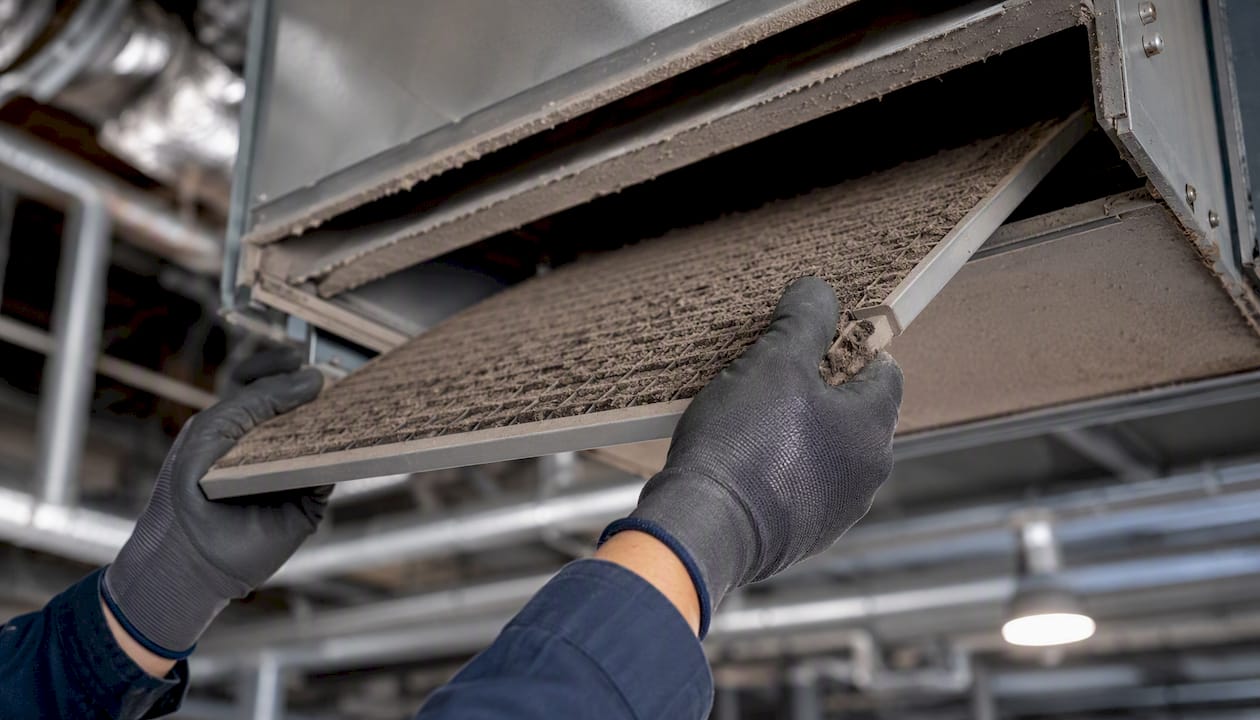
For HVAC, monthly filter checks and quarterly belt inspections prevent the most common failures. A practical summer HVAC maintenance programme covers seasonal actions relevant to warehouse environments. Electrical distribution panels should receive a visual check monthly (signs of overheating, loose terminations, tripped breakers) and a full thermographic survey annually. Emergency lighting should be function-tested monthly and duration-tested annually per BS 5266. Fire alarm panels require weekly functional tests and an annual service by a competent engineer.
Housekeeping and slip/trip control
HSE INDG412 is direct: good housekeeping is one of the most effective controls against the leading causes of warehouse accidents. Check daily:
- Floor surfaces: no spills, no debris, no damaged floor plates
- Pedestrian routes: clearly marked, unobstructed, adequately lit
- Spill kits: stocked and accessible at designated points
- Signage: wet floor, hazard and directional signs in place and legible
How does the three-tier racking inspection approach work?
SEMA recommends a three-tier racking inspection approach that distributes responsibility across operators, in-house teams and qualified external inspectors. SEIS confirms that LOLER places lifting equipment on fixed examination cycles while PUWER applies to racking with risk-based intervals, and that combining schedules reduces audit complexity.
The three tiers in practice
- Immediate operator reporting: any operator who notices damage during normal work must report it before the shift ends. No specialist knowledge is required; the trigger is anything that looks different from the last time the bay was used.
- Regular in-house visual inspection: a competent person (trained in-house) walks every aisle at least weekly, checking uprights, beams, beam-end connectors, base plates and floor fixings. The check should be recorded on a dated racking log with bay references.
- Annual expert inspection: a qualified racking inspector (typically a SARI-accredited inspector via SEMA) carries out a full site survey at least once per year, or after any significant impact or structural change.
Damage categorisation and immediate controls
When damage is found, classify it before deciding the next step:
- Green (minor): superficial marks, no structural deformation. Monitor at next weekly check.
- Amber (moderate): visible deformation within manufacturer tolerance limits. Reduce load, increase monitoring frequency, schedule repair.
- Red (severe): deformation beyond limits, missing components or unknown load history. Offload the bay immediately, install physical barriers and ‘Do Not Use’ signage, and do not return the bay to service until a competent person has assessed and authorised repair or replacement. Simply marking the damage is not sufficient.
What to record in the racking log
- Date and inspector name
- Bay reference (aisle letter, bay number, level)
- Damage description and classification (green/amber/red)
- Photograph with scale reference
- Action taken and target completion date
- Sign-off by competent person on return to service
Action checklist when damage is found
- Offload the affected bay before any further use.
- Install physical barriers and ‘Do Not Use’ signage.
- Photograph the damage with a scale reference and record the bay ID.
- Notify the maintenance planner and, for red-category damage, the external inspector.
- Obtain written authorisation before returning the bay to service.
Which preventive maintenance approaches work best in warehouses?
Planned preventive maintenance (PPM) is the industry term for scheduled, proactive upkeep as opposed to reactive repair after failure. Three models apply in warehouse settings, and the right choice depends on asset criticality and the data you have available.
Time-based PPM runs checks and servicing at fixed calendar intervals regardless of condition. It suits assets where failure is unpredictable and the cost of breakdown is high: fire suppression systems, emergency lighting and statutory LOLER examinations all fall here. The ISD PPM approach demonstrates how a 12-point annual health check for controlled environments, backed by a PPM database, extends asset life and identifies worn parts before failure.
Condition-based maintenance triggers intervention when a measurable parameter crosses a threshold: oil contamination levels in a hydraulic system, vibration readings on a conveyor motor, or filter pressure drop on an HVAC unit. It reduces unnecessary servicing but requires either sensor infrastructure or trained technicians who know what normal looks like.
Predictive maintenance uses trend data to forecast failure. It is most cost-effective on high-value assets with long lead times for parts. For most UK warehouses, a hybrid of time-based and condition-based PPM is the practical starting point.
Moving from reactive to planned schedules
- Audit your current reactive call-out log to identify the assets that fail most often.
- Rank assets by criticality: what stops production if it fails?
- Set initial PPM frequencies from manufacturer manuals, then adjust based on site conditions and your risk assessment.
- Consolidate all schedules into a single calendar so nothing falls through the gaps.
Do and don’t list for PPM implementation
- Do consolidate forklift, racking and building-systems schedules into one calendar.
- Do record the rationale for every frequency decision so auditors can see your risk-based thinking.
- Don’t turn every pre-use check into a burdensome multi-page form. Simple, fast checks get completed; complex ones get skipped.
- Don’t treat PPM as a paper exercise. If a check is not generating corrective actions, either the asset is in excellent condition or the check is not thorough enough.
Pro Tip: Schedule LOLER thorough examinations and fleet servicing outside peak operational hours. Where the fleet is large, split visits so only part of it is off-line at any one time. This approach, noted in SEIS guidance, keeps throughput running while meeting statutory cycles.
PUWER and LOLER do not specify exact intervals for most assets; they require that intervals are determined by risk assessment and, for LOLER lifting equipment, by a competent person. Your written risk assessment is therefore the legal foundation for every frequency decision you make.
How should you record checks and use a CMMS or mobile app?
Paper logbooks work, but a Computerised Maintenance Management System (CMMS) turns completed checks into a searchable, auditable asset history. For a plain-language explanation of terms like CMMS, PPM and PUWER, the Delta First building services glossary is a useful reference.
Essential data fields for every inspection record
Every record, whether paper or digital, should capture:
- Who: name and role of the inspector
- When: date and time (24-hour format)
- Where: site, zone, aisle and asset ID
- What was checked: checklist version and item reference
- Condition found: pass, advisory or fail
- Evidence: photograph attached (mandatory for any defect)
- Defect code and priority: P1 (safety-critical, immediate) through P3 (planned)
- Action owner and due date
CMMS benefits for warehouse maintenance
A CMMS such as MaintainX or a comparable platform delivers scheduling automation, a full audit trail, asset histories, compliance reporting and mobile capture in the field. Technicians close work orders on a tablet; managers see real-time completion rates. For multi-site operations, a single consolidated evidence trail covering fleet, racking and dock equipment reduces compliance gaps and audit friction.
Migration steps from paper to digital
- Pilot one zone or one asset class (e.g. forklifts only) before full roll-out.
- Define asset IDs consistently: site code, asset type, sequential number (e.g. WH1-FLT-003).
- Import the PPM schedule into the CMMS with frequencies, assigned roles and due dates.
- Train users on mobile capture, defect coding and photo attachment.
- Run paper and digital in parallel for four weeks to catch gaps.
- Measure KPIs at week four: schedule compliance rate, open defects by priority, mean time to repair.
- Switch off paper once digital completion rates exceed 95%.
Minimum audit evidence for HSE/PUWER/LOLER inspections
HSE inspection guidance states that records are required where inspection is necessary for safety, and that frequency should be determined by risk assessment, manufacturer recommendations and experience. Keep the following as a minimum:
- Completed pre-use check sheets (retain for at least three years)
- LOLER thorough examination certificates (retain until the next examination or, for lifting equipment in use, indefinitely)
- Racking inspection logs with photographs
- PPM completion records and corrective action close-out evidence
Copyable sample checklists: daily, weekly, monthly and annual
The templates below are designed to be copied directly into your own spreadsheet, CMMS or printed form. Label each template with a version number, site name and effective date so audits remain clear.
Daily checklist (pre-shift and housekeeping)
- All pedestrian aisles clear and floor markings visible
- No spills or slip hazards on traffic routes
- All fire exits unobstructed and push-bar mechanisms functional
- Emergency exit signage illuminated
- Forklift pre-use check completed and signed by operator (horn, brakes, tyres, forks, mast, lights and fluids)
- Pallet truck and order-picker pre-use checks completed
- Spill kits stocked and accessible
- Racking sightline walk: no visible column damage or overloaded bays
- Lighting functional in all work areas and pedestrian routes
Weekly checklist
- Racking visual inspection by competent person (uprights, beams, beam-end connectors, base plates)
- Racking log updated with bay references and any defect classifications
- Conveyor belt tension, tracking and emergency stops checked
- Dock leveller hydraulic operation and lip plate condition checked
- Fire exit hardware (hinges, closers, push-bars) inspected
- Minor repairs from previous week’s log reviewed and closed or escalated
- Pedestrian segregation barriers and floor markings inspected
Monthly checklist
- HVAC filter condition checked; replace if pressure drop exceeds manufacturer threshold
- Emergency lighting function test (press-and-hold test per BS 5266)
- Electrical distribution panel visual check (overheating signs, tripped breakers, loose terminations)
- Sprinkler system pressure gauge reading recorded
- Fire alarm weekly test log reviewed; any faults escalated to competent engineer
- Conveyor drive chain lubrication and sprocket wear check
- Roof drainage outlets and gutters inspected for blockage (warehouse roof maintenance)
Annual checklist
- LOLER thorough examination of all forklifts, order pickers and lifting attachments by competent person
- Expert racking inspection by SARI-accredited inspector (SEMA-aligned)
- Full thermographic survey of electrical distribution
- Emergency lighting duration test (three-hour or one-hour rated, per BS 5266)
- HVAC full service: belts, bearings, coils, refrigerant check
- Pressure System Safety Regulations (PSSR) inspection for any air receivers on site
- Full site walk against risk assessment: update frequencies where operations have changed
- Review and reissue all checklist templates with updated version numbers
Frequency summary
What check frequencies should you follow, and when should you increase them?
Default frequencies are a starting point, not a fixed rule. HSE work equipment inspection guidance is clear that frequency must be determined by risk assessment, manufacturer recommendations and operational experience. The frequency summary table in the previous section gives the baseline; the triggers below tell you when to move beyond it.
Triggers that require more frequent checks
- Environmental extremes: high dust, temperature cycling, humidity or chemical exposure accelerate wear on bearings, seals and electrical connections.
- High traffic intensity: a forklift running three shifts a day accumulates wear faster than one running a single shift. Adjust pre-use check depth and hydraulic service intervals accordingly.
- Recent incidents or near-misses: any incident involving an asset should prompt an immediate unscheduled inspection and a review of the current frequency.
- Manufacturer warnings or product recalls: check manufacturer bulletins and act within the timescales specified.
- Changes in operations: new racking configurations, heavier loads, additional shifts or a change in goods type all require a fresh risk assessment and revised frequencies.
- Post-maintenance return to service: after any significant repair, carry out a functional check before returning the asset to full operational use.
Annual frequency review
Review all frequencies at least once per year as part of your annual site walk. Record the review date, who carried it out and what, if anything, changed. That record is your evidence of a living, risk-based maintenance programme rather than a static document. HSE warehousing guidance expects employers to manage site, vehicle and people risks actively, which means frequencies must reflect current conditions, not the conditions that existed when the checklist was first written.
Eight steps to start a PPM programme in your warehouse
This implementation plan follows the approach Delta First uses when supporting industrial and logistics clients across Essex, Suffolk, Norfolk and Greater London. It is designed to take a site from ad hoc reactive maintenance to a fully documented PPM programme in a structured sequence.
- Asset survey: walk the site and record every maintainable asset with its location, make, model, age and current condition. Assign a unique asset ID to each item.
- Risk assessment: for each asset, assess the consequence of failure (safety, operational, financial) and the likelihood of failure given current condition and usage. This assessment sets your inspection frequencies and determines which assets are business-critical.
- Schedule build: map every asset to a maintenance task, frequency and responsible role. Consolidate into a single annual calendar, grouping tasks where possible to reduce site visits.
- Pilot zone: select one zone or asset class and run the schedule for four weeks. Measure schedule compliance, defects raised and time to close corrective actions.
- Training: brief all operators on pre-use check requirements, defect reporting and escalation routes. Brief supervisors on weekly check procedures and racking log completion.
- CMMS import: migrate the schedule into your chosen CMMS or mobile platform. Define asset IDs, assign work orders and set automated reminders for statutory deadlines.
- Review and adjust: at the end of the pilot, review KPIs: schedule compliance rate, open defects by priority, mean time to repair and audit completeness. Adjust frequencies and task descriptions based on findings.
- Contract and continuous improvement: where specialist tasks (LOLER examinations, expert racking inspections, HVAC servicing) require external contractors, issue a clear scope of work. Key questions to ask any PPM provider: What are your response SLAs for safety-critical defects? In what format do you deliver inspection reports? How do you integrate with our CMMS? What statutory certifications do your engineers hold?
Pilot KPIs to track
- Schedule compliance rate (target: above 95%)
- Defects raised per inspection cycle
- Mean time to repair for P1 and P2 defects
- Audit completeness (percentage of records with photograph and asset ID)
For guidance on selecting a reactive maintenance provider to complement your PPM programme, the reactive maintenance service providers guide covers the key contract questions to ask.
Why disciplined checklists reduce cost and risk
The business case for a structured warehouse maintenance checklist is straightforward, but it is frequently underestimated until something goes wrong. Facilities managers who run disciplined daily and weekly checks consistently report fewer reactive call-outs, shorter downtime events and cleaner audit outcomes. The mechanism is simple: defects found early are cheap to fix; defects found after failure are expensive, and sometimes irreversible.
What the industry gets wrong is treating the checklist as a compliance exercise rather than an operational tool. A checklist that lives in a filing cabinet does nothing. One that is completed on the shop floor, reviewed by a supervisor and converted into a work order within 24 hours is a genuine risk-reduction instrument. The difference between the two is not the form itself but the culture around it.
There is also a cost argument that rarely gets made explicitly. Reactive maintenance typically costs significantly more per intervention than planned maintenance, when you account for emergency call-out rates, parts availability at short notice and production downtime. A PPM programme does not eliminate reactive work, but it reduces the frequency and severity of unplanned failures. For multi-site distribution operations, the cumulative saving across a year is material.
The racking inspection regime is where this discipline matters most. Red-category racking damage that is found during a weekly walk and isolated immediately costs a repair and a day of reduced capacity. The same damage, undiscovered for three months, can result in a collapse, a RIDDOR-reportable incident and a prohibition notice. The checklist is not bureaucracy. It is the difference between a managed risk and an unmanaged one.
Delta First supports your warehouse PPM from survey to ongoing compliance
Keeping a warehouse compliant and operationally reliable requires more than a checklist. It requires qualified engineers who understand the statutory obligations, the equipment and the pace of a live logistics environment.
Delta First delivers planned preventative maintenance, reactive maintenance, electrical, mechanical, HVAC and building fabric services for warehouses and distribution centres across Essex, Suffolk, Norfolk and Greater London. Our engineers carry out LOLER thorough examinations, HVAC servicing, electrical compliance surveys, emergency lighting tests and building fabric inspections, all documented and reported in formats your auditors can use. Whether you need a one-off PPM survey to benchmark your current programme or a long-term maintenance contract with defined SLAs, Delta First provides a single accountable point of contact.
Request a planned maintenance survey or quotation at Delta First and we will respond within one business day.
Need building fabric repairs or maintenance? Delta First’s directly employed team carries out building fabric maintenance and repairs alongside electrical and mechanical work across Essex, Suffolk and London, with 24/7 emergency cover. Call 01206 237422 or request a quote.
Sources
Recommended
Talk to Delta First
Delta First Building Services is a Colchester-based M&E contractor working across Essex, Suffolk and London, with commercial work in Norfolk. Our directly employed electrical team is supported by vetted specialist subcontractors where extra certification is needed, and we offer genuine 24/7 emergency cover. Get in touch to arrange a survey or quote.