

Facilities managing commercial or public sector buildings in the UK face a clear choice: wait for equipment to fail, service it on a calendar, or let real-time data tell you exactly when it needs attention. Predictive maintenance takes the third route. It uses sensors, IoT connectivity, and analytics to monitor actual asset condition continuously, triggering maintenance only when degradation is detected rather than on a fixed schedule. The result is fewer unplanned failures, lower spend, and better compliance support.
Table of Contents
- What is predictive maintenance and why does it matter for UK buildings?
- What technologies power a predictive maintenance system?
- How UK commercial and public sector buildings are applying this in practice
- Which software platforms support predictive maintenance in UK facilities?
- Deltafirst supports your shift to condition-based maintenance
- Key takeaways
What is predictive maintenance and why does it matter for UK buildings?
Predictive maintenance, sometimes called condition-based maintenance, monitors live equipment health data to schedule interventions at the right moment. It differs fundamentally from calendar-based planned preventive maintenance (PPM), which services assets on fixed intervals regardless of their actual condition. The problem with pure PPM is measurable: 62% of equipment failures in commercial buildings occur outside fixed preventive maintenance intervals, because real wear depends on usage intensity, load, and environmental conditions that no calendar can capture.
Facilities that blend predictive analytics with targeted preventive schedules achieve 48% fewer unplanned failures and 31% lower maintenance spend. Vibration sensors on chillers and compressors can detect bearing degradation 3–8 weeks before failure, reducing emergency HVAC call-outs by 55%.
Critically, predictive maintenance does not replace PPM entirely. Fire suppression testing, emergency generator load bank tests, and backflow preventer certifications must remain on fixed regulatory schedules regardless of sensor data. Industry experts recommend a hybrid approach where preventive maintenance forms the foundation and predictive monitoring applies to complex, high-value assets.
Key benefits for UK facilities managers:
- Reduced unplanned downtime and emergency repair costs
- Extended asset lifespan through timely, condition-driven intervention
- More predictable maintenance budgets and resource planning
- Compliance support for statutory inspections alongside condition monitoring
- Improved safety by catching anomalies before they become hazards
What technologies power a predictive maintenance system?
The core of any predictive maintenance system is sensor data feeding into a central platform. IoT sensors, including vibration monitors, temperature probes, energy consumption meters, humidity detectors, airflow sensors, and moisture detectors, connect via WiFi or LoRaWAN to CMMS (Computerised Maintenance Management System) or CAFM (Computer Aided Facilities Management) dashboards. A typical commercial facility deploys dozens of wireless sensors across asset groups such as chillers, air handling units, pumps, and electrical panels.

Battery-powered vibration sensors and thermal probes install quickly with no wiring, integrating over existing building networks with minimal disruption. Entry costs have dropped considerably; vibration sensors are now available for under £50, making retrofitting older equipment far more viable than it was even five years ago.
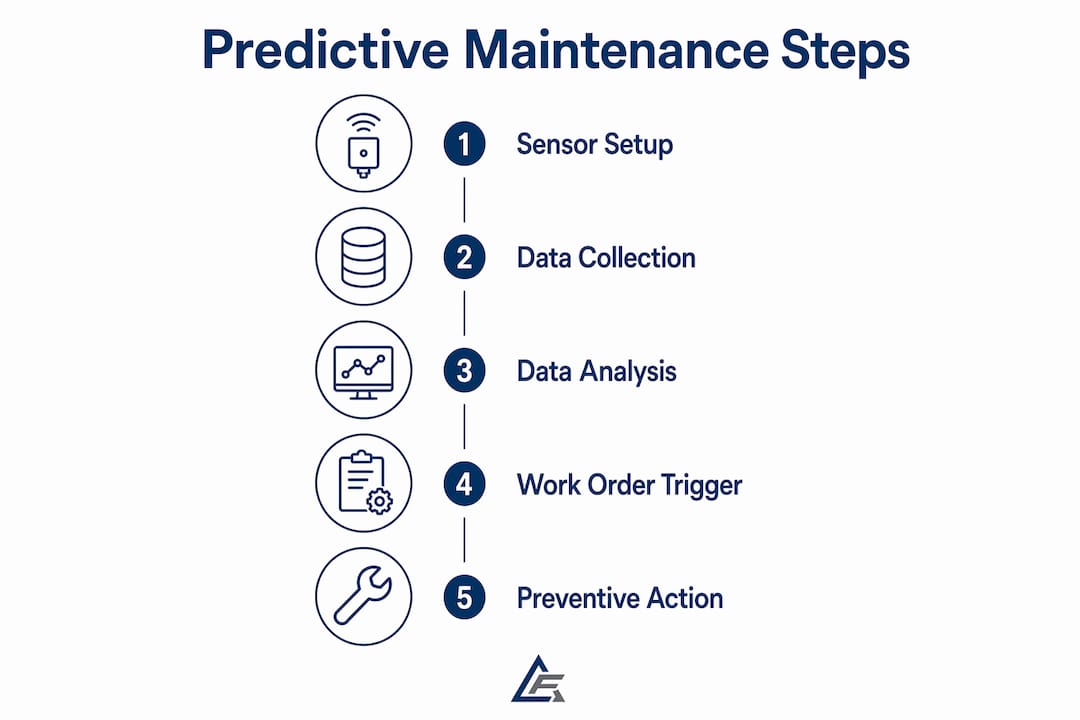
Once data flows into a CMMS, automated condition data processing triggers prioritised work orders when degradation thresholds are crossed. Technicians receive mobile alerts ranked by urgency, removing the manual triage step that delays response in traditional PPM programmes. Training, stakeholder buy-in, and cross-departmental collaboration are critical to making this work in practice. The technology is only as effective as the people interpreting and acting on its outputs.
Pro Tip: Start sensor deployment on your three to five highest-criticality assets, such as your main chiller, primary air handling unit, and main electrical switchgear, before rolling out across the full estate. Selective deployment on high-risk, high-value assets delivers the strongest early return.
How UK commercial and public sector buildings are applying this in practice
Across UK commercial offices, healthcare sites, education estates, and retail properties, the pattern of adoption follows a consistent logic: identify critical assets, instrument them, and integrate the data feed with existing CAFM or CMMS workflows.
In office buildings, differential pressure monitoring across filter banks replaces fixed 90-day filter change schedules. The system triggers a replacement work order only when pressure drop reaches the threshold, cutting unnecessary visits while maintaining air quality standards. In healthcare and NHS environments, where equipment reliability directly affects patient safety, continuous monitoring of HVAC, boilers, and critical plant provides the early-warning capability that manual inspections cannot match between scheduled checks.
Education estates managing multiple buildings across a campus benefit from portfolio-wide visibility through a single CMMS dashboard, allowing estates teams to prioritise reactive resource allocation based on live asset health scores rather than gut feel. Industrial and logistics facilities, where HVAC and electrical panel failures can halt operations entirely, represent the clearest business case for condition-based monitoring on Tier 1 critical assets.
Continuous monitoring with AI and machine learning can reveal subtle failure patterns that manual inspections simply cannot detect, particularly on ageing plant operating outside its original design parameters.
Which software platforms support predictive maintenance in UK facilities?
The software layer is where sensor data becomes actionable. CMMS and CAFM platforms sit at the centre, receiving condition data, classifying assets by criticality, and generating work orders automatically. For UK facilities managers, platforms with CIBSE Guide M alignment and support for statutory compliance documentation are particularly relevant, given the regulatory requirements around fire safety, electrical certification, and gas safety.
Key platform capabilities to look for:
- Real-time asset health dashboards with threshold-based alerting
- Automated work order generation with parts lists and urgency ranking
- Integration with existing CAFM or building management systems
- Audit trails and transparent reporting for compliance and insurance purposes
- Mobile access for field engineers receiving prioritised job notifications
AI and machine learning layers, increasingly embedded within enterprise CMMS platforms, improve prediction accuracy over time as models learn from historical failure data. For facilities managers evaluating platforms, real-time budget tracking integration, as discussed in construction technology contexts, is equally relevant to FM operations managing capital expenditure across multiple sites.
The no-universal-solution principle applies here too. Smaller estates under 50,000 sq ft often gain more from a well-configured CAFM with selective sensor integration than from a full enterprise building automation system costing many times more.
Deltafirst supports your shift to condition-based maintenance

Deltafirst works with facilities managers across Essex, Suffolk, Cambridgeshire, Norfolk, and Greater London to deliver planned preventive maintenance programmes that form the foundation for condition-based monitoring. Our directly employed engineers carry out PPM, compliance inspections, and reactive maintenance across electrical, mechanical, HVAC, and building fabric disciplines, giving you a single accountable partner rather than a fragmented supply chain.
Whether you are looking to introduce sensor-based monitoring on critical plant, align your maintenance programme with CIBSE Guide M best practice, or simply get your statutory compliance documentation in order before moving to a more data-driven model, Deltafirst has the qualified engineers and the operational experience to support you. Contact us today to request a planned maintenance survey or a quotation for your site.
Key takeaways
Facilities that combine condition-based monitoring with a structured preventive maintenance foundation achieve fewer unplanned failures, lower maintenance spend, and stronger compliance outcomes than those running either strategy alone.
| Point | Details |
|---|---|
| Hybrid model is standard | Predictive monitoring supplements PPM; statutory inspections remain on fixed schedules regardless of sensor data. |
| Sensor costs have fallen | Vibration sensors are available for under £50, making retrofitting existing commercial plant genuinely affordable. |
| Scale your deployment | A typical commercial facility uses 40–80 wireless sensors across chillers, AHUs, pumps, and electrical panels. |
| Software integration matters | CMMS and CAFM platforms automate work order generation and compliance reporting from live condition data. |
| Deltafirst as your partner | Deltafirst delivers PPM, compliance, and reactive maintenance across electrical, mechanical, HVAC, and building fabric for UK commercial and public sector clients. |
[…] maintenance, not a standalone project. Once installed, automatic PFC data feeds into the same predictive maintenance approach we already apply to switchgear and distribution boards, flagging capacitor degradation […]