

What is integrated systems testing and why does it matter?
System integration testing (SIT) exercises multiple independently developed systems together in a production-representative environment to find cross-system defects before User Acceptance Testing. It is the last formal filter before release for failures that span system boundaries — defects that unit tests and single-system tests simply cannot surface.
The five coverage axes that define SIT scope are:
- Interoperability: do systems exchange data correctly at all interfaces, including error conditions?
- Performance: does the composed system meet latency and throughput targets under representative load?
- Reliability: does the system survive sustained operation, failure modes, and recovery scenarios?
- Security: are trust boundaries, authentication flows, and authorisation decisions correct across systems?
- Data quality: does data maintain integrity and consistency as it flows across system boundaries?
Pre-Integration Testing (PIT) is a mandatory precursor. Skipping PIT allows avoidable defects to pollute SIT, severely compromising its effectiveness. Each system must complete adequate unit, component, and system testing before entering SIT. Rex Black identifies gating entry to SIT as critical: admitting under-tested systems raises the cost of defect resolution and contaminates the shared environment with defects that SIT was never designed to catch.
A mature SIT practice exhibits seven structural properties: environment discipline, data discipline, configuration management, risk-ordered integration, entry criteria, coverage focus, and defect-management integration. Programmes that invest in all seven regularly achieve defect-detection effectiveness above 99% for the SIT-target defect class.
How to conduct integrated systems testing effectively
Effective SIT depends on disciplined process, not just good tooling. These practices separate programmes that catch defects early from those that discover them in production.
- Enforce strict entry criteria. Systems must pass unit tests, component integration tests, and system tests at defined thresholds before entering SIT. Defect backlogs must fall below a defined severity threshold. Criteria are documented and enforced at the gate.
- Replicate production in the SIT environment. The SIT environment must mirror production: same system versions, network topology, authentication configuration, data stores, and observability stack. Shortcuts here produce false confidence.
- Apply configuration management rigorously. Every system entering SIT is pinned to a known version. All changes to code, configuration, and infrastructure are tracked so the environment state at any defect is fully reconstructable.
- Integrate in risk order. Systems most likely to have integration problems enter first, when schedule buffer remains and fix costs are lowest.
- Use a Requirements Traceability Matrix. RTM-based prioritisation maps test scenarios to business and system requirements, keeping coverage focused on critical cross-system paths.
- Validate test stubs carefully. Test stubs simulate unavailable components and allow early SIT to proceed, but they require validation to avoid masking defects that only appear with real components.
- Design for the SIT-specific defect class. SIT test design targets cross-system interactions, not repetition of lower-level tests. If SIT defects are dominated by single-system issues, the scenarios are wrong.
Pro Tip: For microservices architectures, deploy a service mesh with distributed tracing via OpenTelemetry or Istio. Trace-based verification lets you assert not only that a test passes, but that the execution path through the composed system matches the expected topology and latency budget — a capability that materially improves detection of cross-system performance and reliability defects.
UK providers specialising in integrated system services
Four UK-based providers cover the main disciplines relevant to integrated systems projects: life safety, fire detection, smart building technology, and building automation.

| Provider | Primary specialisation | Services offered | Sectors served | Certifications | Rating |
|---|---|---|---|---|---|
| Total Integrated Solutions | Life safety, security, smart building integration | Design, consultancy, compliance, installation, maintenance of fire, security, and communications systems | Commercial, education, public spaces, retirement communities | Independent systems integrator | 4.2★ (19 reviews) |
| Integrated Fire Safety Systems Ltd | Active fire safety systems | Fire detection, suppression, smoke management, public address, emergency voice communication, digital maintenance contracts | Commercial, healthcare, public sector | Active fire systems specialist | 3.9★ (7 reviews) |
| Integrated System Technologies (IST) Ltd | Smart building tech, IoT, energy-efficient lighting | LED drivers (iDrive®), building management (iMune®), workspace management (iSpayce™), augmented reality navigation (iView™), Power over Ethernet sensors | Commercial, education, smart buildings | Global smart building pioneer | 3★ (4 reviews) |
| Integrated System Control Ltd | Residential and commercial automation | Consultancy, supply, programming (AMX, Lutron), lighting, shading, audio, security integration | Residential, commercial, education, superyacht | Lutron Certified Dealer and Installer | — |
Total Integrated Solutions operates as an independent systems integrator, covering the full lifecycle from design and consultancy through to compliance and ongoing maintenance. Its positioning across life safety, security, and communications makes it well suited to complex commercial environments, education estates, and public spaces where multiple systems must be verified as a cohesive whole. For integrated fire safety systems within that scope, its compliance and maintenance capability is particularly relevant.
Integrated Fire Safety Systems Ltd focuses exclusively on active fire safety: detection, suppression, smoke management, and emergency voice communication. Its digital reporting maintenance contracts support the ongoing compliance documentation that UK regulations require, making it a practical choice for facilities teams that need auditable records alongside system reliability.
Integrated System Technologies (IST) Ltd brings a different angle. Its proprietary product suite, including iDrive® LED drivers, iMune® building management, and iSpayce™ workspace analytics, targets energy efficiency and IoT integration in smart building management. Organisations pursuing carbon reduction alongside system integration will find its analytics and Power over Ethernet sensor technologies directly relevant.
Integrated System Control Ltd holds Lutron Certified Dealer and Installer status, covering residential and commercial automation across lighting, shading, audio, and access control. It suits high-specification residential projects and commercial environments where precise control programming is the primary requirement.
How to choose the right integrated systems testing provider in the UK
Selecting the right partner for an integration project requires more than checking a star rating. Evaluate providers against these criteria:
- Certifications and compliance capability. Confirm the provider holds relevant certifications for your system types and can produce the compliance documentation your sector requires.
- Specialisation match. A fire safety specialist and a smart building integrator serve different briefs. Align the provider’s core expertise with your dominant system types.
- Geographic availability. For projects requiring on-site commissioning, testing, and maintenance, confirm the provider covers your location within the UK.
- Methodology maturity. Ask whether the provider supports test automation, continuous SIT, and observability tooling. Providers who cannot describe their entry criteria or traceability approach are unlikely to deliver mature SIT practice.
- Ongoing maintenance and documentation. Integration projects do not end at go-live. Assess the provider’s capacity for planned preventative maintenance, digital reporting, and statutory certification.
- Contract clarity. Confirm scope, pricing structure, and escalation procedures before committing. Vague contract terms are a reliable indicator of vague delivery.
How these providers were evaluated
Each provider was assessed against publicly available information: official website service listings, stated specialisations, sector coverage, certifications, and Google Places ratings. No performance benchmarks were invented and no proprietary test results were used. The comparison prioritises concrete service scope and verified credentials over review volume. Where a provider’s public profile is thin, the entry reflects that honestly rather than padding with inferred claims. This approach mirrors the methodology recommended by testing authorities such as Rex Black: evaluate on documented, measurable criteria, not on assertion.
Common challenges in SIT and how to mitigate them
Environment instability is the most common SIT failure mode. When the test environment drifts from production, defects appear that do not exist in live systems, and real defects go undetected. The mitigation is strict configuration management and environment-as-code practices that make the environment state reproducible at any point.
Poorly defined entry criteria create a second category of problems. Under-tested systems admitted to SIT pollute the shared environment and consume time on defects that should have been resolved at unit or system level. Documented, enforced entry gates prevent this.
Interface ambiguity between teams or vendors causes a third class of defects. When two systems interpret the same interface specification differently, the error only surfaces under integrated execution. Early prototyping of high-risk interfaces, combined with shared design walkthroughs, surfaces these conflicts before formal SIT begins.
Finally, test scope creep — re-running single-system functional tests inside the SIT environment — wastes capacity and produces a false sense of coverage. SIT test design must target cross-system scenarios exclusively.
Typical timeline and phases for integrated systems testing
SIT timelines vary with system complexity and release frequency, but the phase structure is consistent across UK programmes.
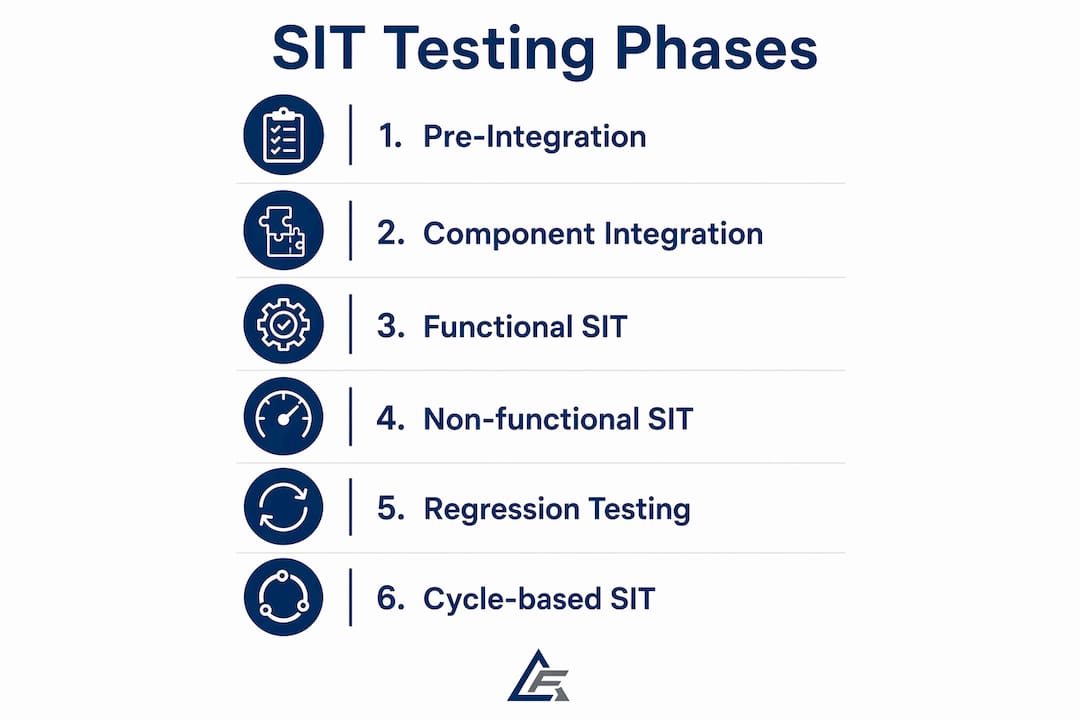
PIT phase runs first, in parallel across all participating systems. Each organisation tests its own system in isolation. Duration depends on system complexity, typically several weeks.
Component Integration Testing (CIT) progressively onboards systems into the shared environment, verifying bilateral interface compliance before full end-to-end scenarios run. Systems enter in risk order.
Functional SIT executes end-to-end business scenarios across the composed system. This is the primary phase for interoperability and data quality defect detection.
Non-functional SIT covers performance, security, and reliability testing at the composed-system level. Cross-system performance regressions rarely appear before this phase.
Regression testing runs on each new system release before it enters the SIT environment, preventing previously resolved defects from reappearing.
Cycle-based SIT uses fixed durations, commonly two weeks to two months per cycle, suited to programmes with larger system footprints and heterogeneous release cadences. Continuous SIT suits delivery programmes with tight cross-system coupling and high automation maturity.
Cost considerations for integrated systems testing projects in the UK
SIT costs are driven by environment complexity, the number of participating systems, and the duration of each test phase. Environment provisioning, including infrastructure, tooling licences, and observability stack configuration, typically represents a significant upfront investment. Ongoing costs include test execution resource, defect management, and regression cycles triggered by late system changes.
The cost of finding a defect rises sharply at each successive test level. Defects caught during PIT cost a fraction of those caught during SIT, and SIT defects cost far less than post-release incidents. Investing in mature entry criteria and environment discipline reduces total SIT cost by preventing the environment pollution that extends cycle duration.
For UK public sector and regulated programmes, independent assurance adds a further cost layer. Ofgem’s three-lines-of-defence model, used in the MHHS programme, requires self-assurance, programme-level assurance, and independent assurance. Budget for all three from the outset rather than treating independent assurance as optional.
Deltafirst supports your integrated facilities management needs
Integrated systems in commercial buildings depend on more than software verification. Electrical, mechanical, HVAC, and building fabric services all require planned maintenance, compliance management, and reliable reactive cover to keep integrated environments operating safely.

Deltafirst delivers planned preventative maintenance, reactive maintenance, compliance management, and emergency call-out services across Essex, Suffolk, Cambridgeshire, Norfolk, and Greater London. Qualified engineers serve commercial offices, healthcare and NHS estates, education, retail, hospitality, industrial, and public sector clients. Every engagement is backed by transparent reporting and a clear focus on statutory compliance. If your project requires a dependable building services partner alongside your integration programme, contact Deltafirst to request a quotation or planned maintenance survey.
Key takeaways
Mature integrated systems testing, built on strict entry criteria and production-representative environments, achieves defect-detection effectiveness above 99% for cross-system defects.
| Point | Details |
|---|---|
| PIT is mandatory before SIT | Skipping Pre-Integration Testing pollutes the SIT environment with avoidable defects and reduces overall effectiveness. |
| Seven structural properties drive SIT maturity | Environment discipline, data discipline, configuration management, risk-ordered integration, entry criteria, coverage focus, and defect management are all required. |
| UK providers serve distinct specialisations | Total Integrated Solutions, Integrated Fire Safety Systems Ltd, IST Ltd, and Integrated System Control Ltd each cover different system types and sectors. |
| Cost rises at each test level | Defects caught at PIT cost far less to fix than those caught at SIT or post-release; invest in entry gates early. |
| Deltafirst for building services compliance | Deltafirst provides PPM, reactive maintenance, and compliance management across commercial, healthcare, education, and public sector estates in the UK. |