

If you commission construction work, CDM 2015 makes you the client, and that status carries legal weight. You must make suitable arrangements for managing the project, allocate sufficient time and resources, appoint a principal designer and principal contractor where more than one contractor is involved, provide pre-construction information, and ensure a construction phase plan and health and safety file exist. Notify HSE where the project meets the notifiable thresholds.
TL;DR:
- Proper pre-construction information should be assembled and shared early, focusing on site constraints, hazards, and existing plant records to prevent project delays.
- Appointing a principal designer and contractor must occur before work begins, with clear documented roles, competence checks, and scope of duties to avoid legal and safety risks.
- Continuous oversight through scheduled governance reviews, decision logs, and a designated CDM lead is essential to meet ongoing management obligations throughout the project.
- Maintaining a comprehensive, up-to-date health and safety file at handover is vital for future maintenance, statutory testing, and legal compliance.
- Using existing maintenance and asset data can streamline compliance efforts, reducing external costs and strengthening documentation for auditing or enforcement.
Who counts as a commercial client under CDM 2015
A commercial client is any organisation or individual for whom a construction project is carried out as part of a business, whether that business is construction related or not. This differs sharply from a domestic client, whose duties are normally passed to the contractor or principal contractor instead. If you commission work on a property you own, lease, or manage for business purposes, the duties sit with you and don’t transfer automatically.
In practice, the “client” role lands on whoever holds procurement control and appoints the dutyholders. That typically includes:
- Facilities managers commissioning refurbishment or plant replacement
- Landlords instructing fit-out or fabric repair works
- Estates teams at schools, NHS trusts, or local authorities managing capital projects
- Property owners overseeing extensions or change-of-use works
Because you control the budget, the programme, and who gets appointed, HSE treats you as the party best placed to manage risk from the outset. That’s not a technicality. It’s the reason enforcement action against clients tends to focus on decisions made at the procurement stage, long before a single tool touches the site.
Making suitable arrangements: your core legal duty explained
Regulation 4 requires you to make suitable arrangements for managing a project, including allocating sufficient time and other resources, so the work can proceed without unnecessary risk to health or safety. “Suitable” isn’t a vague aspiration. It’s tested against whether your appointees had a realistic chance to do their job properly.
That means checking three things before you sign anything off. First, is the programme realistic, or has procurement squeezed design and mobilisation time to hit an arbitrary completion date? Second, is there contingency in the budget for design revisions once surveys reveal, say, unexpected asbestos or structural issues? Third, have you actually verified the competence of the people you’re appointing, rather than taking a tender submission at face value?
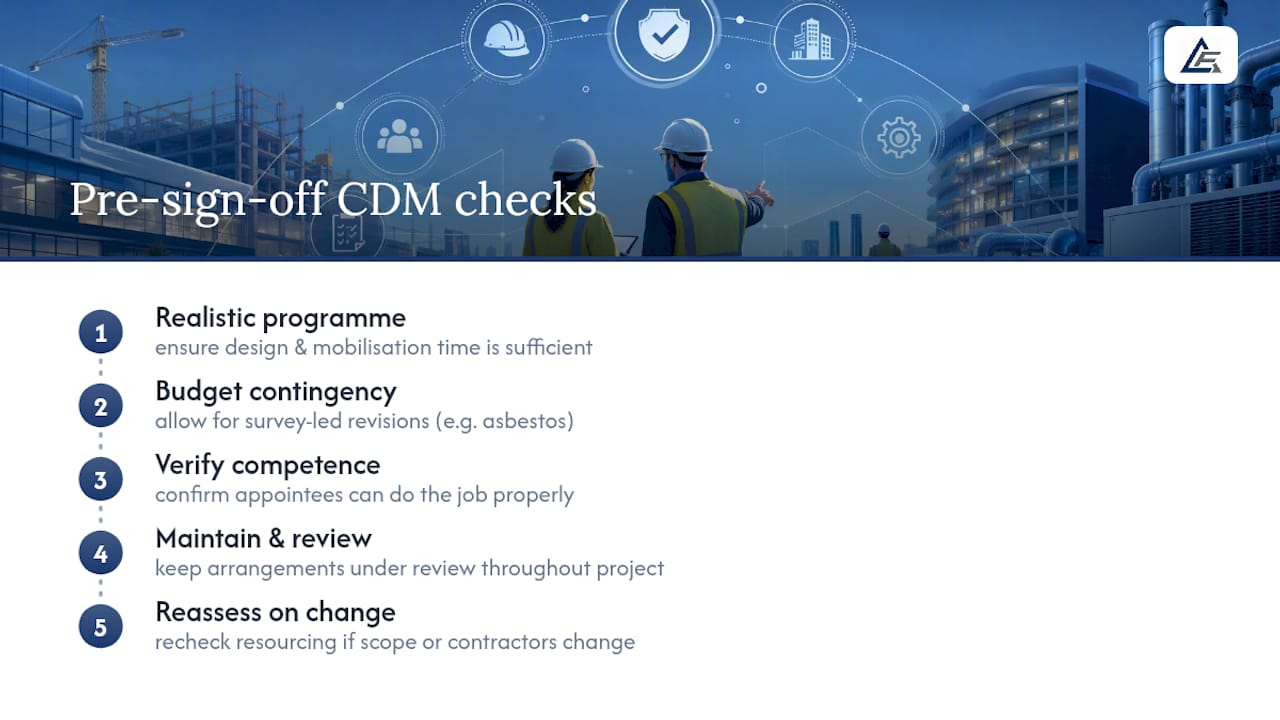
This duty doesn’t end when the contract is signed. Arrangements must be maintained and reviewed throughout the project, right up until you dispose of your interest in the site. If the scope changes or a new contractor joins midway through, your obligation to reassess resourcing kicks back in immediately.
Pro Tip: Name one accountable CDM lead within your organisation for every project, even a small one. A project without a named owner is where suitable arrangements quietly stop being reviewed, and that’s exactly the gap HSE inspectors look for.
Appointing a principal designer and principal contractor
Where more than one contractor is involved, whether that’s confirmed from the outset or becomes likely as the project develops, you must appoint a principal designer and a principal contractor in writing, and do so as soon as practicable, and before construction work begins. Leaving this until the contractor mobilises on site is too late.
Your appointment letters should cover, at minimum:
- The scope of duties being delegated under CDM 2015
- Evidence you’ve checked competence, including relevant experience, resources, and qualifications for the project’s complexity
- Reporting lines and the point at which the appointment takes effect
If you fail to appoint a principal designer or principal contractor when the regulations require it, those duties don’t simply disappear. You become responsible for fulfilling them yourself, which is rarely a position a facilities or estates team wants to be in without the resource to match. Keep dated copies of every appointment letter and competence check on file. If you’re working with multiple clients on one project, the regulations allow you to agree in writing which party is treated as the client, though some duties remain owed by everyone involved regardless of that agreement.
What pre-construction information you must provide, and when
Pre-construction information has to reach prospective appointees and, later, the appointed designers and contractors as soon as practicable, well before work starts. Late delivery is one of the most common ways clients undermine their own compliance, because it forces risk to be discovered mid-programme rather than planned around.
The information you’re expected to hold and share typically includes:
- Known site constraints, including access limitations and existing services
- Records of existing plant, structural details, and building fabric condition
- Asbestos surveys and any other hazardous materials data
- Previous incident history or known defects relevant to the works
- Utilities and services information, including isolation points
Deliver this as a single, versioned digital pack rather than a scatter of emails. Assign one named owner for updates and sign-off, so contractors always know they’re working from the current version rather than an outdated draft. Late or incomplete pre-construction information is consistently where projects come unstuck, and it’s entirely within your control to fix.
Construction phase plans and welfare facilities before work starts
The construction phase plan itself isn’t your document to write. On a single-contractor project, the contractor produces it; on a multi-contractor project, that responsibility sits with the principal contractor. Your job is to check it before work begins, not sign it off unread.
Look for these before giving approval:
- Risk controls that match the pre-construction information you actually provided
- Realistic sequencing that reflects site access and any operational constraints
- Clear emergency arrangements, including evacuation and first aid provision
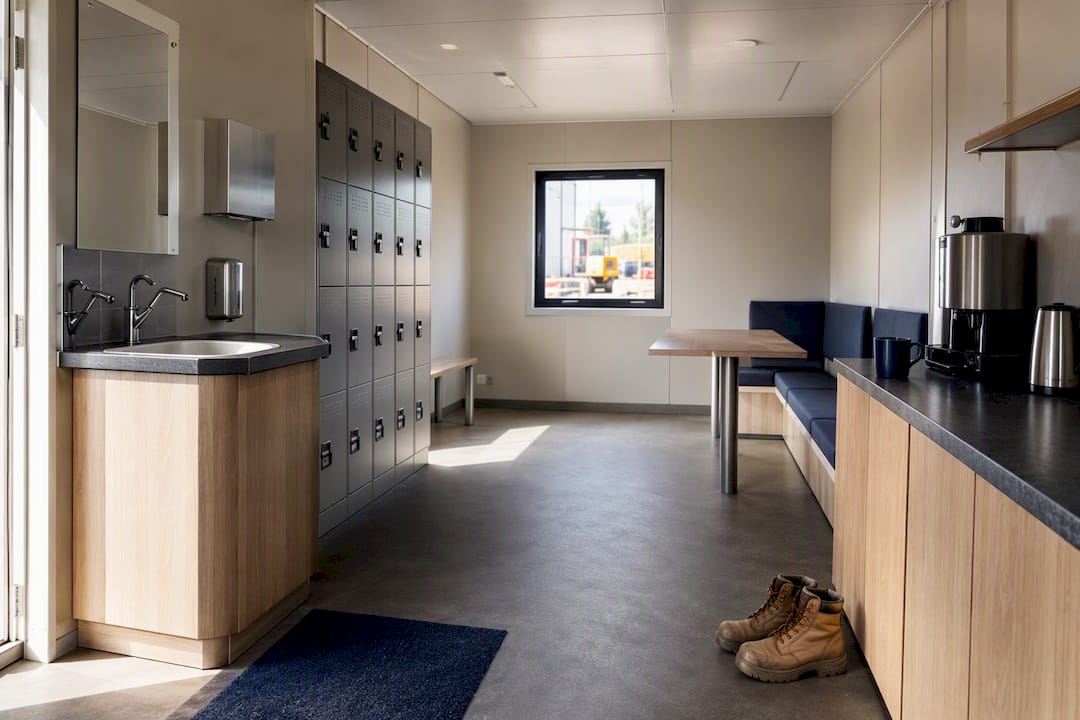
- Confirmation that welfare facilities meet Schedule 2 requirements, covering toilets, washing facilities, drinking water, and rest areas
Welfare provision is frequently underestimated on smaller commercial projects, particularly short-term works where contractors assume existing building facilities will suffice. Confirm access arrangements explicitly rather than leaving it to assumption.
The health and safety file: your handover obligation explained
The principal designer prepares and maintains the health and safety file, pulling together the information a future contractor, maintenance team, or emergency service would need to work safely on the building. That includes residual hazards, as-built drawings, plant specifications, and maintenance requirements specific to what’s been installed.
Your facilities team will lean on this file for years after handover, so its quality matters well beyond project completion:
- Confirm the file is handed over at practical completion, not weeks later once memories and paperwork have gone cold
- Check it covers statutory testing requirements for anything newly installed
- Record the handover date and recipient in writing, particularly important if you later dispose of your interest in the building, since that obligation to pass the file on transfers with the sale
A poorly maintained file is a maintenance liability disguised as a paperwork gap, one that surfaces the first time an engineer needs to isolate a service nobody documented properly; following a property maintenance workflow can help prevent these issues by ensuring organized, ongoing estate-management processes.
Notifiable projects: when you must submit an F10 to HSE
A project becomes notifiable when construction work will last longer than 30 working days and involve more than 20 workers at any one time, or when it will exceed 500 person-days of work in total.
Notification threshold: projects exceeding 30 working days with over 20 workers on site simultaneously, or surpassing 500 worker-days overall, must be notified to HSE using form F10 before construction begins.
Once notified, a copy of the F10 must be displayed prominently on site, typically in the site office or at the main entrance. Practical points worth building into your process:
- Submit as soon as the principal contractor is appointed and the timeline is confirmed, not once work has already begun
- Update the notification if project details change materially, such as duration or worker numbers
- Retain the submitted F10 alongside your appointment records as evidence of compliance
A practical compliance checklist for commercial clients
Meeting your CDM 2015 duties comes down to procurement discipline paired with governance you can actually evidence. Build these into your project process rather than treating them as one-off box-ticking:
- Vet competence formally before appointment, don’t rely on tender documents alone
- Issue written appointment letters for principal designer and principal contractor roles
- Deliver a complete pre-construction information pack before design work starts in earnest
- Name a single CDM lead accountable for reviewing arrangements throughout the project
- Schedule governance reviews at defined milestones, not just at project kick-off
- Keep decision logs and meeting minutes that show ongoing oversight, not just initial planning
- Retain appointment letters, the pre-construction pack, the construction phase plan, the health and safety file, and any F10 submission in one accessible record
Pro Tip: Store these records centrally and label them by project reference from day one. When HSE or an insurer asks for evidence months later, the client who can produce a complete, dated file in minutes is in a fundamentally stronger position than one still searching through inboxes.
Common failures and legal risks: where clients typically fall short
Three failure patterns show up repeatedly. Late or incomplete pre-construction information forces designers to guess at site conditions, and the fix is straightforward: assemble the pack before tender, not after appointment. Compressed programmes and thin budgets erode the “suitable arrangements” duty from the outset, since no amount of on-site management compensates for a timeline that was never realistic. And missing written appointments, or appointments made informally over email without competence checks, leave clients holding duties they never intended to carry, discovered only when something goes wrong and the paperwork isn’t there to show otherwise.
Delta First’s view: meeting CDM duties on live buildings
Working across occupied commercial estates, Delta First routinely finds that the information clients hold, but rarely package properly, is exactly what pre-construction packs need: plant asset records, access constraints around live areas, and confirmed shutdown windows for isolations. That data sits in maintenance systems long before a project team asks for it.
Planned preventative maintenance records also feed directly into a stronger health and safety file, since asset condition and service history are already documented rather than reconstructed after the fact. For facilities teams weighing up a refurbishment or compliance programme, a Delta First survey can identify what pre-construction information you already hold, saving weeks at the procurement stage.
Where the industry gets client duties wrong
Most compliance guidance treats CDM 2015 as a one-off appointment exercise, get the paperwork signed and move on. That’s the wrong emphasis entirely. The regulations are built around continuous management, and the “suitable arrangements” duty doesn’t lapse once contracts are in place. It’s tested against decisions made throughout the project, not just at the start.
The overrated priority is appointment letters in isolation. Plenty of clients have immaculate paperwork for principal designer and principal contractor appointments, yet still fail on pre-construction information because nobody owned the job of assembling site data before tender. Paperwork without substance behind it satisfies nobody in an enforcement conversation.
What actually protects a commercial client is unglamorous: named accountability, scheduled reviews, and records that show you were watching the project, not just launching it. Facilities and estates teams have an underused advantage here. You already hold the plant records, access constraints, and maintenance history that make pre-construction information genuinely useful, rather than a generic template bolted onto a tender pack. Use that asset. It’s more valuable to your compliance position than another appointment letter template.
— Ashley
Get help meeting your CDM client duties with Delta First
Delta First is the practical route to CDM 2015 compliance for commercial clients who need the underlying building data, not just the paperwork template. Where generic compliance consultants start from a blank page, Delta First already holds the plant records, fabric condition history, and access constraints that pre-construction information packs actually require, because that data comes from ongoing maintenance work, not a one-off site visit.
Whether you’re commissioning a refurbishment, a mechanical or electrical upgrade, or need a compliance survey ahead of appointing your principal designer, Delta First gives you a single point of contact across electrical, mechanical, HVAC, and building fabric services, with documented records ready to feed straight into your pre-construction pack and eventual health and safety file. That documentation also supports a cleaner handover if you later dispose of your interest in the building. Delta First serves commercial, education, healthcare, retail, and public sector clients across Essex, Suffolk, Norfolk, and Greater London. If you manage a commercial office estate and need a planned maintenance survey ahead of your next project, request a quotation from Delta First today.
Primary sources for CDM 2015 client duties
For the legal text itself, consult regulation 4 on legislation.gov.uk, which sets out client duties in full. HSE’s guidance for commercial clients translates that into practical roles and responsibilities, while the HSE summary of duties covers all dutyholders side by side. For notification requirements, use the HSE F10 notification page directly rather than a third-party summary.
Need a reliable maintenance and compliance partner? Delta First provides planned preventive maintenance, statutory compliance support and reactive repairs from one accountable contractor across Essex, Suffolk and London, with 24/7 emergency cover. Call 01206 237422 or request a quote.
Sources
- Commercial clients: roles and responsibilities – HSE
- The Construction (Design and Management) Regulations 2015 – Part 2: Client duties (regulation 4)
Recommended
- Summer HVAC maintenance: a guide for facilities managers
- BMS maintenance: the practical checklist for facilities managers
- SFG20 maintenance: your guide to UK compliance standards
Talk to Delta First
Delta First Building Services is a Colchester-based M&E contractor working across Essex, Suffolk and London, with commercial work in Norfolk. Our directly employed electrical team is supported by vetted specialist subcontractors where extra certification is needed, and we offer genuine 24/7 emergency cover. Get in touch to arrange a survey or quote.
[…] 7 key checks: CDM 2015 client duties for UK facilities managers […]