

A PPM schedule, or planned preventative maintenance schedule, is a structured document that records every asset you maintain, the task to be carried out, how often, who is responsible, how long it takes, what it costs, and whether the task is a statutory requirement. The immediate action to take is to open a spreadsheet or your CAFM import template and begin an asset inventory. Before you write a single task, check three sources: SFG20 for the UK industry standard task library, the RICS PPM guidance for survey format and cost modelling, and HSE maintenance guidance for statutory and safe-working obligations.
Key takeaways
A PPM schedule built on a complete asset register, mapped to statutory obligations, and loaded into a CAFM with a documented audit trail is the most reliable way to control maintenance costs and meet compliance requirements.
| Point | Details |
|---|---|
| Start with the asset register | A complete, physically labelled asset register is the foundation; gaps here create gaps in every task that follows. |
| Map statutory tasks first | Identify all legally mandated tasks using SFG20, HSE guidance, and legislation.gov.uk before setting any other frequencies. |
| Use a spreadsheet, then CAFM | Build in a spreadsheet for flexibility and cost modelling per RICS guidance, then import into CAFM for audit trails and recurring work orders. |
| Pilot on critical assets | Run one full cycle on P1 assets before loading the full estate; use the results to refine the schedule and justify the budget. |
| Review annually and after changes | Update the schedule whenever regulations change, assets are replaced, or building use evolves, not only on a fixed annual cycle. |
| Delta First as your PPM partner | Delta First provides a full planned maintenance survey, directly employed qualified engineers, and a single point of contact across Essex, Suffolk, Norfolk, and Greater London. |
What must a PPM schedule include?
Every effective maintenance schedule planner shares the same core architecture, regardless of whether you manage a single commercial building or a multi-site estate. The fields below form the minimum column set for a defensible, auditable schedule.
Core fields for every PPM schedule:
- Reference number — a unique ID that links the row to your asset register and CAFM work order
- Location — building, floor, room or grid reference so engineers can find the asset without ambiguity
- Asset description — type, make, model and serial number where applicable
- Task description — a clear, specific description of what is to be done (not just “service boiler” but “annual gas boiler service including flue gas analysis, heat exchanger inspection and safety device check”)
- Frequency code — D (daily), W (weekly), M (monthly), Q (quarterly), 6M (biannual), A (annual), or a specific interval in months
- Owner/role — the named role or contractor responsible; avoid personal names that become outdated
- Estimated duration — in hours, to support resource planning and contractor scheduling
- Cost/budget — unit cost per visit and annual total; keep these in separate columns so you can model year-on-year spend
- Statutory flag — a clear Y/N or colour code indicating whether the task is a legal requirement
- Priority/risk code — P1 (critical), P2 (essential), P3 (recommended), or equivalent, derived from your risk assessment
- Condition — current condition rating (e.g. A–D scale) from the most recent inspection
- Photo reference — a file name or hyperlink to the asset photograph or condition survey image
- Notes — manufacturer instruction reference, last service date, defects outstanding
RICS guidance recommends structuring the schedule as a spreadsheet so cost items can be inserted, altered or omitted for dynamic cost modelling and multi-year forecasting. That flexibility is exactly why a spreadsheet remains the starting point even when you plan to import into a CAFM system later.
Pro Tip: Set up two cost columns from the outset: one for a conservative estimate and one for a worst-case figure. This lets you toggle between scenarios when presenting service charge impacts to landlords or tenants, following the RICS approach to budget discussion.
How do you create a PPM schedule step by step?
The workflow below takes you from a blank sheet to a live, recurring maintenance programme. Follow it sequentially; skipping steps, particularly the asset inventory and statutory task mapping, is the single most common reason schedules fail their first compliance audit.
Step 1: prepare your brief and scope
Define the building or estate boundary, the asset categories in scope, and who has sign-off authority. Agree whether the schedule will cover landlord obligations only, or tenant plant as well. Record this in a one-page scope document that sits alongside the schedule.
Step 2: build the asset register
Walk the building and tag every maintainable asset. Capture make, model, serial number, installation date, location, and condition. A structured asset register is the foundation; a PPM schedule built without one will have gaps that only surface during an audit or a breakdown.
Step 3: gather manufacturer instructions and statutory task lists
Pull the O&M manuals for each asset. Cross-reference with SFG20 to identify the standard task library entries that apply. Map statutory tasks using Legislation and HSE guidance to confirm legal obligations.
Step 4: set frequencies and priorities
Assign a frequency to each task based on the three drivers covered in the next section: statutory requirement, manufacturer recommendation, and condition. Assign a priority code using a risk matrix.
Risk-based priority matrix:
| Likelihood Consequence | Low | Medium | High |
|---|---|---|---|
| Low | P3 | P3 | P2 |
| Medium | P3 | P2 | P1 |
| High | P2 | P1 | P1 |
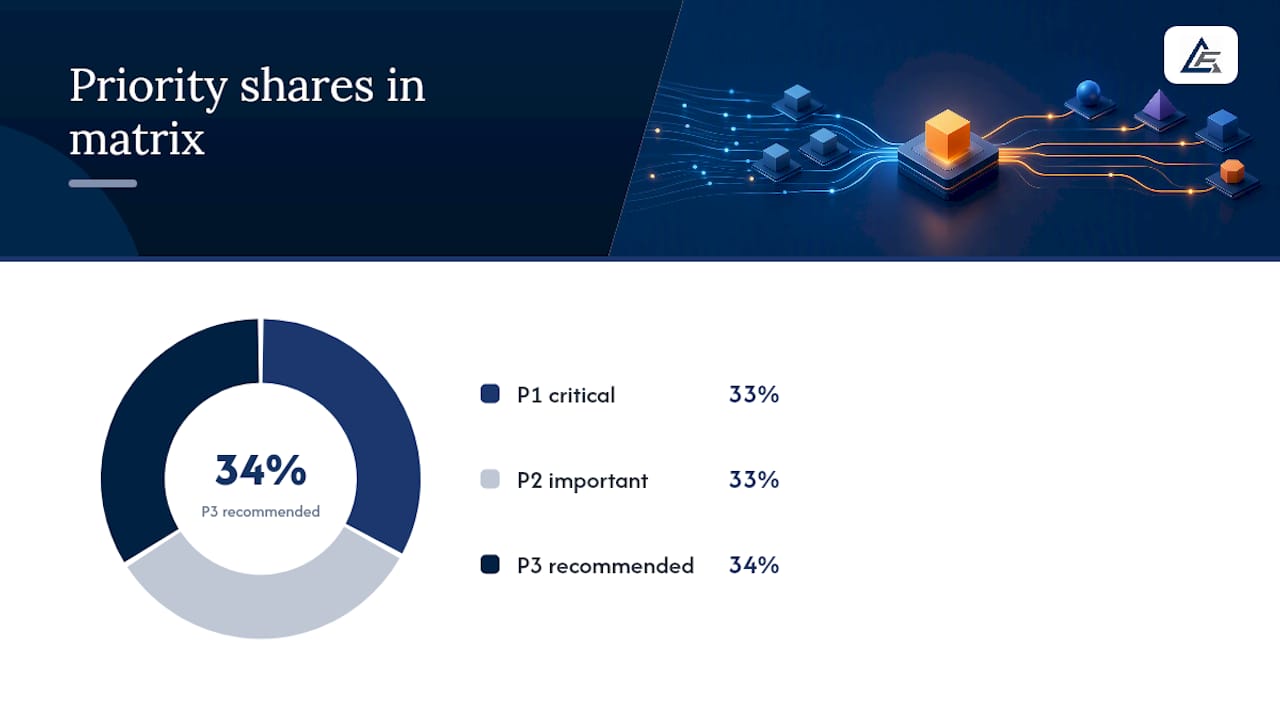
P1 tasks are critical: failure causes safety risk, legal breach, or significant operational disruption. P2 tasks are important but allow a short deferral window. P3 tasks are recommended and can be deferred if budget is constrained, provided the decision is documented.
Step 5: define task details and assign owners
Write a specific task description for each row. Assign a role (in-house technician, accredited contractor, competent person) rather than a name. Note the skill level and any certification required.
Step 6: load into CAFM or CMMS and set recurring work orders
Import the completed spreadsheet into your CAFM or CMMS. Set recurring work orders against each task frequency. Attach the relevant manufacturer instruction document and any permit-to-work template.
Step 7: pilot on critical assets, then scale
Start the live schedule on your P1 assets only. Run one full cycle, review completion rates, and correct any resourcing or access issues before loading the full estate. RICS notes that a phased approach improves buy-in and allows you to prove the data and cost model before scaling.
Step 8: set KPIs and a review cycle
Review the full schedule quarterly for the first year, then annually thereafter.
Pro Tip: Run your pilot during a planned outage or shutdown window. Access to plant rooms and roof plant is far easier when the building is unoccupied, and you can physically label assets at the same time, which dramatically improves inventory accuracy.
How should you set task frequencies and priorities?
Three drivers determine how often a task appears on your maintenance calendar, and understanding the hierarchy between them keeps your schedule both compliant and cost-efficient.
The three frequency drivers:
- Statutory/legislative — tasks mandated by law or regulation, such as annual gas safety checks under the Gas Safety (Installation and Use) Regulations 1998, five-yearly fixed electrical installation condition reports (EICRs) under BS 7671, six-monthly fire alarm inspections under BS 5839-1, and thorough examination of lifting equipment under LOLER 1998. These intervals are non-negotiable; they set the floor, not the ceiling.
- Manufacturer recommendation — the O&M manual specifies service intervals for a reason: warranty validity, performance, and component life. Departing from these intervals without documented justification can void warranties and weaken your position in a liability dispute.
- Condition-based — inspection results, sensor data, or oil analysis can justify extending an interval where evidence supports it, or shortening it where deterioration is faster than expected. This is the basis of condition-based maintenance and links directly to predictive maintenance techniques.
The correct approach is to layer these drivers. Statutory tasks are always retained at their mandated frequency. Manufacturer tasks are recommended unless condition monitoring provides a documented reason to adjust. Condition-based evidence can move a task from scheduled to corrective, or extend an interval, but only when the rationale is recorded in the schedule notes column.
Statutory examples worth flagging explicitly in your schedule include: annual gas boiler servicing and gas safety certificates, LOLER thorough examinations for lifts and hoists, L8 Legionella risk assessment and monitoring, fire alarm weekly tests and six-monthly inspections, and emergency lighting monthly function tests and annual discharge tests.
HSE guidance is clear that maintenance must be carried out by competent people following manufacturers’ instructions and safe systems of work. That obligation applies equally to the frequency decision: if you extend an interval beyond the manufacturer’s recommendation, document why, who authorised it, and what monitoring is in place.
RICS reports that properly executed PPM surveys and schedules support sustainability objectives and help preserve or increase asset value by avoiding large, unexpected repair bills. Frequency decisions that are too conservative waste budget; those that are too aggressive risk asset failure and compliance breach.
Pro Tip: Create a “frequency rationale” column in your spreadsheet, even if it is hidden in the working version. When an auditor or client asks why a task runs every 18 months rather than annually, you can show the documented decision rather than reconstruct it from memory.
What does a PPM schedule template look like?
A spreadsheet remains the canonical format for an initial PPM schedule because it allows flexible cost modelling, easy sharing with surveyors and clients, and straightforward import or export to most CAFM platforms. RICS guidance specifically recommends this format so that cost items can be toggled, adjusted, or omitted during budget discussions.
Suggested column headers for your PPM spreadsheet:
- Ref, Location, Asset Type, Make/Model, Serial No., Task Description, Frequency Code, Statutory (Y/N), Skill Level, Est. Duration (hrs), Unit Cost (£), Annual Cost (£), Condition (A–D), Priority, Next Due Date, Review Date, Photo Ref, Notes
Sample rows:
For multi-year cost modelling, add year columns (Year 1, Year 2, Year 3 and so on) to the right of the annual cost column. Enter the expected cost for each year, factoring in planned replacements or major overhauls. This gives you a five-year or ten-year expenditure forecast that supports capital budgeting and service charge apportionment. Mark each row with a “Landlord” or “Tenant” liability flag where applicable.
Sector bodies publish practical PPM templates that make a useful starting point for building a bespoke spreadsheet. A PPM survey typically produces a year-by-year maintenance plan covering 5–20 years, with condition ratings, defect listings, and cost recommendations to aid phased budgeting.
Pro Tip: When importing into a CAFM system, map your frequency codes to the system’s own recurrence settings before you start. A mismatch between “Q” in your spreadsheet and a 90-day recurrence in the CAFM is a common source of scheduling drift that only becomes visible when tasks start falling due on the wrong dates.
How should you manage records and audit trails in a CAFM?
A spreadsheet gets you started, but it cannot close work orders, attach certificates, or generate a compliance dashboard. Knowing when to stay in a spreadsheet and when to move to a CAFM or CMMS is a practical decision, not a theoretical one.
When a spreadsheet is sufficient:
- Single building with fewer than 50 maintainable assets
- Small team where one person manages all scheduling
- Early-stage PPM build where the asset register is still being validated
- Client or landlord reporting that requires a simple, shareable format
When you need CAFM or CMMS:
- Multi-site or multi-building estates
- Multiple contractors and in-house engineers sharing a schedule
- Statutory compliance reporting with an auditable work order trail
- Integration with procurement, invoicing, or helpdesk systems
Once you move to a CAFM, best practice for record-keeping includes: linking every task to a unique asset ID, attaching photographs and condition notes at each visit, storing certificates (gas safety, EICR, LOLER) against the relevant asset record, keeping a change log that records every frequency change with a date, reason, and authoriser.
SFG20 via Facilities-iQ provides colour-coded statutory task mapping and API integration to CAFM systems, which significantly reduces the manual effort of keeping your schedule aligned with the current standard. Statutory tasks are flagged in a distinct colour so they are immediately visible in any compliance report or client dashboard.
Audit-trail checklist for compliance reviews:
- Completed work orders with engineer signature or digital sign-off
- Certificates attached to the relevant asset record (not filed separately)
- Change log for any frequency or task description amendments
- Evidence of contractor competence (Gas Safe registration for gas work, electrical qualifications and registrations, MEWP training) stored against the contractor record
- Outstanding defects log with target resolution dates
- Client or landlord sign-off records for any deferred statutory tasks
Pro Tip: Set your CAFM to flag any statutory task that is overdue by more than seven days and escalate it automatically to the responsible manager. A missed statutory task that sits unnoticed for weeks is a compliance and liability risk; an automated escalation makes it visible before it becomes a problem.
What are the typical PPM tasks for common asset types?
The checklists below cover the assets facilities managers encounter most often. Use them to populate your template quickly, then cross-reference with SFG20 and manufacturer O&M manuals to confirm task specifics and intervals for your site.
HVAC systems
- Air handling units: filter change, belt and drive check, coil clean, drain pan inspection, damper operation check (quarterly)
- Fan coil units: filter clean or replace, coil inspection, condensate drain check (biannual)
- Chiller plant: refrigerant leak check, condenser coil clean, water treatment check, controls calibration (annual, with monthly water treatment monitoring)
- Cooling towers: biocide dosing, drift eliminator inspection, basin clean (monthly/quarterly per L8 risk assessment)
- Extract fans: blade clean, bearing lubrication, belt check (biannual)
For a detailed HVAC maintenance plan covering task specifics and seasonal considerations, Delta First’s own guidance sets out the full task library.
Boilers and heating
- Annual gas boiler service including flue gas analysis, heat exchanger inspection, safety valve and controls check (Gas Safe engineer, annual, statutory)
- Monthly visual inspection of boiler house, pressure checks, water treatment log review (competent person)
- Pressurisation unit check and water softener salt top-up (monthly)
Electrical distribution
- Distribution board visual inspection and thermal imaging (annual, approved electrician)
- Fixed electrical installation condition report — EICR (every five years for commercial premises, or as specified by BS 7671)
- Emergency lighting monthly function test and annual three-hour discharge test (competent person)
- PAT testing of portable appliances (frequency risk-based, typically annual for high-use items)
Fire safety systems
- Fire alarm weekly test (competent person, logged)
- Fire alarm six-monthly inspection and annual service (third-party accredited contractor, BS 5839-1)
- Sprinkler system quarterly inspection and annual service (specialist contractor)
- Fire extinguisher annual inspection and five-yearly overhaul or replacement
- Fire damper annual drop test (competent person or specialist)
Lifts and hoists
- Thorough examination by a competent person every six months for passenger lifts (LOLER 1998, statutory)
- Routine maintenance visit monthly or quarterly per manufacturer recommendation (specialist lift contractor)
Building fabric and drainage
- Flat and pitched roof inspection biannually and after severe weather events
- Gutters and downpipes cleared biannually (spring and autumn)
- External cladding and glazing inspection annually
- Drainage CCTV survey every three to five years for larger estates
Tasks such as gas servicing, LOLER examinations, and EICR must be carried out by appropriately accredited contractors. Weekly fire alarm tests, monthly boiler visual checks, and filter changes can often be handled by a trained in-house technician, provided competence is documented.
What safety and competence obligations apply to PPM in the UK?
Scheduling a task is only half the responsibility. The Health and Safety at Work etc. Act 1974 and associated regulations place a duty on employers and building owners to ensure maintenance is carried out safely by people with the right competence.
Contractor vetting checklist before mobilisation:
- Confirmed competence: Gas Safe registration, electrical qualifications, MEWP or tower training and F-gas certification as applicable
- Current public liability and employers’ liability insurance certificates
- Method statements and risk assessments (RAMS) reviewed and accepted before work begins
- Evidence of relevant training and qualifications for the specific task
- References or track record for comparable building types
HSE guidance states that maintenance must be carried out by competent people using manufacturers’ instructions and appropriate safe systems of work, including isolations and permits where necessary. For higher-risk tasks, a permit-to-work system is not optional; it is the mechanism that controls access, isolation, and re-energisation.
Delta First’s directly employed engineers have their competence and training records managed in-house, with any specialist subcontractors vetted and managed by Delta First for compliance-critical tasks.
Safety checklist to embed in your PPM schedule:
- Isolation required (Y/N) — note the isolation point and lock-out/tag-out procedure
- Permit to work required (Y/N) — note the permit type (hot work, confined space, electrical isolation, working at height)
- PPE required — specify type (gloves, RPE, safety footwear, harness)
- Competency requirement — state the minimum certification or accreditation
- Manufacturer instruction reference — document number and version
Pro Tip: Add a “safe system of work” column to your PPM spreadsheet that links directly to the relevant method statement or permit template. Engineers and contractors can then access the correct document before they start, rather than relying on memory or a separate filing system.
How does a phased PPM roll-out work in practice?
A structured roll-out reduces the risk of a poorly loaded schedule causing more disruption than it prevents. The approach Delta First uses with new clients follows a consistent phased sequence.
- Scoping and asset tagging — site walkdown, asset register creation, and physical labelling of all maintainable plant. This typically takes one to two days per building depending on size and complexity.
- Statutory task mapping — identify all legally mandated tasks, confirm current compliance status, and flag any overdue statutory items for immediate attention before the schedule goes live.
- Pilot on critical assets — load P1 assets into the CAFM and run one full cycle of all tasks. Review completion rates, access issues, and cost accuracy before proceeding.
- Full schedule load — import the complete PPM schedule into the CAFM, set all recurring work orders, and confirm contractor mobilisation dates.
- Contractor mobilisation and induction — brief all contractors on site rules, permit-to-work procedures, and reporting requirements. Confirm RAMS are in place for each task category.
- Quarterly review for the first 12 months — review KPIs (completion rate, overdue tasks, cost versus budget) at each quarter. Adjust frequencies, task descriptions, or resource allocation based on actual performance data.
Expected outcomes from a well-executed roll-out include a measurable improvement in PPM completion rate, smoother annual budget forecasting, a reduction in reactive spend spikes caused by unplanned failures, and a documented audit trail that satisfies compliance requirements. RICS confirms that properly executed PPM supports sustainability objectives and helps preserve asset value by avoiding large, unexpected repair bills.
To request a planned maintenance survey or quotation from Delta First, visit the facilities management services page or contact the team directly.
Pro Tip: Ask your contractor to provide a post-pilot report after the first full cycle on critical assets. A written summary of completion rates, access issues, and any defects found gives you the evidence base to refine the schedule and justify the budget to senior stakeholders.
The part of PPM implementation most guides skip over
The most common stumbling block in a PPM roll-out is not the spreadsheet, the CAFM, or even the budget. It is the asset inventory. Facilities managers consistently underestimate how long it takes to produce an accurate, complete asset register, and the consequences of getting it wrong ripple through every subsequent step.

Assets get missed during a walkdown because plant rooms are locked, access hatches are unmarked, or equipment is hidden above a suspended ceiling. When those assets are absent from the register, they are absent from the schedule. They receive no maintenance, their condition deteriorates unmonitored, and they surface only when they fail, usually at the worst possible moment.
The practical fix is to conduct the asset walkdown during a planned shutdown or out-of-hours window when all areas are accessible. Label every asset physically at the same time as recording it digitally. A label on a piece of plant is the link between the physical world and the CAFM record; without it, engineers waste time identifying assets on every visit.
One further point worth making: a PPM schedule is not a static document. Regulations change, assets are replaced, and building use evolves. The schedule must be reviewed whenever any of these things happen, not just on an annual cycle. Delta First’s planned preventative maintenance guide covers the review process in detail, including how to handle mid-cycle changes without disrupting the compliance audit trail.
Delta First PPM services: one accountable partner for your estate
Delta First delivers planned preventative maintenance across electrical, mechanical, HVAC, and building fabric disciplines for commercial, industrial, education, healthcare, retail, and public sector clients throughout Essex, Suffolk, Norfolk, and Greater London. Rather than managing multiple specialist contractors with separate schedules and reporting lines, you get a single point of contact who coordinates the full scope, maintains the audit trail, and escalates reactive issues without you having to chase.

Where a statutory task requires specific certification, such as Gas Safe registration, F-gas certification or MEWP training, Delta First uses suitably certified specialist subcontractors and manages the work as one accountable service. Every visit generates a digital work record, certificate, and condition note that feeds directly into your compliance dashboard. We carry out a planned maintenance survey before any contract starts, so the schedule we build reflects your actual assets and obligations, not a generic template.
To request a planned maintenance survey or a quotation for your site, visit our building services glossary and resources page or contact the Delta First team directly. We will respond within one working day.
Need a reliable maintenance and compliance partner? Delta First provides planned preventive maintenance, statutory compliance support and reactive repairs from one accountable contractor across Essex, Suffolk and London, with 24/7 emergency cover. Call 01206 237422 or request a quote.
Sources
Recommended
Talk to Delta First
Delta First Building Services is a Colchester-based M&E contractor working across Essex, Suffolk and London, with commercial work in Norfolk. Our directly employed electrical team is supported by vetted specialist subcontractors where extra certification is needed, and we offer genuine 24/7 emergency cover. Get in touch to arrange a survey or quote.