

If you are the dutyholder for non-domestic premises in the UK, you must have an asbestos management plan (AMP) that records known and presumed asbestos-containing materials (ACMs), assigns clear responsibility and sets out monitoring, control and emergency arrangements. This is not optional guidance. Regulation 4 of the Control of Asbestos Regulations 2012 places a legal duty to manage asbestos on every dutyholder for non-domestic premises, and failure to comply is a criminal offence carrying unlimited fines and up to two years’ imprisonment.
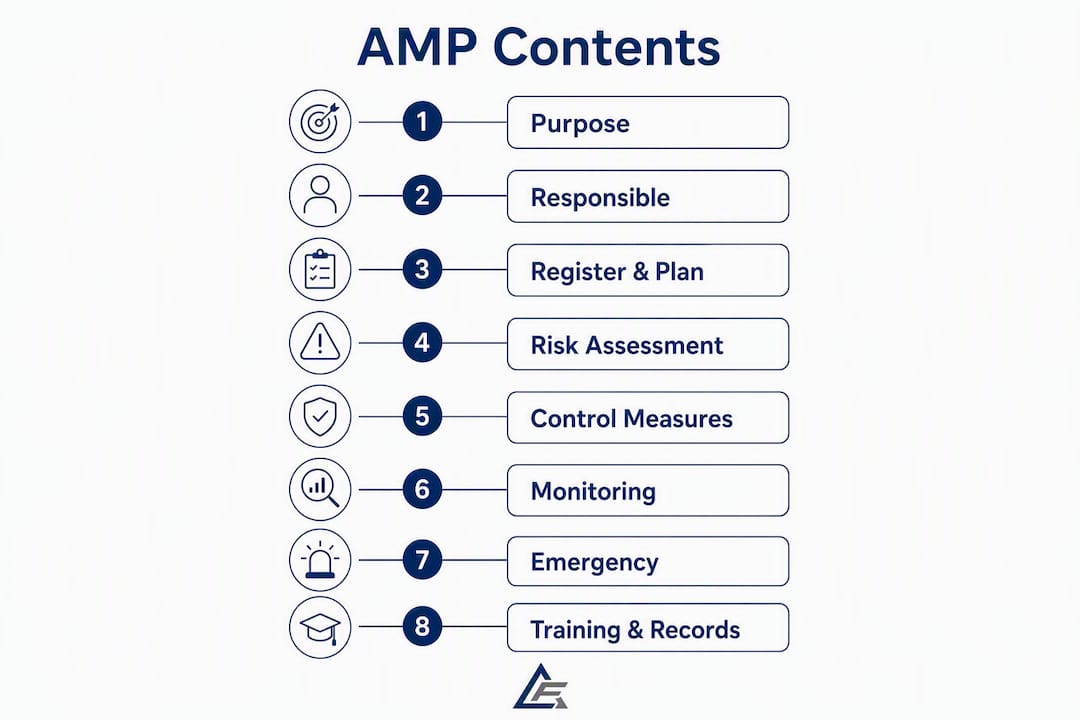
Your plan must, at minimum, contain:
- A named responsible person (and deputies)
- An asbestos register linked to site plans
- A risk assessment for each ACM
- A monitoring and inspection schedule
- Control arrangements for managing ACMs in place
- Emergency procedures for accidental disturbance
The Health and Safety Executive (HSE) is the authoritative source for all asbestos duty guidance in Great Britain. Everything in this guide aligns with HSE requirements and the Control of Asbestos Regulations 2012.
What should your asbestos management plan contain?
HSE sets out the required contents clearly: the plan must be written or electronic, site-specific and kept up to date. A generic template filed away and never touched does not satisfy the duty. Below is a practical breakdown of every section your plan should include, with guidance on what to write under each heading.

Purpose and scope
State the building(s) covered, the date of the plan and the legal basis (Control of Asbestos Regulations 2012, Regulation 4). One paragraph is sufficient. Avoid copying boilerplate text that does not reflect your site.
Named responsible person and deputies
Identify the dutyholder by name and job title, then name at least one deputy. Include contact details and confirm who holds authority to commission surveys, approve remediation and update the register. Deputies must be able to act without delay if the primary contact is unavailable.
Asbestos register and site plan
The register is the operational core of the plan. Cross-reference it to annotated floor plans showing the location of every known or presumed ACM. The register and site plan must be accessible to anyone who may disturb the fabric of the building.
Risk assessment and prioritisation
For each ACM, record its condition, accessibility, likelihood of disturbance and the action decided upon: monitor, repair, encapsulate or remove. This section drives the monitoring schedule and contractor briefings.
Control arrangements
Describe how ACMs left in place are managed: access restrictions, signage, permit-to-work requirements and any encapsulation or repair measures in place. Be specific to your site rather than repeating generic text.
Monitoring schedule
State the frequency of condition checks for each ACM (which depends on risk) and confirm the plan itself is reviewed at least every 12 months. Record who carries out checks and where results are logged.
Emergency procedures
Detail the steps to take if asbestos is disturbed accidentally: stop work immediately, evacuate the area, prevent re-entry, notify the responsible person and contact a licensed contractor. Include out-of-hours contact numbers.
Communication, training and recordkeeping
Confirm how the register is shared with employees and contractors, what training is in place and how records of briefings, inspections and remediation are stored.
Pro Tip: The HSE example asbestos management plan shows how a real building’s survey findings, site plans and condition monitoring are incorporated into a working document. Use it as a model, not a template to copy verbatim. Every field must reflect your building.
Who is the dutyholder and what are they responsible for?
The dutyholder is the person or organisation with legal responsibility for maintaining or repairing non-domestic premises. In practice, this is typically:
- The building owner
- The landlord where a lease places maintenance responsibility on them
- The organisation or person with clear contractual control over maintenance where no lease exists
HSE’s duty-to-manage check covers all non-domestic premises and the common parts of multi-occupancy domestic buildings such as purpose-built flats. If you control maintenance, you have the duty.
Dutyholder responsibilities include:
- Appointing a competent person (or persons) to manage asbestos day-to-day
- Commissioning a management survey and maintaining the register
- Ensuring pre-start checks are completed before any building fabric work begins
- Acting on monitoring findings promptly and recording decisions
- Providing or arranging appropriate asbestos awareness training for staff and contractors
- Reviewing the plan at least annually and after any incident, change of use or personnel change
Legal accountability remains with the dutyholder even when tasks are delegated. You can appoint a competent facilities manager or contractor to carry out the practical work, but you cannot transfer the legal duty itself. Failure to manage asbestos is a criminal offence: the Control of Asbestos Regulations 2012 provides for unlimited fines and imprisonment of up to two years. HSE enforcement action can follow a single incident of accidental disturbance where the duty has not been met.
How do you prepare the asbestos register and site plan?
The register is a live document, not a one-off survey report. Each entry must record:
- Location (building, floor, room reference)
- Material type and product description (where identified)
- Condition at time of survey (good, fair, poor)
- Risk assessment score or category
- Photographs where practicable
- Access restrictions or no-access zones
- Areas not inspected and the reason
Site plans should be annotated floor plans with a reference number for each ACM that matches the register entry. Mark presumed ACM areas clearly and distinguish them from confirmed finds.
Management survey vs refurbishment/demolition survey
The two survey types serve different purposes, and using the wrong one is a common compliance gap.
| Feature | Management survey | Refurbishment/demolition survey |
|---|---|---|
| Purpose | Identify ACMs for ongoing management | Locate all ACMs before intrusive works |
| Access level | Non-intrusive; samples taken where safe | Fully intrusive; all areas accessed |
| When required | Routine duty to manage; feeds the register | Before any refurbishment, demolition or major works |
| Findings used for | Monitoring, control arrangements, AMP | Safe removal or encapsulation prior to works |
| Who carries it out | Competent surveyor | Competent surveyor (often UKAS-accredited lab) |
HSE confirms that management survey data feeds the register for routine controls, while a refurbishment/demolition survey is required before any intrusive works to confirm safety. If you are planning HVAC replacement, electrical rewiring or any work that opens up building fabric, a refurbishment survey must be completed first and its findings incorporated into the register before work starts.
Example register entry:
Room 14, Ground Floor, Block B | Ceiling tiles (presumed asbestos insulating board) | Condition: Fair | Risk: Low (undisturbed, good condition) | Action: Monitor annually | Last checked: March 2025 | Next check: March 2026 | Photographs: Ref 14-B-001
How do you decide whether to monitor, repair, encapsulate or remove?
The right management action depends on four factors assessed together: the condition of the ACM, its location and accessibility, the likelihood of disturbance during normal use or planned works, and the occupancy pattern of the area.
- Monitor in place — ACM is in good condition, unlikely to be disturbed, and in a low-traffic area. Record condition checks on schedule and update the register after each inspection.
- Repair or seal — Minor damage or surface deterioration that can be addressed without full removal. Use a competent contractor; record the work and update the register entry.
- Encapsulate — ACM is in a location where disturbance risk is moderate but removal is not immediately practicable. Encapsulation must be carried out by a competent contractor and recorded with photographic evidence.
- Remove — ACM is in poor condition, in a high-disturbance area, or removal is required before planned works. Many removal and remediation tasks require a licensed contractor under the Control of Asbestos Regulations 2012.
Licensed work is required for most asbestos insulation, asbestos insulating board and asbestos coatings. HSG227 provides decision flowcharts and technical guidance on when licensed work applies and how to assess contractor competency.
The dutyholder’s role when appointing a licensed contractor includes:
- Verifying the contractor holds a current HSE licence
- Confirming a written plan of work is in place before works begin
- Ensuring the register is updated with removal certificates after completion
- Retaining all documentation with the relevant register entry
Survey and removal costs vary depending on building size, access difficulty, survey type and the extent of sampling or laboratory analysis required. For budgeting purposes, treat any published figures as indicative market context rather than fixed prices, and get a site-specific quote.
How should you monitor ACMs and integrate the plan with PPM?
Monitoring is where many AMPs fail in practice. The plan is written, filed and then disconnected from the day-to-day maintenance programme. HSE is explicit that the duty to manage is active: the AMP must be integrated into maintenance and contractor workflows.
The register and plan must be reviewed at least every 12 months, and updated immediately after any ACM deterioration, incident, change of use or remediation work.
Monitoring record table
| What to record | Who records it | Where stored | Review trigger |
|---|---|---|---|
| Condition check result per ACM | Named responsible person or deputy | Register entry (linked to site plan) | Annually minimum; sooner if condition changes |
| Contractor pre-start check | Contractor and permit issuer | Permit-to-work record and job file | Before every building fabric task |
| Remediation or removal | Licensed contractor + dutyholder | Register entry with removal certificate | Immediately after works complete |
| Plan review date and outcome | Named responsible person | AMP document (version-controlled) | Annually or after incident/change |
Integrating the AMP with planned preventative maintenance
- Add an asbestos register check as a mandatory step in every permit-to-work for building fabric works
- Include the relevant register extract in contractor job packs before any PPM visit that involves fabric access
- Brief your PPM contractor at contract start and at each annual review
- Flag ACM locations in your asset management system so maintenance tasks automatically prompt a register check
Pro Tip: Make the register check a gate in your permit-to-work process, not an afterthought. A reactive maintenance call-out that disturbs an unidentified ACM can result in enforcement action even when the original survey was thorough. The permit-to-work is your last line of defence.
How do you share the plan and train staff and contractors?
The register must be shared with anyone who may disturb ACMs. This is a legal requirement under Regulation 4 of the Control of Asbestos Regulations 2012. Sharing the plan is not a courtesy; it is part of the duty.
Contractor briefing checklist
- Issue the relevant register extract and site plan before any building fabric work begins
- Confirm the contractor has read and understood the register (written acknowledgement)
- Complete a pre-start check and record it on the permit-to-work
- Confirm the contractor’s own asbestos competency and, where required, their HSE licence
- Retain signed briefing records with the job file
Training requirements
- Asbestos awareness training — required for anyone whose work could disturb ACMs (maintenance operatives, electricians, plumbers, HVAC engineers, decorators). This is Category A awareness training under HSE guidance.
Training records must be kept and reviewed at each plan review. Where a contractor provides their own trained operatives, obtain evidence of their training and retain it with the job record.
Pro Tip: Confirm contractor acknowledgement in writing before any work on building fabric starts, and attach that confirmation to the job record. A verbal briefing is not auditable. If HSE investigates an incident, written evidence of pre-start checks is the difference between demonstrating compliance and facing prosecution.
How do you use HSE and KELSI templates to build a site-specific plan?
HSE provides two downloadable documents that together give you everything you need to start:
- HSE blank asbestos management plan template — a structured Word-format document with instructions and placeholder sections
- HSE example asbestos management plan — a completed example showing how survey findings, site plans and monitoring records are incorporated
The KELSI (Kent Education Learning and Skills Information) template is a widely used local authority and education sector adaptation of the HSE format, often cited by estates teams in schools and colleges. It follows the same structure and is a legitimate starting point for education dutyholders, though it must still be adapted to your specific site.
Step-by-step guide to completing your plan
- Enter site details first — building name, address, construction date (if known), number of floors and total floor area. These fields anchor every other section.
- Link the register — attach or reference the survey report and register as a supporting document. Never embed the full register in the plan body; cross-reference it so both documents stay current independently.
- Name the responsible persons — complete the dutyholder, nominated person and deputy fields with current names, job titles and contact numbers. Update these whenever personnel change.
- Customise the control arrangements — replace generic text with your actual site procedures: which areas are restricted, what signage is in place, how permits-to-work are issued.
- Set the monitoring schedule — enter specific inspection dates for each ACM category, not just “annually”. Higher-risk ACMs may need quarterly checks.
- Complete the emergency procedures section — include your licensed contractor’s out-of-hours number and the name of the person authorised to declare an area safe for re-entry.
Common pitfalls to avoid
- Leaving template placeholder text in the published plan (e.g. “”)
- Storing the plan in a location inaccessible to contractors or out-of-hours responders
- Using a management survey report as a substitute for a refurbishment survey before intrusive works
- Failing to version-control the plan so it is unclear which copy is current
For digital registers, store the plan and register in a shared drive or facilities management system with access controls and a clear version history. Paper registers must be held on site and backed up. Evidence of actions — inspection records, photographs, removal certificates — should be stored directly with the relevant register entry so audits can verify timely action.
Key takeaways
A dutyholder for non-domestic premises in the UK must maintain a written, site-specific asbestos management plan under the Control of Asbestos Regulations 2012, reviewed at least every 12 months and integrated into all maintenance and contractor workflows.
| Point | Details |
|---|---|
| Legal duty is non-negotiable | Regulation 4 of the Control of Asbestos Regulations 2012 applies to all non-domestic premises; failure is a criminal offence. |
| Plan must be site-specific | Generic templates are a starting point only; every field must reflect your actual building, ACM locations and personnel. |
| Annual review is the minimum | Review the plan and register at least every 12 months and immediately after any incident, change of use or remediation work. |
| Integrate with PPM and permits | Register checks must be a mandatory gate in every permit-to-work for building fabric works, not an optional step. |
| Delta First supports compliance | Delta First integrates asbestos register checks into PPM and reactive maintenance contracts across Essex, Suffolk, Norfolk and Greater London. |
Why the AMP is only as good as the maintenance system around it
The most common failure Delta First sees is not a missing plan. It is a plan that exists in a folder and plays no part in day-to-day operations. Dutyholders invest in a survey, produce a register and then issue permits-to-work with no reference to it. An electrician opens a ceiling void. An HVAC engineer removes a panel. Neither has seen the register. That is where exposure incidents happen, and that is where enforcement follows.
The Control of Asbestos Regulations 2012 does not ask you to produce a document. It asks you to manage a risk. Those are different things. A plan that is not embedded in your PPM programme, your permit-to-work process and your contractor briefing pack is not managing anything. It is a liability dressed up as compliance.
What actually works is treating the register as a live operational tool: linked to your asset management system, checked before every fabric task, updated after every inspection and reviewed with your maintenance contractor at least once a year. That is the standard HSE expects, and it is the standard that protects your building’s occupants and your own legal position.
For healthcare and education estates in particular, where buildings are often older, occupied continuously and subject to frequent minor works, the register must be genuinely accessible to every contractor on site. Not emailed on request. Accessible. The distinction matters when something goes wrong at 10pm on a Friday.
Delta First can help you manage asbestos compliance within your PPM programme
Asbestos compliance does not sit in isolation from your wider maintenance obligations. Delta First works with facilities managers, estates teams and property owners across Essex, Suffolk, Norfolk and Greater London to integrate asbestos register checks directly into planned preventative maintenance programmes, reactive call-outs and contractor management processes.

Our engineers carry out pre-start register checks as standard before any building fabric work, coordinate with licensed asbestos contractors where specialist remediation is required, and support dutyholders with audit-ready recordkeeping. We work across commercial, education, healthcare and NHS, retail, industrial and public sector estates. Whether you need a compliance review, a PPM contract that accounts for your asbestos register, or support coordinating a refurbishment survey before planned works, Delta First provides a single accountable point of contact. Request a compliance quotation or planned maintenance survey at deltafirst.co.uk.
Useful sources and further reading
- The duty to manage asbestos: overview — HSE — the primary starting point for all dutyholders; explains who has the duty, what it requires and the legal basis.
- Write your asbestos management plan and monitor it — HSE — detailed HSE guidance on plan contents, monitoring and review requirements.
- Make a register and assess the risk — HSE — guidance on producing the register, assessing ACM condition and recording findings.
- HSE blank asbestos management plan template (PDF) — the official downloadable template; use as a starting point and adapt fully to your site.
- HSE example asbestos management plan (PDF) — a completed example showing how to populate the template with real survey data and monitoring records.
- The Control of Asbestos Regulations 2012 — legislation.gov.uk — the primary legislation; Regulation 4 sets out the full duty to manage.
- HSG227: Asbestos — the licensed contractor’s guide — HSE — technical reference for remediation decisions, licensed work thresholds and contractor competency assessment.
This article provides general information about asbestos management obligations under UK law. It is not a substitute for professional advice. Confirm current regulatory requirements with HSE or a qualified asbestos consultant before finalising your plan.
Recommended
- Summer HVAC maintenance: a guide for facilities managers
- HVAC maintenance plan: protect your system and save money
Need a reliable maintenance and compliance partner? Delta First provides planned preventive maintenance, statutory compliance support and reactive repairs from one accountable contractor across Essex, Suffolk and London, with 24/7 emergency cover. Call 01206 237422 or request a quote.
Talk to Delta First
Delta First Building Services is a Colchester-based M&E contractor working across Essex, Suffolk and London, with commercial work in Norfolk. Our directly employed electrical team is supported by vetted specialist subcontractors where extra certification is needed, and we offer genuine 24/7 emergency cover. Get in touch to arrange a survey or quote.